QUESTION IMAGE
Question
three-dimensional thinking
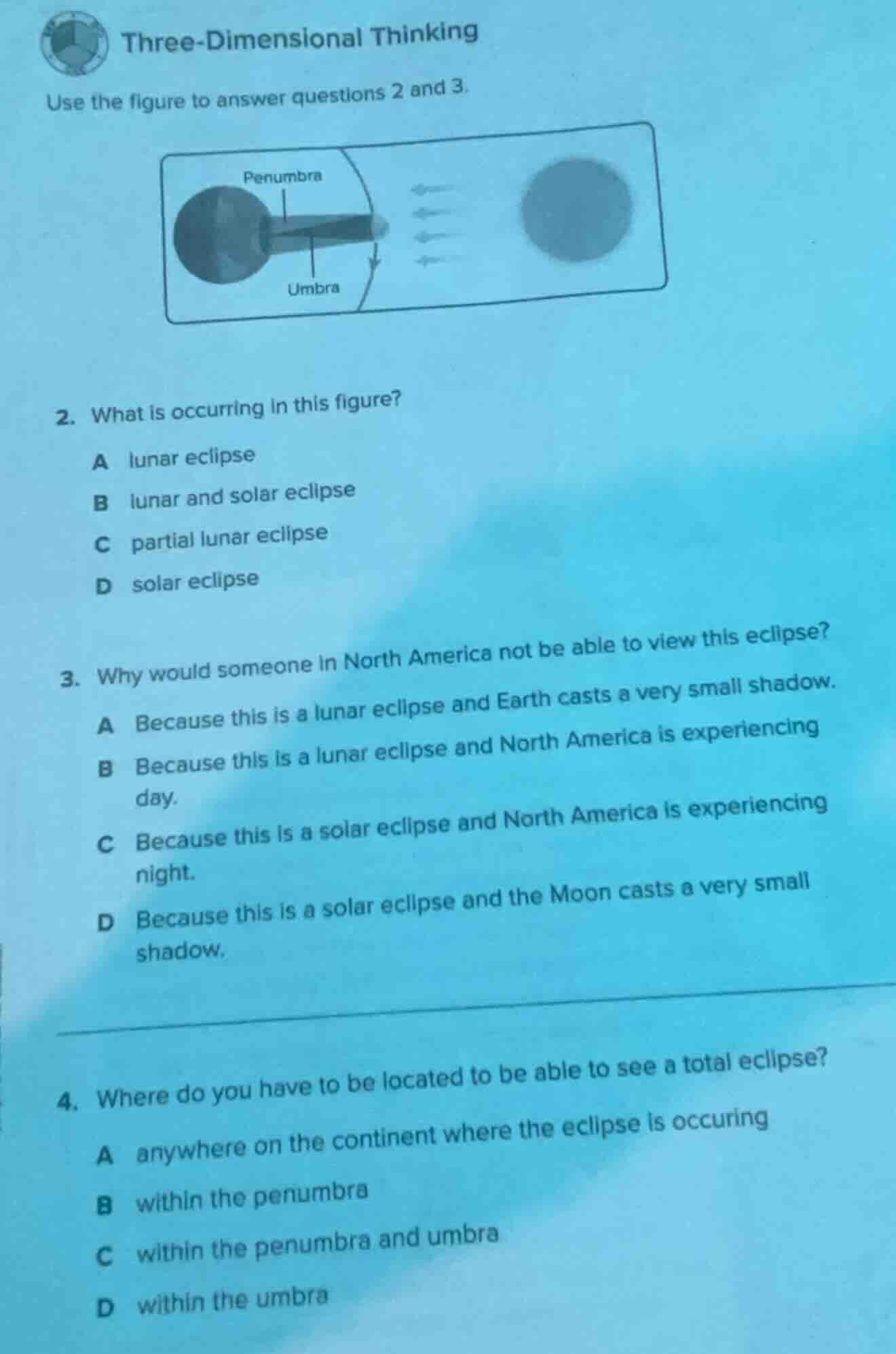
use the figure to answer questions 2 and 3.
- what is occurring in this figure?
a lunar eclipse
b lunar and solar eclipse
c partial lunar eclipse
d solar eclipse
- why would someone in north america not be able to view this eclipse?
a because this is a lunar eclipse and earth casts a very small shadow.
b because this is a lunar eclipse and north america is experiencing day.
c because this is a solar eclipse and north america is experiencing night.
d because this is a solar eclipse and the moon casts a very small shadow.
- where do you have to be located to be able to see a total eclipse?
a anywhere on the continent where the eclipse is occurring
b within the penumbra
c within the penumbra and umbra
d within the umbra
🆕 New Concept Discovered: Mechanics of Astronomical Eclipses
How shadows in space block light to create eclipses
Step 1: Analyze the diagram for Question 2
Let's look at the alignment of the celestial bodies in the provided diagram:
- On the far right, we have the Sun (indicated by the incoming parallel light rays pointing left).
- In the middle, we have the Moon.
- On the far left, we have the Earth, which has a shadow cast upon it.
Because the Moon is directly between the Sun and the Earth, the Moon blocks the sunlight and casts its shadow (consisting of the dark inner umbra and the lighter outer penumbra) onto the surface of the Earth.
When the Moon's shadow falls on the Earth, blocking our view of the Sun, a solar eclipse occurs.
- Question 2 Answer: D (solar eclipse)
---
Step 2: Analyze the conditions for Question 3
A solar eclipse can only be seen from the specific, relatively small areas on Earth where the Moon's shadow actually lands.
- The Moon is much smaller than the Earth, so its shadow (specifically the umbra and penumbra) only covers a very small, localized path on the Earth's surface at any given time.
- Anyone outside of this narrow path of the shadow—even if they are on the daytime side of Earth—will not see the eclipse.
Let's evaluate the options:
- A & B: Incorrect because this is a solar eclipse, not a lunar eclipse.
- C: Incorrect because solar eclipses can only happen during the day when the Sun is visible.
- D: Correct because the Moon is small, meaning its shadow only covers a very small portion of Earth's surface.
- Question 3 Answer: D (Because this is a solar eclipse and the Moon casts a very small shadow.)
---
Step 3: Determine the location needed for a total eclipse in Question 4
An observer's position within the shadow determines what kind of eclipse they see:
- Umbra: The dark, central region of the shadow where the light source (the Sun) is completely blocked by the Moon. Standing here allows you to see a total eclipse.
- Penumbra: The lighter, outer region of the shadow where the light source is only partially blocked. Standing here allows you to see a partial eclipse.
Therefore, to see a total eclipse, you must be located within the umbra.
- Question 4 Answer: D (within the umbra)

Snap & solve any problem in the app
Get step-by-step solutions on Sovi AI
Photo-based solutions with guided steps
Explore more problems and detailed explanations
- 2. D
- 3. D
- 4. D