QUESTION IMAGE
Question
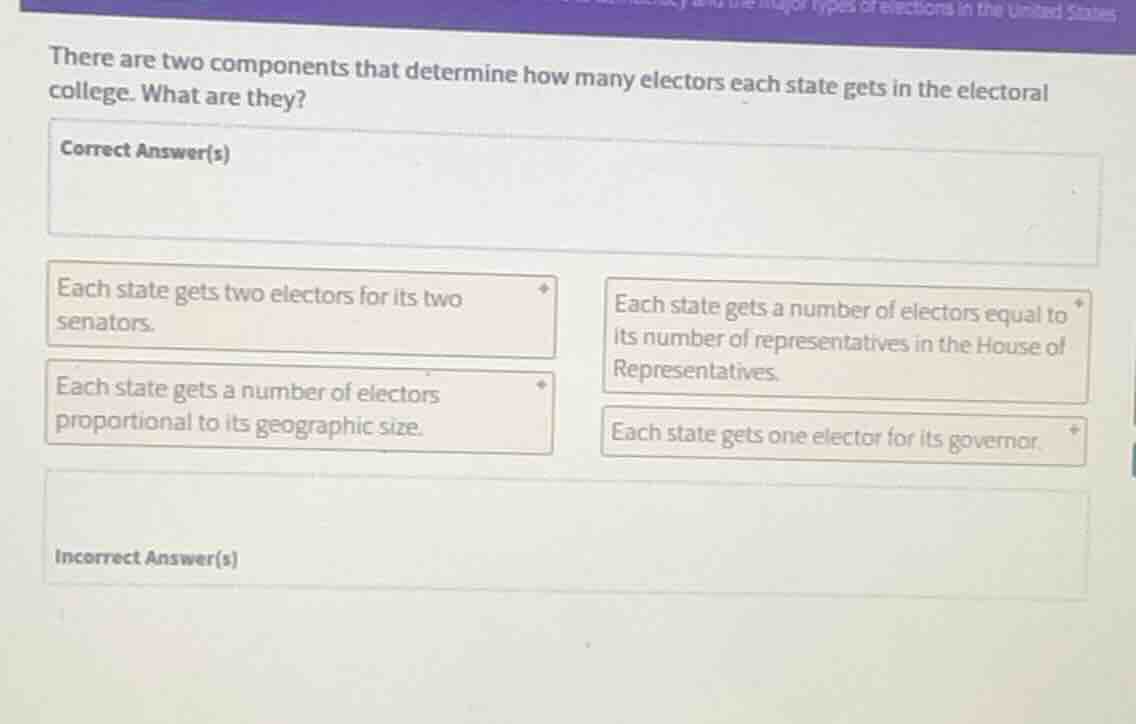
there are two components that determine how many electors each state gets in the electoral college. what are they?
correct answer(s)
each state gets two electors for its two senators.
each state gets a number of electors equal to its number of representatives in the house of representatives.
each state gets a number of electors proportional to its geographic size.
each state gets one elector for its governor.
incorrect answer(s)
Identify constitutional basis for electoral allocation
Under Article II, Section 1, Clause 2 of the U.S. Constitution, each state is allocated a number of electors equal to the whole number of Senators and Representatives to which the State may be entitled in the Congress.
Evaluate the given options against constitutional rules
- "Each state gets two electors for its two senators": Correct, as every state has exactly two senators.
- "Each state gets a number of electors equal to its number of representatives in the House of Representatives": Correct, as House representation is the second component.
- "Each state gets a number of electors proportional to its geographic size": Incorrect, geographic size does not determine electoral votes.
- "Each state gets one elector for its governor": Incorrect, governors are not part of the allocation formula.

Snap & solve any problem in the app
Get step-by-step solutions on Sovi AI
Photo-based solutions with guided steps
Explore more problems and detailed explanations
- Each state gets two electors for its two senators. (Correct answer)
- Each state gets a number of electors equal to its number of representatives in the House of Representatives. (Correct answer)
- Each state gets a number of electors proportional to its geographic size.
- Each state gets one elector for its governor.