QUESTION IMAGE
Question
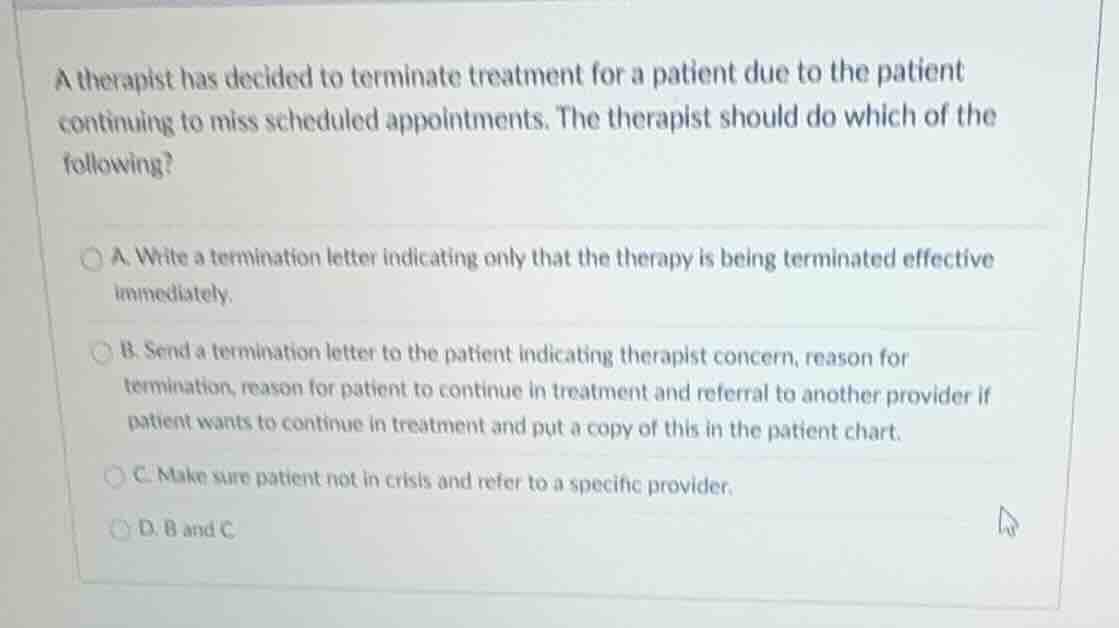
a therapist has decided to terminate treatment for a patient due to the patient continuing to miss scheduled appointments. the therapist should do which of the following?
a. write a termination letter indicating only that the therapy is being terminated effective immediately.
b. send a termination letter to the patient indicating therapist concern, reason for termination, reason for patient to continue in treatment and referral to another provider if patient wants to continue in treatment and put a copy of this in the patient chart.
c. make sure patient not in crisis and refer to a specific provider.
d. b and c
🆕 New Concept Discovered: Ethical Termination of Therapy
How to safely end therapy without abandoning the patient.
Step 1: Understand the risk of abandonment
In clinical practice, terminating therapy must be handled carefully to avoid "patient abandonment," which is both an ethical violation and a legal liability. Even when a patient is non-compliant (such as repeatedly missing appointments), a therapist cannot simply cut off services abruptly without taking protective measures.
Step 2: Evaluate the required elements of a termination letter
When terminating a patient due to non-compliance, ethical guidelines require the therapist to document the process thoroughly. A proper termination letter (Option B) should:
- Express clinical concern for the patient.
- State the clear reason for termination (e.g., missed appointments).
- Emphasize the clinical importance of the patient continuing treatment elsewhere.
- Provide referrals to other providers or resources.
- Be documented securely in the patient's clinical record (chart).
Option A is incorrect because terminating "effective immediately" without providing transition time or referrals constitutes abandonment.
Step 3: Evaluate the clinical safety check
Before finalizing termination (Option C), the therapist must ensure the patient is not currently in an acute crisis (e.g., suicidal or in immediate danger). If the patient is in crisis, the therapist must stabilize them or facilitate emergency care before terminating. Additionally, providing referrals to specific, appropriate alternative providers is a standard ethical duty to ensure continuity of care.
Step 4: Combine the correct actions
Because both the administrative/documentation steps outlined in B and the clinical safety/referral steps outlined in C are ethically and legally required to safely terminate a patient, the most complete and correct choice is D (B and C).

Snap & solve any problem in the app
Get step-by-step solutions on Sovi AI
Photo-based solutions with guided steps
Explore more problems and detailed explanations
D. B and C