QUESTION IMAGE
Question
test: question 6
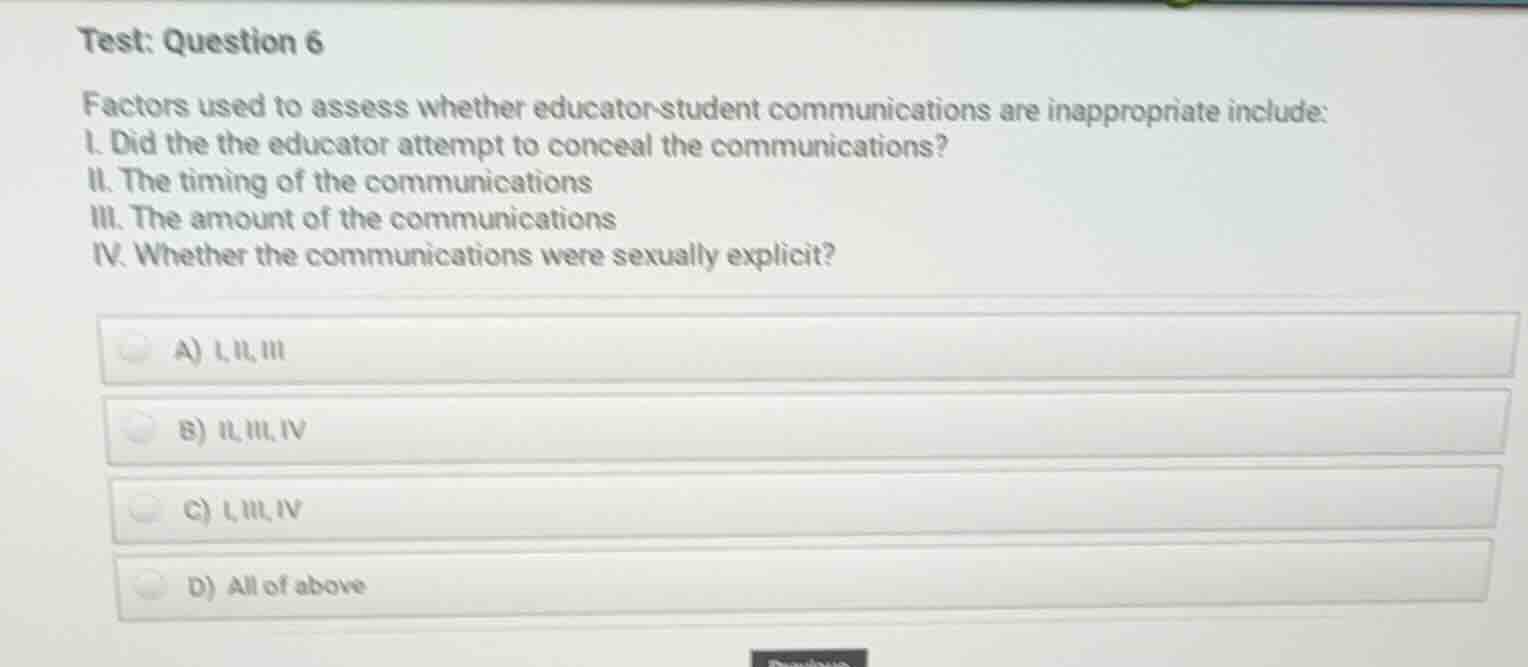
factors used to assess whether educator-student communications are inappropriate include:
i. did the the educator attempt to conceal the communications?
ii. the timing of the communications
iii. the amount of the communications
iv. whether the communications were sexually explicit?
a) i, ii, iii
b) ii, iii, iv
c) i, iii, iv
d) all of above
🆕 New Concept Discovered: Educator-Student Boundary Assessment
Evaluating professional boundaries and communication appropriateness.
Step 1: Analyze the factors of appropriate communication
To determine whether communication between an educator and a student crosses professional boundaries, regulatory and educational bodies evaluate several contextual factors:
- I. Attempt to conceal (Secrecy): If an educator tries to hide messages, deletes chat histories, or uses private, non-approved personal channels instead of official school platforms, it strongly indicates inappropriate behavior.
- II. Timing of the communications: Messages sent late at night or during non-school hours without an urgent academic reason are highly suspect.
- III. Amount of the communications (Frequency): An excessive volume of messages, especially those unrelated to schoolwork, suggests an over-familiar relationship.
- IV. Sexually explicit content: Any communication containing sexually explicit language, jokes, or media is inherently inappropriate and a severe violation of professional standards.
Step 2: Evaluate the options
Since all four listed factors (I, II, III, and IV) are standard criteria used by school administrations and legal bodies to assess the appropriateness of educator-student interactions, they are all correct.
- A) I, II, III (Missing IV)
- B) II, III, IV (Missing I)
- C) I, III, IV (Missing II)
- D) All of above (Includes all correct factors)

Snap & solve any problem in the app
Get step-by-step solutions on Sovi AI
Photo-based solutions with guided steps
Explore more problems and detailed explanations
D) All of above