QUESTION IMAGE
Question
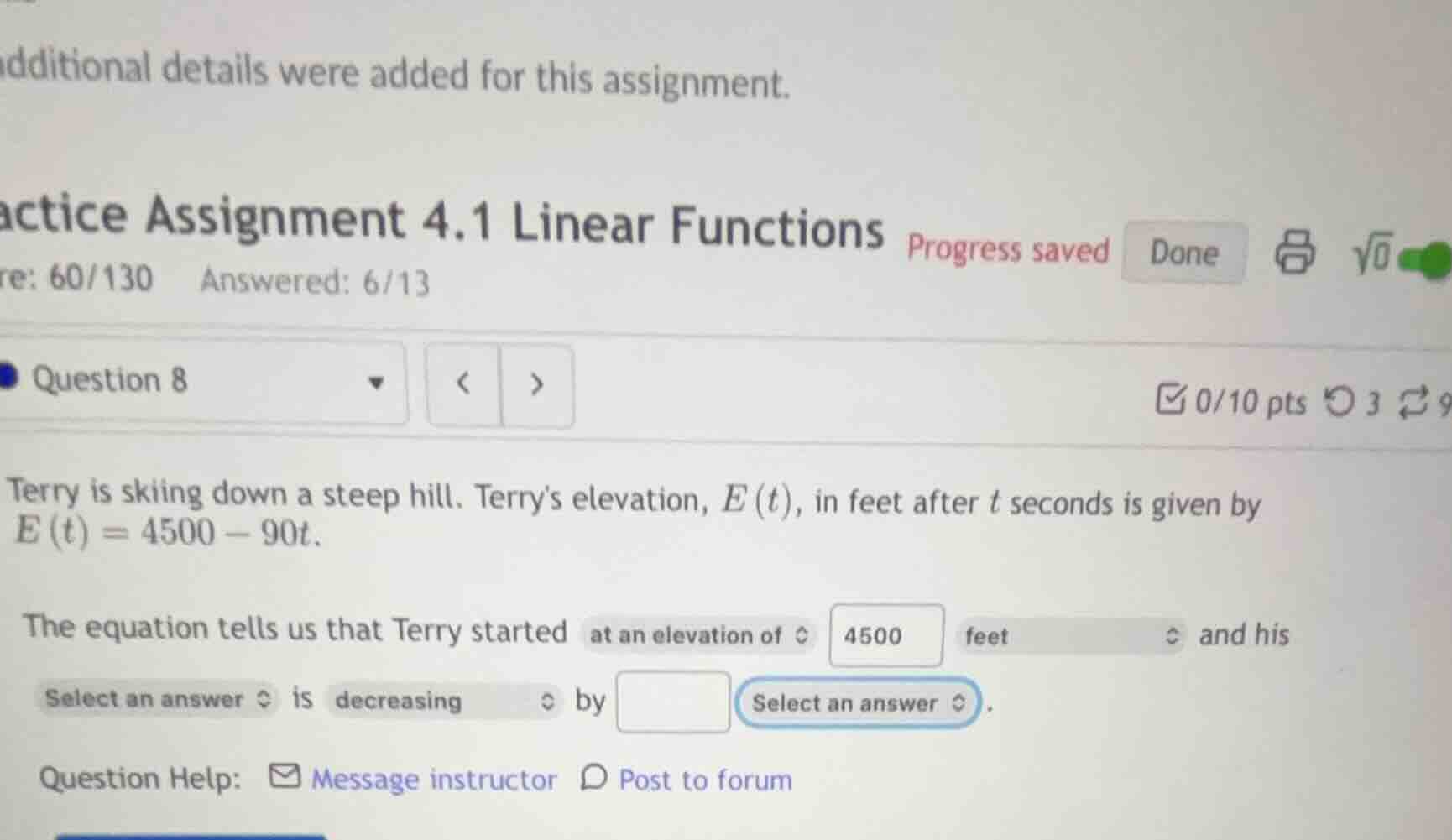
terry is skiing down a steep hill. terrys elevation, (e(t)), in feet after (t) seconds is given by (e(t) = 4500 - 90t).
the equation tells us that terry started at an elevation of 4500 feet and his elevation is decreasing by 90 feet per second.
⚡ Using what you learned: slope-intercept and standard form
Step 1: Identify the starting value
The linear function is given by:
When \( t = 0 \) (at the start):
This represents the initial elevation.
- First dropdown:
at an elevation of - First input box:
4500 - Second dropdown:
feet
Step 2: Identify the rate of change
The coefficient of \( t \) is \( -90 \). This represents the rate of change of elevation over time.
- The negative sign means the elevation is decreasing.
- The value \( 90 \) represents the rate of decrease in feet per second.
- Third dropdown:
elevation - Fourth dropdown:
is decreasing - Second input box:
90 - Fifth dropdown:
feet per second

Snap & solve any problem in the app
Get step-by-step solutions on Sovi AI
Photo-based solutions with guided steps
Explore more problems and detailed explanations
The equation tells us that Terry started at an elevation of 4500 feet and his elevation is decreasing by 90 feet per second.