QUESTION IMAGE
Question
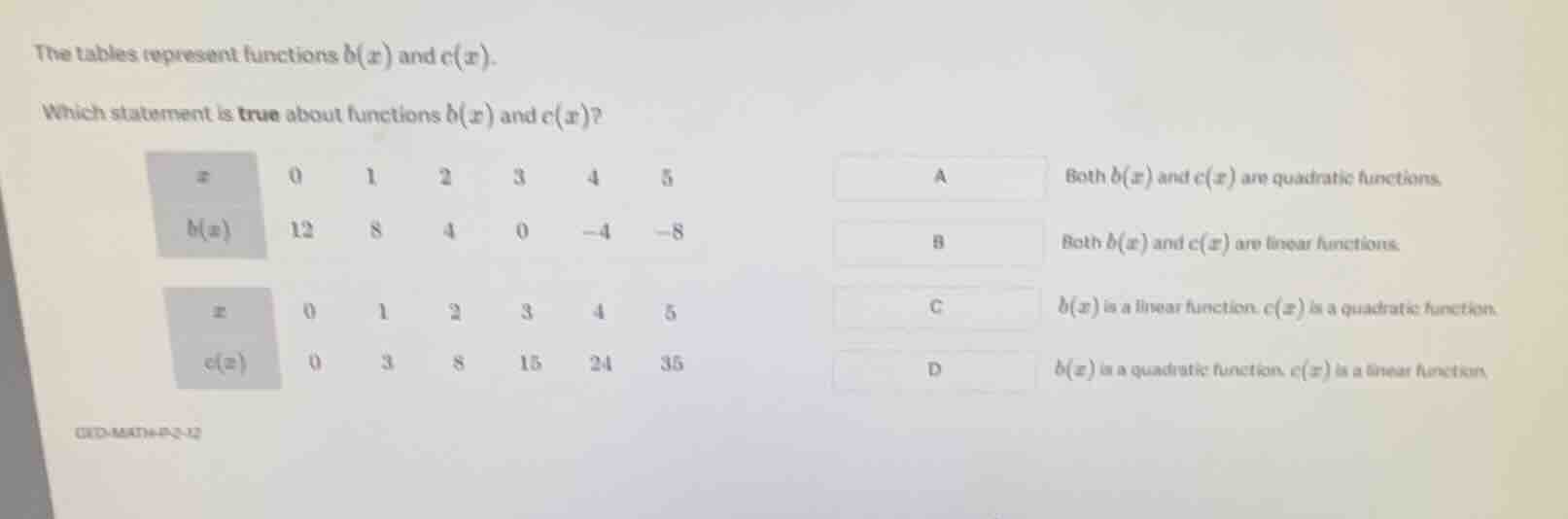
the tables represent functions (b(x)) and (c(x)).
which statement is true about functions (b(x)) and (c(x))?
table 1:
\\(x\\) | 0 | 1 | 2 | 3 | 4 | 5
\\(b(x)\\) | 12 | 8 | 4 | 0 | -4 | -8
table 2:
\\(x\\) | 0 | 1 | 2 | 3 | 4 | 5
\\(c(x)\\) | 0 | 3 | 8 | 15 | 24 | 35
a. both (b(x)) and (c(x)) are quadratic functions.
b. both (b(x)) and (c(x)) are linear functions.
c. (b(x)) is a linear function, (c(x)) is a quadratic function.
d. (b(x)) is a quadratic function, (c(x)) is a linear function.
🆕 New Concept Discovered: Identifying Linear and Quadratic Functions from Tables
How differences in outputs help us classify functions.
Step 1: Analyze the differences for \( b(x) \)
To determine if a function is linear or quadratic, we look at the differences between consecutive outputs when the inputs change by a constant amount (here, \( x \) increases by \( 1 \) each step).
- Linear function: The first differences (the change from one output to the next) are constant.
- Quadratic function: The first differences change, but the second differences (the differences of the differences) are constant.
Let's calculate the first differences for \( b(x) \):
Since the first differences are constantly \( -4 \), \( b(x) \) is a linear function.
Step 2: Analyze the differences for \( c(x) \)
Let's calculate the first differences for \( c(x) \):
The first differences are not constant, so \( c(x) \) is not linear.
Now, let's calculate the second differences (the differences between consecutive first differences):
Since the second differences are constantly \( 2 \), \( c(x) \) is a quadratic function.
Step 3: Match with the given options
- Option A: Both \( b(x) \) and \( c(x) \) are quadratic functions. (False)
- Option B: Both \( b(x) \) and \( c(x) \) are linear functions. (False)
- Option C: \( b(x) \) is a linear function, \( c(x) \) is a quadratic function. (True)
- Option D: \( b(x) \) is a quadratic function, \( c(x) \) is a linear function. (False)

Snap & solve any problem in the app
Get step-by-step solutions on Sovi AI
Photo-based solutions with guided steps
Explore more problems and detailed explanations
C (\( b(x) \) is a linear function, \( c(x) \) is a quadratic function.)