QUESTION IMAGE
Question
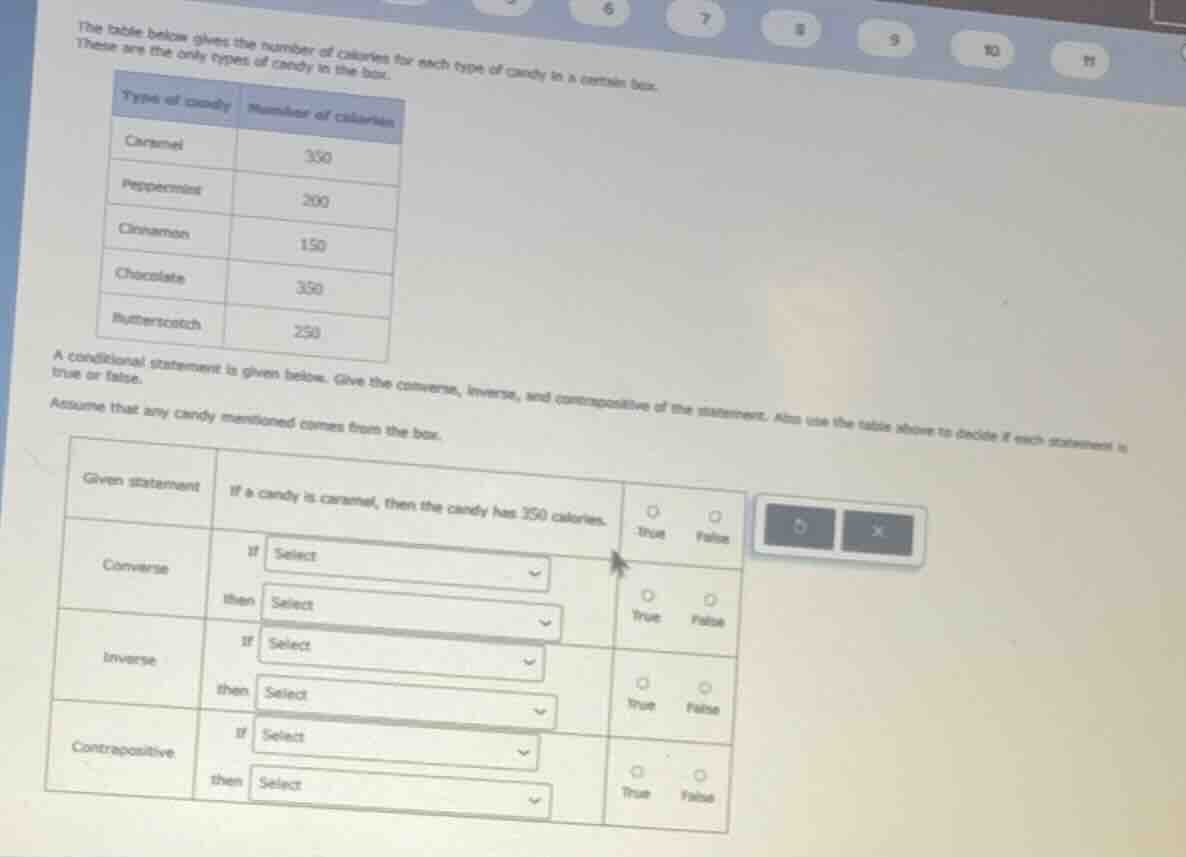
the table below gives the number of calories for each type of candy in a certain box. these are the only types of candy in the box.
\
a conditional statement is given below. give the converse, inverse, and contrapositive of the statement. also use the table above to decide if each statement is true or false.
assume that any candy mentioned comes from the box.
\
\\\\
\hline
converse & \
& \
\\\\
\hline
inverse & \
& \
\\\\
\hline
contrapositive & \
& \
\\\\
\hline
\end{tabular}
🆕 New Concept Discovered: Conditional Statements and Logical Variations
Switching, negating, or doing both to "if-then" statements
Step 1: Analyze the Given Statement and Table
The table lists the calories for each type of candy in a box:
- Caramel: \(350\) calories
- Peppermint: \(200\) calories
- Cinnamon: \(150\) calories
- Chocolate: \(350\) calories
- Butterscotch: \(250\) calories
The given conditional statement is:
- Given statement: "If a candy is caramel, then the candy has \(350\) calories."
Let's represent this symbolically as \(p
ightarrow q\), where:
- \(p\): "a candy is caramel"
- \(q\): "the candy has \(350\) calories"
Truth Value of the Given Statement:
Looking at the table, Caramel indeed has \(350\) calories. Therefore, the given statement is True.
---
Step 2: Formulate and Evaluate the Converse
The converse of a conditional statement \(p
ightarrow q\) is formed by swapping the hypothesis and the conclusion: \(q
ightarrow p\).
- Converse Statement: "If a candy has \(350\) calories, then the candy is caramel."
Truth Value of the Converse:
We look at the table to see if every candy with \(350\) calories is caramel.
- Chocolate also has \(350\) calories.
- Since a candy could have \(350\) calories and be chocolate (not caramel), the converse is False.
---
Step 3: Formulate and Evaluate the Inverse
The inverse of a conditional statement \(p
ightarrow q\) is formed by negating both the hypothesis and the conclusion: \(\sim p
ightarrow \sim q\).
- Inverse Statement: "If a candy is not caramel, then the candy does not have \(350\) calories."
Truth Value of the Inverse:
We check if any candy other than caramel has \(350\) calories.
- Chocolate is not caramel, but it has \(350\) calories.
- Therefore, this statement is False.
---
Step 4: Formulate and Evaluate the Contrapositive
The contrapositive of a conditional statement \(p
ightarrow q\) is formed by both swapping and negating the hypothesis and the conclusion: \(\sim q
ightarrow \sim p\).
- Contrapositive Statement: "If a candy does not have \(350\) calories, then the candy is not caramel."
Truth Value of the Contrapositive:
A conditional statement and its contrapositive always share the same truth value.
- If a candy does not have \(350\) calories, it must be Peppermint (\(200\)), Cinnamon (\(150\)), or Butterscotch (\(250\)). None of these are caramel.
- Therefore, the contrapositive is True.
---

Snap & solve any problem in the app
Get step-by-step solutions on Sovi AI
Photo-based solutions with guided steps
Explore more problems and detailed explanations
Given statement:
- Statement: If a candy is caramel, then the candy has \(350\) calories.
- Truth Value: True
Converse:
- If: a candy has \(350\) calories
- then: the candy is caramel
- Truth Value: False
Inverse:
- If: a candy is not caramel
- then: the candy does not have \(350\) calories
- Truth Value: False
Contrapositive:
- If: a candy does not have \(350\) calories
- then: the candy is not caramel
- Truth Value: True