QUESTION IMAGE
Question
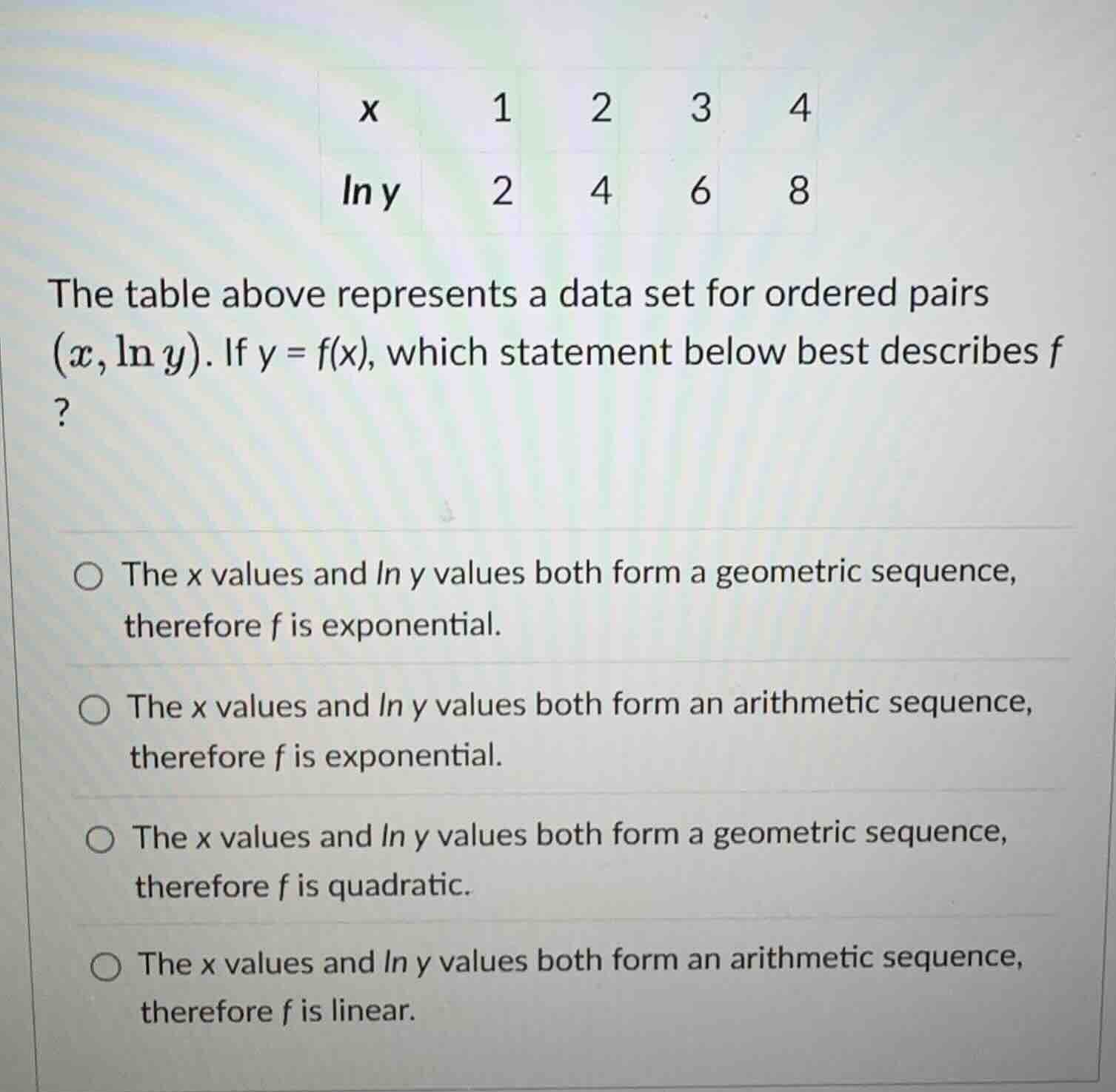
the table above represents a data set for ordered pairs \\((x, \ln y)\\). if \\(y = f(x)\\), which statement below best describes \\(f\\)?
- the \\(x\\) values and \\(\ln y\\) values both form a geometric sequence, therefore \\(f\\) is exponential.
- the \\(x\\) values and \\(\ln y\\) values both form an arithmetic sequence, therefore \\(f\\) is exponential.
- the \\(x\\) values and \\(\ln y\\) values both form a geometric sequence, therefore \\(f\\) is quadratic.
- the \\(x\\) values and \\(\ln y\\) values both form an arithmetic sequence, therefore \\(f\\) is linear.
🆕 New Concept Discovered: Linearizing Data and Semi-Log Models
Using logarithms to identify exponential relationships.
Step 1: Analyze the sequences of $x$ and $\ln y$
Examine the values in the table:
- The $x$-values are: \(1, 2, 3, 4\). Each term increases by adding \(1\). This is an arithmetic sequence.
- The \(\ln y\) values are: \(2, 4, 6, 8\). Each term increases by adding \(2\). This is also an arithmetic sequence.
Step 2: Determine the relationship between $x$ and $\ln y$
Since both sequences are arithmetic and increase by constant differences, there is a linear relationship between \(x\) and \(\ln y\):
Using the points \((1, 2)\) and \((2, 4)\):
- Slope \(m = \frac{4 - 2}{2 - 1} = 2\)
- Equation: \(\ln y = 2x\)
Step 3: Solve for $y$ to find the function type
To find \(y = f(x)\), exponentiate both sides using base \(e\):
This is in the form \(y = a \cdot b^x\), which represents an exponential function. Therefore, \(f\) is exponential.

Snap & solve any problem in the app
Get step-by-step solutions on Sovi AI
Photo-based solutions with guided steps
Explore more problems and detailed explanations
The $x$ values and $\ln y$ values both form an arithmetic sequence, therefore $f$ is exponential.