QUESTION IMAGE
Question
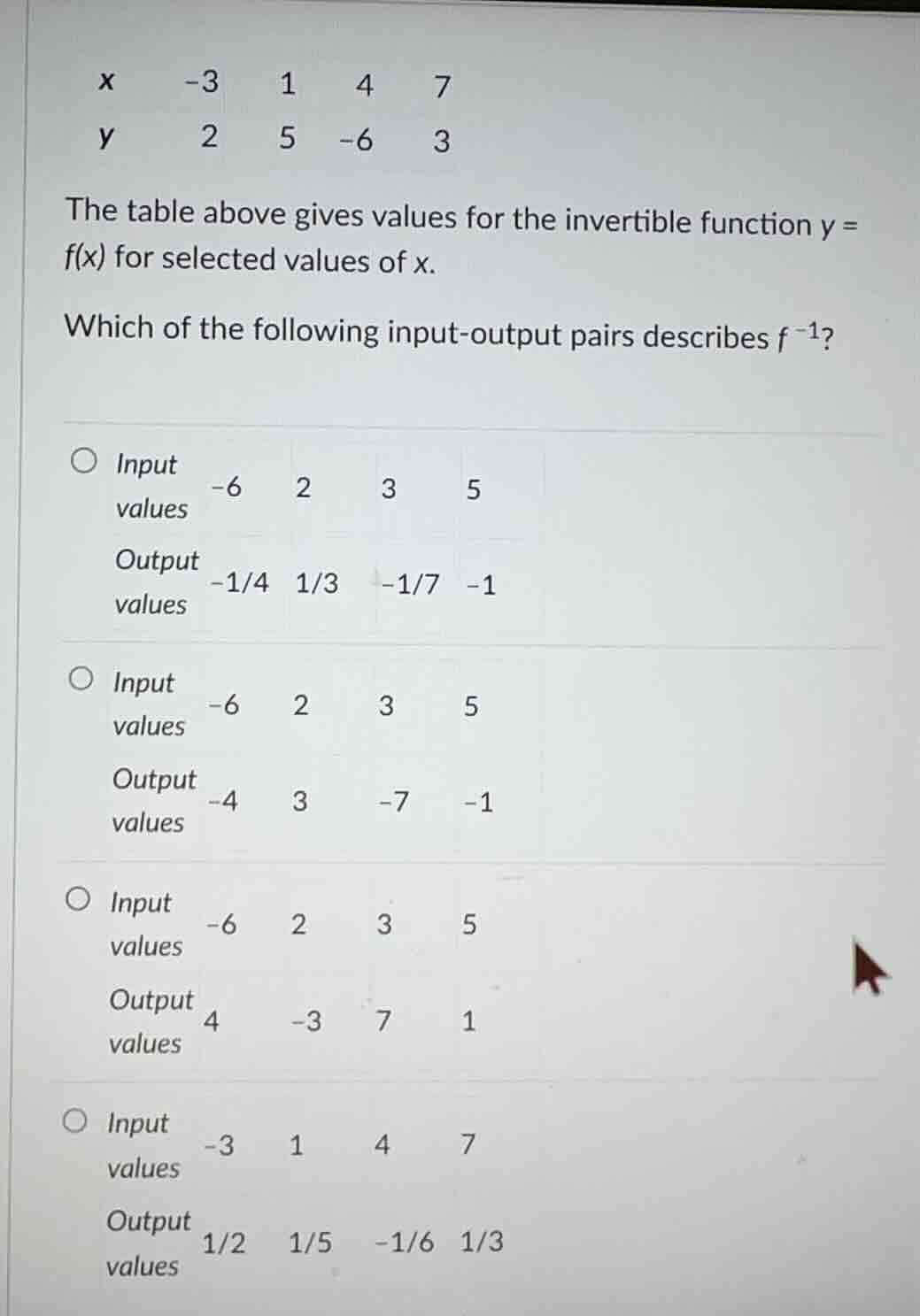
the table above gives values for the invertible function (y = f(x)) for selected values of (x).
which of the following input-output pairs describes (f^{-1})?
- option 1:
input values: (-6), (2), (3), (5)
output values: (-1/4), (1/3), (-1/7), (-1)
- option 2:
input values: (-6), (2), (3), (5)
output values: (-4), (3), (-7), (-1)
- option 3:
input values: (-6), (2), (3), (5)
output values: (4), (-3), (7), (1)
- option 4:
input values: (-3), (1), (4), (7)
output values: (1/2), (1/5), (-1/6), (1/3)
🆕 New Concept Discovered: Inverse Functions
Swapping inputs and outputs to reverse a function's action.
Step 1: Understand the definition of an inverse function
An inverse function, denoted as \( f^{-1} \), reverses the action of the original function \( f \).
If the original function maps an input \( x \) to an output \( y \):
Then the inverse function maps that output \( y \) back to the original input \( x \):
In terms of tables, this means we swap the roles of the inputs and outputs:
- The outputs (\( y \)-values) of \( f \) become the inputs of \( f^{-1} \).
- The inputs (\( x \)-values) of \( f \) become the outputs of \( f^{-1} \).
---
Step 2: Swap the table values
Let's look at the given coordinate pairs \( (x, y) \) for \( f(x) \):
- \( (-3, 2) \implies f(-3) = 2 \)
- \( (1, 5) \implies f(1) = 5 \)
- \( (4, -6) \implies f(4) = -6 \)
- \( (7, 3) \implies f(7) = 3 \)
Now, we swap the coordinates to find the corresponding pairs \( (y, x) \) for \( f^{-1} \):
- \( f^{-1}(2) = -3 \)
- \( f^{-1}(5) = 1 \)
- \( f^{-1}(-6) = 4 \)
- \( f^{-1}(3) = 7 \)
---
Step 3: Match with the given options
Let's organize our new pairs into a table where the inputs are sorted in ascending order:
This matches the third option.

Snap & solve any problem in the app
Get step-by-step solutions on Sovi AI
Photo-based solutions with guided steps
Explore more problems and detailed explanations
The third option is correct:
- Input values: \(-6\), \(2\), \(3\), \(5\)
- Output values: \(4\), \(-3\), \(7\), \(1\)