QUESTION IMAGE
Question
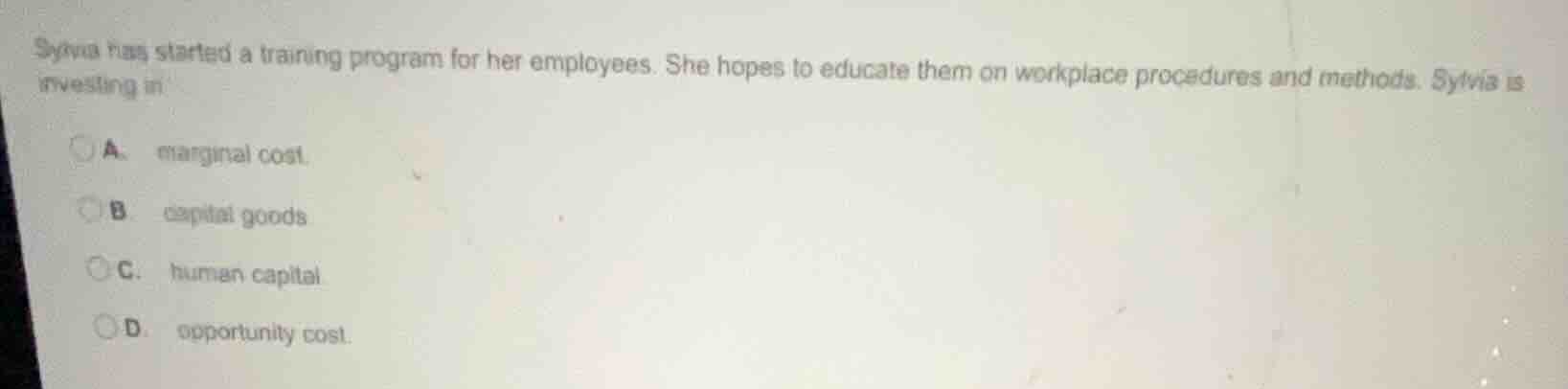
sylvia has started a training program for her employees. she hopes to educate them on workplace procedures and methods. sylvia is investing in
a. marginal cost.
b. capital goods.
c. human capital.
d. opportunity cost.
<pre_analysis>
{
"quality": "clear",
"question_count": 1,
"skills_matched": [
"direct_cot",
"multiple_choice_formatter",
"explain_then_answer",
"tutor"
],
"needs_drawing": false,
"concepts_used": [],
"new_concepts": [
"Human Capital",
"Factors of Production"
],
"current_concepts": [
"Human Capital",
"Factors of Production",
"Capital Goods"
]
}
</pre_analysis>
<reasoning>
Analyze the scenario
The scenario describes Sylvia starting a training program for her employees to educate them on workplace procedures and methods. This represents an investment in the skills, knowledge, and education of her workforce.
Define the economic terms
- Marginal cost is the cost of producing one additional unit of a good or service.
- Capital goods are physical assets used in production, such as machinery, buildings, and tools.
- Human capital refers to the economic value of a worker's experience, skills, knowledge, and training.
- Opportunity cost is the value of the next best alternative given up when making a choice.
Match the scenario to the correct concept
Since Sylvia is investing in training and educating her employees, she is directly increasing their skills and productivity. This is the definition of investing in human capital.
</reasoning>
<answer>
<mcq-option>(A) marginal cost.</mcq-option>
<mcq-option>(B) capital goods.</mcq-option>
<mcq-correct>(C) human capital.</mcq-correct>
<mcq-option>(D) opportunity cost.</mcq-option>
</answer>
<post_analysis>
{
"subject": "Business",
"question_type": "Multiple Choice",
"knowledge_point": [
"Business",
"Economics",
"Human Capital"
]
}
</post_analysis>
Snap & solve any problem in the app
Get step-by-step solutions on Sovi AI
Photo-based solutions with guided steps
Explore more problems and detailed explanations
<pre_analysis>
{
"quality": "clear",
"question_count": 1,
"skills_matched": [
"direct_cot",
"multiple_choice_formatter",
"explain_then_answer",
"tutor"
],
"needs_drawing": false,
"concepts_used": [],
"new_concepts": [
"Human Capital",
"Factors of Production"
],
"current_concepts": [
"Human Capital",
"Factors of Production",
"Capital Goods"
]
}
</pre_analysis>
<reasoning>
Analyze the scenario
The scenario describes Sylvia starting a training program for her employees to educate them on workplace procedures and methods. This represents an investment in the skills, knowledge, and education of her workforce.
Define the economic terms
- Marginal cost is the cost of producing one additional unit of a good or service.
- Capital goods are physical assets used in production, such as machinery, buildings, and tools.
- Human capital refers to the economic value of a worker's experience, skills, knowledge, and training.
- Opportunity cost is the value of the next best alternative given up when making a choice.
Match the scenario to the correct concept
Since Sylvia is investing in training and educating her employees, she is directly increasing their skills and productivity. This is the definition of investing in human capital.
</reasoning>
<answer>
<mcq-option>(A) marginal cost.</mcq-option>
<mcq-option>(B) capital goods.</mcq-option>
<mcq-correct>(C) human capital.</mcq-correct>
<mcq-option>(D) opportunity cost.</mcq-option>
</answer>
<post_analysis>
{
"subject": "Business",
"question_type": "Multiple Choice",
"knowledge_point": [
"Business",
"Economics",
"Human Capital"
]
}
</post_analysis>