QUESTION IMAGE
Question
svlc algebra 1a - standard (15260)
solving systems of linear equations: substitution
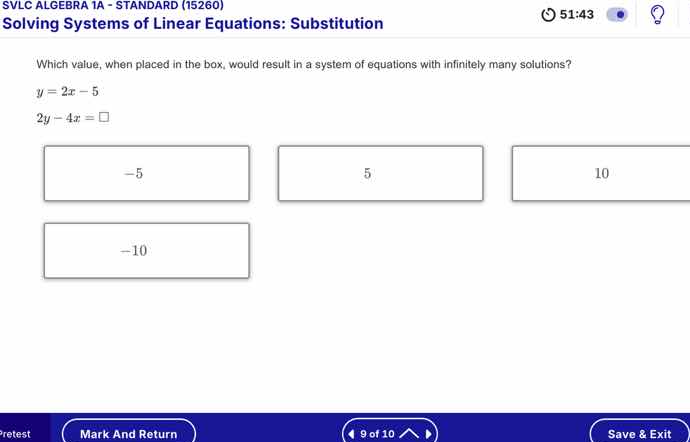
which value, when placed in the box, would result in a system of equations with infinitely many solutions?
y = 2x - 5
2y - 4x = □
-5
5
10
-10
pretest \tmark and return \t\t9 of 10 \t\tsave & exit
Step1: Recall infinite solutions condition
For a system of linear equations \(a_1x + b_1y = c_1\) and \(a_2x + b_2y = c_2\) to have infinitely many solutions, the two equations must be equivalent (i.e., one is a multiple of the other). First, rewrite the first equation \(y = 2x - 5\) in standard form: \(2x - y = 5\) or multiply by 2: \(4x - 2y = 10\), which can be rewritten as \(2y - 4x=- 10\).
Step2: Substitute \(y = 2x - 5\) into the second equation
Substitute \(y = 2x - 5\) into \(2y - 4x=\square\). So, \(2(2x - 5)-4x=\square\).
Step3: Simplify the left - hand side
Expand \(2(2x - 5)-4x\): \(4x-10 - 4x=\square\). The \(4x\) and \(-4x\) cancel out, leaving \(-10=\square\).

Snap & solve any problem in the app
Get step-by-step solutions on Sovi AI
Photo-based solutions with guided steps
Explore more problems and detailed explanations
\(-10\) (corresponding to the option with value \(-10\))