QUESTION IMAGE
Question
svlc algebra 1a - standard (15260)
slope-intercept form of a line
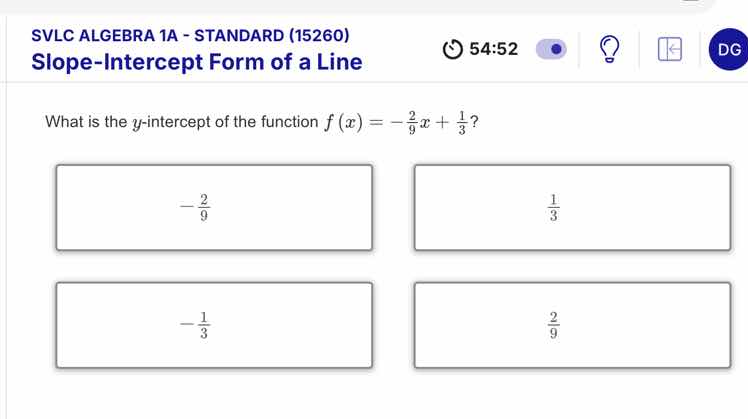
what is the y-intercept of the function $f(x) = -\frac{2}{9}x + \frac{1}{3}$?
$-\frac{2}{9}$ $\frac{1}{3}$
$-\frac{1}{3}$ $\frac{2}{9}$
Step1: Recall slope - intercept form
The slope - intercept form of a linear function is given by \(y = mx + b\), where \(m\) is the slope of the line and \(b\) is the \(y\) - intercept. In the function \(f(x)=-\frac{2}{9}x+\frac{1}{3}\), we can think of \(y = f(x)\), so it is in the form \(y=mx + b\) with \(m =-\frac{2}{9}\) and \(b=\frac{1}{3}\).
Step2: Identify the \(y\) - intercept
By the definition of the slope - intercept form, the \(y\) - intercept is the value of \(b\) in the equation \(y = mx + b\). In the function \(f(x)=-\frac{2}{9}x+\frac{1}{3}\), the value of \(b\) (the \(y\) - intercept) is \(\frac{1}{3}\).

Snap & solve any problem in the app
Get step-by-step solutions on Sovi AI
Photo-based solutions with guided steps
Explore more problems and detailed explanations
\(\frac{1}{3}\) (corresponding to the option with \(\frac{1}{3}\))