QUESTION IMAGE
Question
svlc algebra 1a - standard (15260)
representing relationships
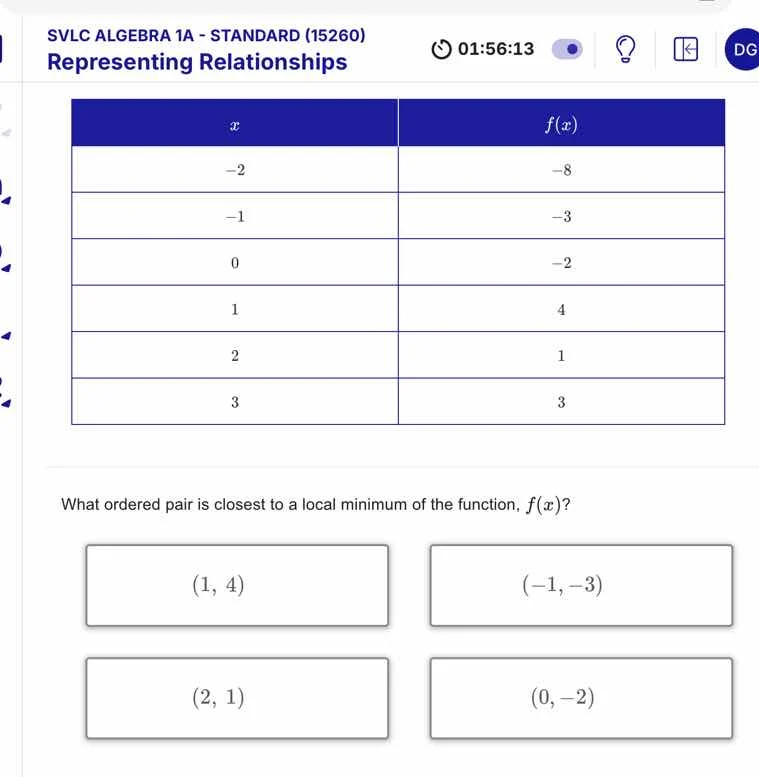
x | f(x)
-2 | -8
-1 | -3
0 | -2
1 | 4
2 | 1
3 | 3
what ordered pair is closest to a local minimum of the function, f(x)?
(1, 4) (-1, -3)
(2, 1) (0, -2)
Step1: Understand local minimum
A local minimum is a point where the function value is lower than its neighboring points. We analyze the given \( x \) and \( f(x) \) values.
Step2: Analyze each ordered pair
- For \( (1, 4) \): \( f(1) = 4 \). Neighboring points: \( f(0) = -2 \), \( f(2) = 1 \). 4 is higher than both, so not a minimum.
- For \( (-1, -3) \): \( f(-1) = -3 \). Neighboring points: \( f(-2) = -8 \), \( f(0) = -2 \). -3 is higher than \( f(-2) \) (-8) and lower than \( f(0) \) (-2). But let's check others.
- For \( (2, 1) \): \( f(2) = 1 \). Neighboring points: \( f(1) = 4 \), \( f(3) = 3 \). 1 is lower than both? No, 1 is lower than 4 and 3? Wait, 1 is less than 4 and 3? Wait, 1 is less than 4 (yes) and less than 3 (no, 1 < 3? Wait 1 is less than 3? Yes, 1 < 3. Wait, no, 1 is less than 3? Wait 1 is 1, 3 is 3. So 1 < 3. But let's check the other point.
- For \( (0, -2) \): \( f(0) = -2 \). Neighboring points: \( f(-1) = -3 \), \( f(1) = 4 \). -2 is higher than \( f(-1) \) (-3) and lower than \( f(1) \) (4). Now compare \( f(-1) = -3 \), \( f(0) = -2 \), \( f(2) = 1 \). Wait, the local minimum should be around where the function changes from decreasing to increasing. Let's list the \( f(x) \) values in order of \( x \): \( x=-2, f=-8 \); \( x=-1, f=-3 \); \( x=0, f=-2 \); \( x=1, f=4 \); \( x=2, f=1 \); \( x=3, f=3 \). Wait, from \( x=-2 \) to \( x=-1 \): \( f \) increases from -8 to -3. From \( x=-1 \) to \( x=0 \): \( f \) increases from -3 to -2. From \( x=0 \) to \( x=1 \): \( f \) increases to 4. Then decreases to 1 at \( x=2 \), then increases to 3 at \( x=3 \). Wait, but the local minimum would be around the lowest point in a small interval. Wait, the values: \( f(-2) = -8 \) (very low), but the options don't have \( (-2, -8) \). The options are \( (1,4) \), \( (-1,-3) \), \( (2,1) \), \( (0,-2) \). Wait, maybe I misread. Wait the question is "closest to a local minimum". Wait, maybe the function's behavior: let's see the trend. From \( x=-2 \) to \( x=0 \), \( f(x) \) is increasing (from -8 to -3 to -2). Then from \( x=0 \) to \( x=1 \), it increases to 4. Then decreases to 1 at \( x=2 \), then increases to 3 at \( x=3 \). Wait, but the local minimum in the given options: the lowest \( f(x) \) among the options is \( (-1, -3) \) with \( f=-3 \), then \( (0, -2) \) with \( f=-2 \), then \( (2,1) \), then \( (1,4) \). But wait, maybe the local minimum is around where the function changes direction. Wait, maybe I made a mistake. Wait, let's check the values again. The \( f(x) \) values:
\( x=-2 \): -8
\( x=-1 \): -3
\( x=0 \): -2
\( x=1 \): 4
\( x=2 \): 1
\( x=3 \): 3
So from \( x=-2 \) to \( x=0 \), the function is increasing (since -8 < -3 < -2). Then from \( x=0 \) to \( x=1 \), it increases to 4. Then decreases to 1 at \( x=2 \), then increases to 3 at \( x=3 \). So the local minimum in the interval around the given points: the lowest value among the options is \( (-1, -3) \) with \( f=-3 \), but wait \( x=-2 \) has \( f=-8 \) which is lower, but it's not an option. Wait the options are \( (1,4) \), \( (-1,-3) \), \( (2,1) \), \( (0,-2) \). Wait, maybe the question is about local minimum in the visible points. Wait, maybe I misinterpret. Wait, a local minimum is a point where the function value is less than or equal to its immediate neighbors. Let's check each option's neighbors:
- \( (-1, -3) \): neighbors \( x=-2 \) (f=-8) and \( x=0 \) (f=-2). So \( f(-1) = -3 \) is greater than \( f(-2) = -8 \), so it's not a local minimum (since left neighbor is lower).
- \( (0, -2) \): neighbors \( x=-1 \) (f=-…

Snap & solve any problem in the app
Get step-by-step solutions on Sovi AI
Photo-based solutions with guided steps
Explore more problems and detailed explanations
\boxed{(-1, -3)}