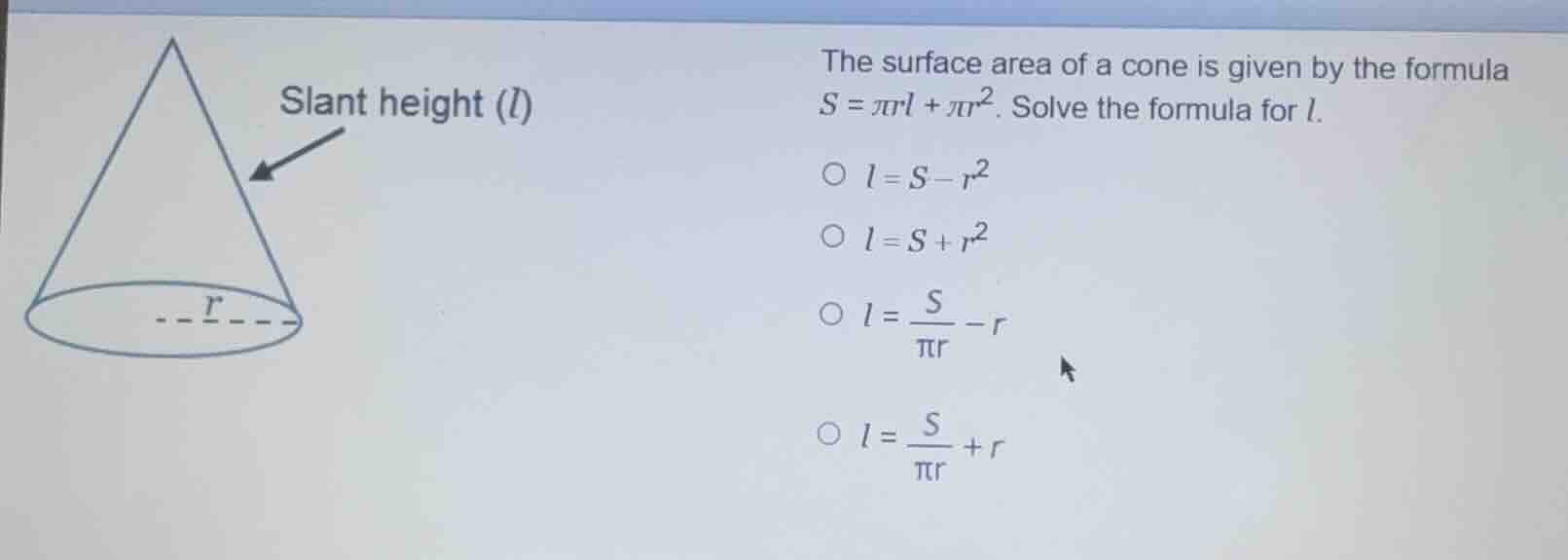
QUESTION IMAGE
22,852 Learners found this answer helpful
Question
the surface area of a cone is given by the formula \\(s = \pi r l + \pi r^2\\). solve the formula for \\(l\\).
\\(l = s - r^2\\)
\\(l = s + r^2\\)
\\(l = \frac{s}{\pi r} - r\\)
\\(l = \frac{s}{\pi r} + r\\)
State the given equation
We begin with the formula for the surface area of a cone:
$$S = \pi r l + \pi r^2$$
Isolate the term containing l
Subtract \(\pi r^2\) from both sides of the equation:
$$S - \pi r^2 = \pi r l$$
Solve for l
Divide both sides by \(\pi r\) to isolate \(l\):
$$l = \frac{S - \pi r^2}{\pi r}$$
Simplify the expression
Divide each term in the numerator by the denominator:
$$l = \frac{S}{\pi r} - \frac{\pi r^2}{\pi r}$$
$$l = \frac{S}{\pi r} - r$$

Snap & solve any problem in the app
Get step-by-step solutions on Sovi AI
Photo-based solutions with guided steps
Explore more problems and detailed explanations
- (A) \(l = S - r^2\)
- (B) \(l = S + r^2\)
- (C) \(l = \frac{S}{\pi r} - r\) (Correct answer)
- (D) \(l = \frac{S}{\pi r} + r\)