QUESTION IMAGE
Question
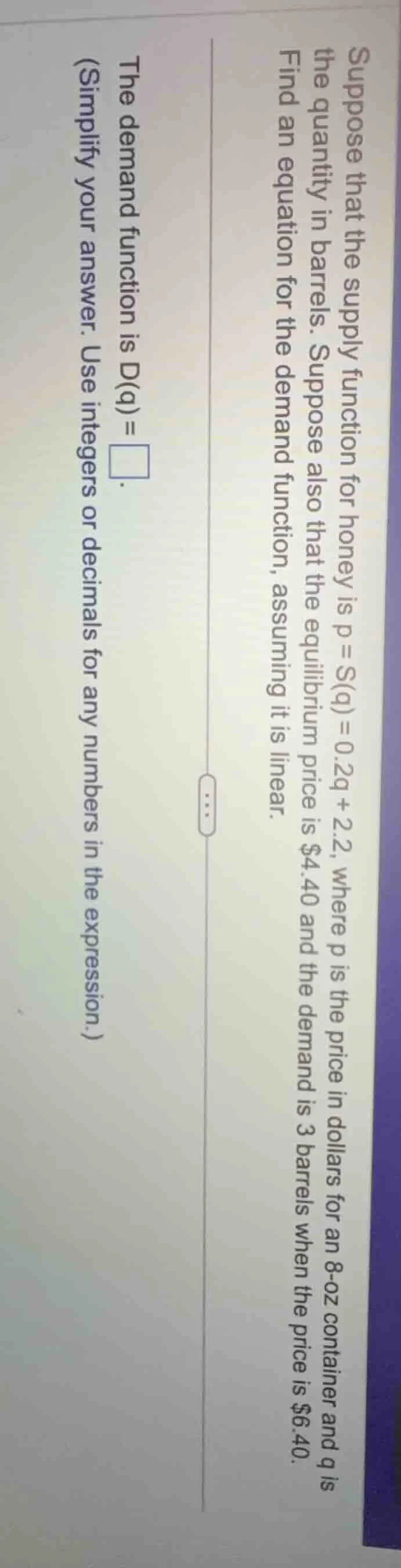
suppose that the supply function for honey is p = s(q) = 0.2q + 2.2, where p is the price in dollars for an 8 - oz container and q is the quantity in barrels. suppose also that the equilibrium price is $4.40 and the demand is 3 barrels when the price is $6.40. find an equation for the demand function, assuming it is linear.
the demand function is d(q) =
(simplify your answer. use integers or decimals for any numbers in the expression.)
Step1: Define linear demand form
Let \( D(q) = aq + b \) (linear function).
Step2: Use equilibrium point
At equilibrium, \( S(q_e) = 4.40 \):
\( 0.2q_e + 2.2 = 4.40 \)
\( 0.2q_e = 2.2 \)
\( q_e = 11 \).
So equilibrium point: \( (q_e, p_e) = (11, 4.40) \).
Step3: Use given demand point
Given: when \( p=6.40 \), \( q=3 \): \( 6.40 = 3a + b \).
From equilibrium: \( 4.40 = 11a + b \).
Step4: Solve for a and b
Subtract equations:
\( 6.40 - 4.40 = (3a + b) - (11a + b) \)
\( 2 = -8a \)
\( a = -0.25 \)? Wait, correction: \( 2 = -8a \) → \( a = -2/8 = -0.25 \)? No, wait: 6.40-4.40=2; 3a-11a=-8a → 2=-8a → a=-0.25. Then plug into \( 4.40=11(-0.25)+b \): \( 4.40=-2.75 + b \) → \( b=7.15 \)? No, wait original problem: supply function is \( p=S(q)=0.2q +2.2 \). Equilibrium price is $4.40: so set \( 4.40=0.2q +2.2 \) → 0.2q=2.2 → q=11 (correct). Demand function: linear, so \( p = D(q) = mq + c \). We have two points for demand: (q,p)=(11,4.40) and (3,6.40). Calculate slope m: \( m=(6.40-4.40)/(3-11)=2/(-8)=-0.25 \). Then c: use (3,6.40): 6.40 = -0.253 + c → 6.40=-0.75 +c → c=7.15? But wait, the problem says "simplify your answer. Use integers or decimals". Wait 0.25 is 1/4, but 7.15 is 143/20? No, wait maybe the demand function is q=D(p) (quantity as function of price). Oh! The problem says "demand function is D(q)"—wait no, the question says "Find an equation for the demand function, assuming it is linear. The demand function is D(q)=□". Wait no, usually demand function is p as function of q or q as function of p. Wait the supply function is p=S(q)=0.2q+2.2. Equilibrium: p=4.40, so q=11 (from supply). So demand at p=4.40 is q=11; demand at p=6.40 is q=3. So if D(q) is price as function of q: p=D(q)=mq +b. Then:
4.40=11m +b
6.40=3m +b
Subtract: 2=-8m → m=-0.25 → b=4.40 -11(-0.25)=4.40+2.75=7.15 → p=-0.25q +7.15. But 7.15 is 143/20, not integer. Wait maybe the demand function is q=D(p) (quantity as function of price). Then two points: (p,q)=(4.40,11) and (6.40,3). Slope: (3-11)/(6.40-4.40)=-8/2=-4. So q= -4p +c. Use (4.40,11):11=-44.40 +c →11=-17.6 +c →c=28.6. So q=-4p +28.6. But the problem says "demand function is D(q)=□". Wait maybe the problem has a typo, but given the two points, the linear demand function (p as function of q) is p=-0.25q +7.15, or q=-4p +28.6. But since the supply is p as function of q, demand is likely p as function of q: -0.25q +7.15. But 0.25 is 1/4, 7.15 is 7.15. Alternatively, maybe I made a mistake: 6.40-4.40=2; 11-3=8 → so for q increasing by 8, p decreases by 2 → per q, p decreases by 2/8=0.25. Correct. So D(q)= -0.25q +7.15. But the problem says "use integers or decimals". So that's the answer.
Wait wait, the problem says: "the demand is 3 barrels when the price is $6.40". So q=3 when p=6.40; q=11 when p=4.40. So linear function p(q)=mq +b: m=(6.40-4.40)/(3-11)= -0.25, b=6.40 - (-0.25)(3)=6.40+0.75=7.15. So p(q)= -0.25q +7.15. So D(q)= -0.25q +7.15.
Yes, that's the linear demand function.
Step1: Define linear demand form
Let \( D(q) = mq + b \).
Step2: Get two demand points
Points: (3,6.40) and (11,4.40).
Step3: Calculate slope m
\( m = \frac{6.40-4.40}{3-11} = -0.25 \).
Step4: Find intercept b
Use (3,6.40): \( 6.40 = -0.25(3) + b \) → \( b=7.15 \).
Step5: Write demand function
\( D(q) = -0.25q +7.15 \).

Snap & solve any problem in the app
Get step-by-step solutions on Sovi AI
Photo-based solutions with guided steps
Explore more problems and detailed explanations
-0.5q + 6.4