QUESTION IMAGE
Question
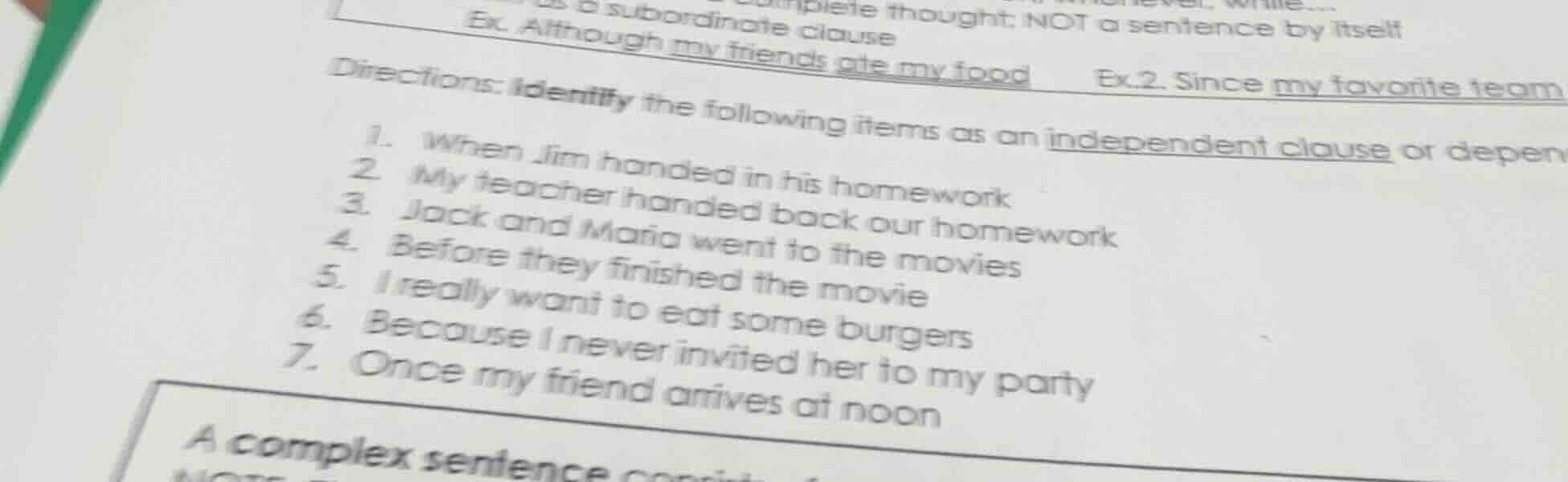
a subordinate clause
ex. although my friends ate my food ex.2. since my favorite team
directions: identify the following items as an independent clause or depen
- when jim handed in his homework
- my teacher handed back our homework
- jack and maria went to the movies
- before they finished the movie
- i really want to eat some burgers
- because i never invited her to my party
- once my friend arrives at noon
a complex sentence
To solve this, we first recall the definitions: an independent clause can stand alone as a complete sentence (has a subject and a predicate, and expresses a complete thought), while a dependent clause (also called subordinate clause) cannot stand alone (it has a subject and a verb but does not express a complete thought, often introduced by a subordinating conjunction like when, before, because, once, etc.).
1. When Jim handed in his homework
- The subordinating conjunction when introduces this clause. It has a subject (Jim) and a verb (handed in), but it does not express a complete thought (we need to know what happened when Jim handed in his homework).
- Classification: Dependent clause
2. My teacher handed back our homework
- It has a subject (My teacher) and a predicate (handed back our homework), and it expresses a complete thought (we understand what the teacher did).
- Classification: Independent clause
3. Jack and Maria went to the movies
- Subject: Jack and Maria; Predicate: went to the movies. It expresses a complete thought (tells us what Jack and Maria did).
- Classification: Independent clause
4. Before they finished the movie
- Subordinating conjunction before introduces the clause. Subject: they; Verb: finished. It does not express a complete thought (we need to know what happened before they finished the movie).
- Classification: Dependent clause
5. I really want to eat some burgers
- Subject: I; Predicate: really want to eat some burgers. It expresses a complete thought (tells us what the speaker wants).
- Classification: Independent clause
6. Because I never invited her to my party
- Subordinating conjunction because introduces the clause. Subject: I; Verb: invited. It does not express a complete thought (we need to know what happened because of this).
- Classification: Dependent clause
7. Once my friend arrives at noon
- Subordinating conjunction once introduces the clause. Subject: my friend; Verb: arrives. It does not express a complete thought (we need to know what will happen once the friend arrives).
- Classification: Dependent clause
Final Answers (Clause Type for Each Item):
- Dependent clause
- Independent clause
- Independent clause
- Dependent clause
- Independent clause
- Dependent clause
- Dependent clause

Snap & solve any problem in the app
Get step-by-step solutions on Sovi AI
Photo-based solutions with guided steps
Explore more problems and detailed explanations
To solve this, we first recall the definitions: an independent clause can stand alone as a complete sentence (has a subject and a predicate, and expresses a complete thought), while a dependent clause (also called subordinate clause) cannot stand alone (it has a subject and a verb but does not express a complete thought, often introduced by a subordinating conjunction like when, before, because, once, etc.).
1. When Jim handed in his homework
- The subordinating conjunction when introduces this clause. It has a subject (Jim) and a verb (handed in), but it does not express a complete thought (we need to know what happened when Jim handed in his homework).
- Classification: Dependent clause
2. My teacher handed back our homework
- It has a subject (My teacher) and a predicate (handed back our homework), and it expresses a complete thought (we understand what the teacher did).
- Classification: Independent clause
3. Jack and Maria went to the movies
- Subject: Jack and Maria; Predicate: went to the movies. It expresses a complete thought (tells us what Jack and Maria did).
- Classification: Independent clause
4. Before they finished the movie
- Subordinating conjunction before introduces the clause. Subject: they; Verb: finished. It does not express a complete thought (we need to know what happened before they finished the movie).
- Classification: Dependent clause
5. I really want to eat some burgers
- Subject: I; Predicate: really want to eat some burgers. It expresses a complete thought (tells us what the speaker wants).
- Classification: Independent clause
6. Because I never invited her to my party
- Subordinating conjunction because introduces the clause. Subject: I; Verb: invited. It does not express a complete thought (we need to know what happened because of this).
- Classification: Dependent clause
7. Once my friend arrives at noon
- Subordinating conjunction once introduces the clause. Subject: my friend; Verb: arrives. It does not express a complete thought (we need to know what will happen once the friend arrives).
- Classification: Dependent clause
Final Answers (Clause Type for Each Item):
- Dependent clause
- Independent clause
- Independent clause
- Dependent clause
- Independent clause
- Dependent clause
- Dependent clause