QUESTION IMAGE
Question
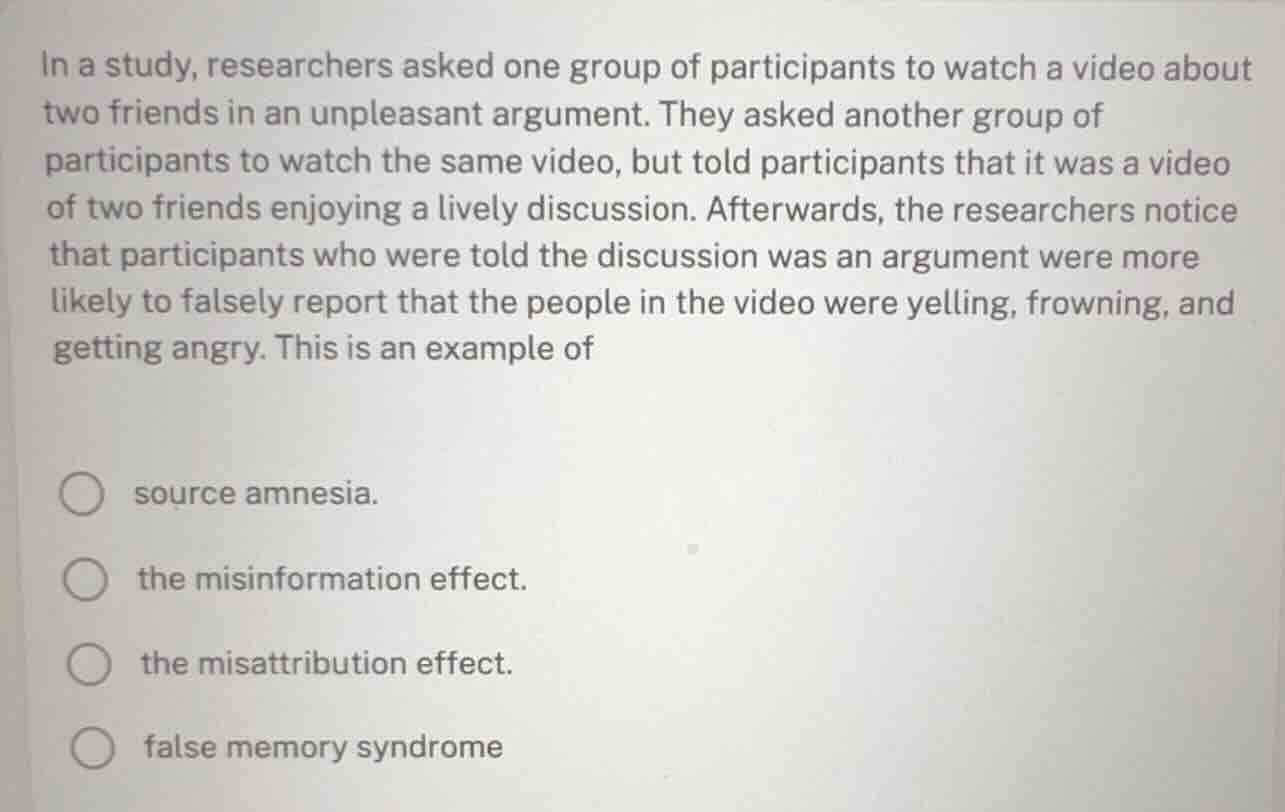
in a study, researchers asked one group of participants to watch a video about two friends in an unpleasant argument. they asked another group of participants to watch the same video, but told participants that it was a video of two friends enjoying a lively discussion. afterwards, the researchers notice that participants who were told the discussion was an argument were more likely to falsely report that the people in the video were yelling, frowning, and getting angry. this is an example of
source amnesia.
the misinformation effect.
the misattribution effect.
false memory syndrome
Analyze the experimental scenario
The study describes an experiment where participants watch a video of two friends. One group is told the video shows an "unpleasant argument," while another group is told it shows a "lively discussion." Afterwards, those told it was an argument are more likely to falsely report details like yelling, frowning, and getting angry. This demonstrates how post-event information or suggestive framing can distort a person's memory of an event.
Evaluate the psychological concepts
- Source amnesia: Inability to remember where, when, or how previously learned information has been acquired. This does not fit the scenario.
- The misinformation effect: This occurs when a person's recall of episodic memories becomes less accurate because of post-event information. In this study, the suggestive framing (being told it was an "argument") acts as misleading post-event information that alters the participants' reconstructed memory of the video. This is a classic demonstration of the Misinformation Effect.
- The misattribution effect: Suggests attributing a memory to the wrong source, which is closely related to source monitoring errors but is less specific to the post-event suggestion altering details of the event itself.
- False memory syndrome: Typically refers to a condition in which a person's identity and relationships are strongly affected by false memories, heavily associated with recovered memories of traumatic events, which is too broad and clinical for this specific experimental paradigm.
Select the correct option
The scenario is a classic experimental demonstration of the misinformation effect, where misleading or suggestive information presented after an event (or during its framing) alters the subsequent retrieval and reconstruction of that memory.

Snap & solve any problem in the app
Get step-by-step solutions on Sovi AI
Photo-based solutions with guided steps
Explore more problems and detailed explanations
- source amnesia.
- the misinformation effect. (Correct answer)
- the misattribution effect.
- false memory syndrome