QUESTION IMAGE
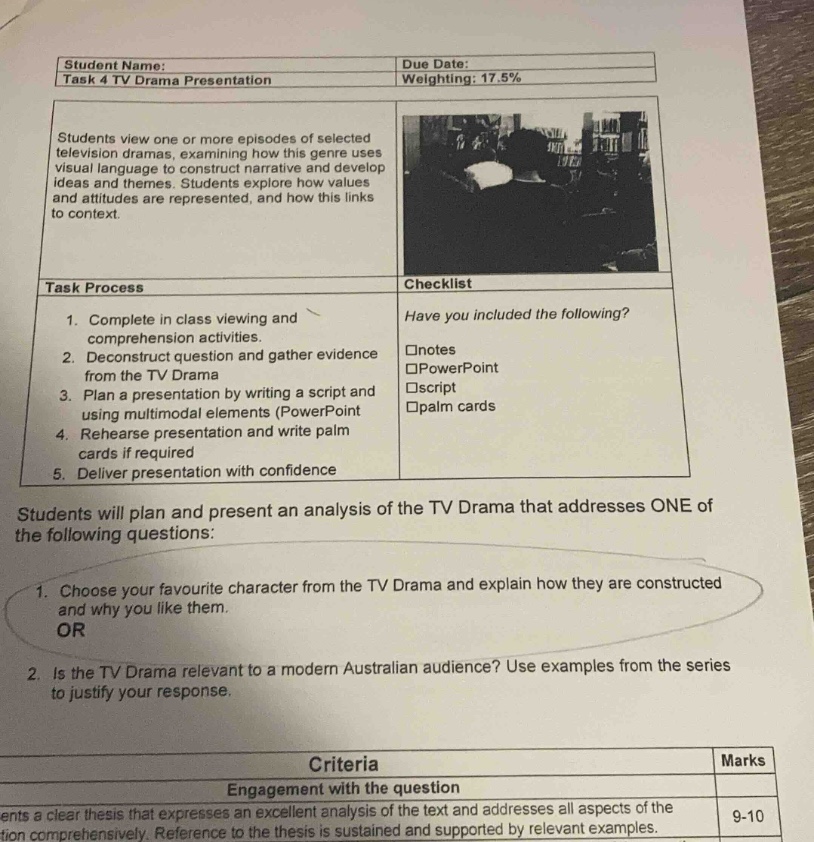
Question
student name:
due date:
task 4 tv drama presentation
weighting: 17.5%
students view one or more episodes of selected television dramas, examining how this genre uses visual language to construct narrative and develop ideas and themes. students explore how values and attitudes are represented, and how this links to context.
task process
- complete in class viewing and comprehension activities.
- deconstruct question and gather evidence from the tv drama
- plan a presentation by writing a script and using multimodal elements (powerpoint
- rehearse presentation and write palm cards if required
- deliver presentation with confidence
checklist
have you included the following?
notes
powerpoint
script
palm cards
students will plan and present an analysis of the tv drama that addresses one of the following questions:
- choose your favourite character from the tv drama and explain how they are constructed and why you like them.
or
- is the tv drama relevant to a modern australian audience? use examples from the series to justify your response.
Identify the selected task prompt
The student has circled Question 1 on the assignment sheet: "Choose your favourite character from the TV Drama and explain how they are constructed and why you like them."
Define character construction in TV drama
Character construction refers to how a character is built by the creators using media codes and conventions. This includes:
- Visual elements: Costuming, makeup, physical appearance, body language, and positioning in the frame.
- Audio elements: Dialogue, tone of voice, music associated with them, and sound effects.
- Narrative elements: Their actions, motivations, relationships with other characters, and role in the plot.
Structure the presentation plan
To address this prompt comprehensively for a high school presentation, the student needs to structure their analysis into clear, logical steps:
- Introduction: State the chosen TV drama, name the favorite character, and present a clear thesis statement about how they are constructed and why they are compelling.
- Visual Construction: Analyze how the character looks and moves (costume, lighting, camera angles).
- Auditory and Dialogue Construction: Analyze what they say, how they say it, and how sound design shapes our perception of them.
- Narrative Role and Personal Appeal: Explain their actions, relationships, and why this combination makes them appealing or relatable to the audience.
Formulate actionable advice for the student
Provide a clear, step-by-step guide on how to plan, write, and deliver this specific presentation based on the assignment's checklist (notes, PowerPoint, script, palm cards).

Snap & solve any problem in the app
Get step-by-step solutions on Sovi AI
Photo-based solutions with guided steps
Explore more problems and detailed explanations
To successfully complete Task 4: TV Drama Presentation focusing on your circled option (Question 1), follow this structured guide to plan, write, and deliver your analysis:
1. Choose Your Character & Formulate a Thesis
Select a character who has a clear development arc or distinct visual style. Your thesis should state who the character is and summarize how they are constructed to make them appealing.
- Example: "In [TV Drama], the character of [Name] is constructed as a sympathetic outsider through contrasting costuming and vulnerable dialogue, making them the most compelling figure in the series."
2. Analyze Visual Construction (How They Look)
Examine the visual language used by the directors to build this character:
- Costume & Makeup: What do their clothes, colors, or hair tell us about their personality, social status, or emotional state?
- Camera Techniques: Are they often filmed in close-ups (to show emotion) or low angles (to show power)?
- Body Language: How do their posture, gestures, and facial expressions convey their inner feelings?
3. Analyze Auditory Construction (How They Sound)
Examine how sound design and speech shape the character:
- Dialogue & Tone: What vocabulary do they use? Is their delivery confident, hesitant, sarcastic, or quiet?
- Soundtrack: Is there a specific musical theme or instrument that plays when this character enters a scene?
4. Explain Why You Like Them (Narrative & Appeal)
Connect their construction to your personal response:
- Relatability or Complexity: Do you like them because they are flawed, heroic, or realistic?
- Relationships: How do their interactions with other characters highlight their best or worst traits?
5. Prepare Your Presentation Materials
Align your preparation with the assignment checklist:
- Notes: Gather specific scene timestamps and quotes to use as evidence.
- PowerPoint: Use high-quality screenshots of your character to visually demonstrate your points about costuming and camera angles. Keep slide text minimal.
- Script: Write out your spoken response, ensuring you use analytical terms (e.g., camera techniques, juxtaposition, non-verbal cues).
- Palm Cards: Condense your script into bullet points of key ideas and cues to maintain eye contact with your audience during delivery.