Sovi.AI - AI Math Tutor

Scan to solve math questions

QUESTION IMAGE

strict followers of __________ believed that cognition did not have a r…

Question

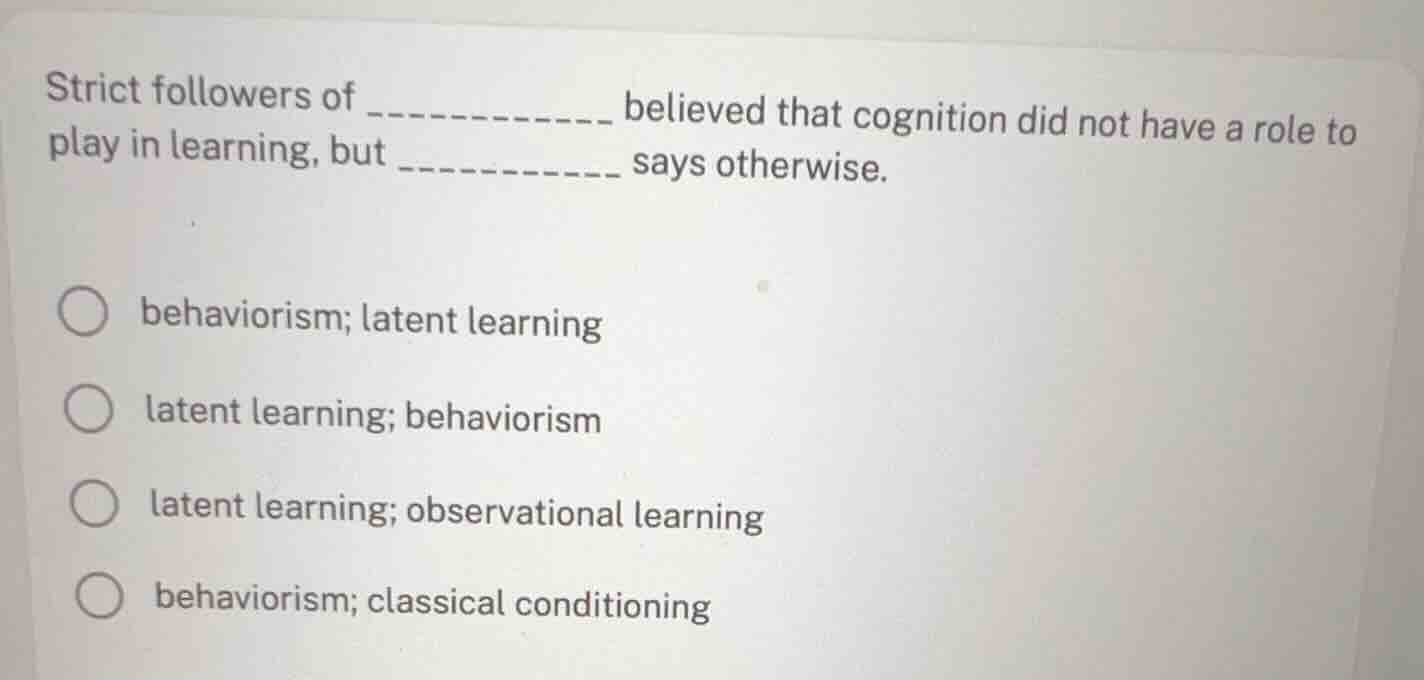
strict followers of ________ believed that cognition did not have a role to play in learning, but ________ says otherwise.

behaviorism; latent learning
latent learning; behaviorism
latent learning; observational learning
behaviorism; classical conditioning

Explanation:

Response

<pre_analysis>
{
"quality": "clear",
"question_count": 1,
"skills_matched": [
"direct_cot",
"multiple_choice_formatter",
"explain_then_answer",
"tutor"
],
"needs_drawing": false,
"concepts_used": [
"Classical Conditioning",
"Observational Learning"
],
"new_concepts": [
"Behaviorism",
"Latent Learning"
],
"current_concepts": [
"Behaviorism",
"Latent Learning",
"Classical Conditioning",
"Observational Learning"
]
}
</pre_analysis>

<reasoning>

Analyze the core psychological perspectives

The question asks about a perspective that rejects the role of cognition in learning, contrasted with a concept that demonstrates learning can occur without immediate reinforcement or outward behavior, thereby proving a cognitive component. Strict followers of Behaviorism (specifically radical behaviorism, like that of B.F. Skinner) believed that learning is purely a product of environmental conditioning and stimulus-response associations, completely excluding internal mental states or cognition.

Evaluate the contrasting concept

In contrast, Latent Learning (first systematically studied by Edward C. Tolman) refers to learning that occurs without any obvious reinforcement or immediate demonstration of behavior. It only becomes apparent when there is an incentive to display it (such as rats forming a cognitive map of a maze). This directly demonstrates that cognitive processes (like mental representations) play a crucial role in learning, contradicting strict behaviorist views.

Match with the given options

Let's evaluate the options based on our analysis:

  • behaviorism; latent learning: This perfectly fits. Strict followers of behaviorism believed cognition had no role, but latent learning says otherwise.
  • latent learning; behaviorism: This is reversed.
  • latent learning; observational learning: Both involve cognitive elements, so they do not contrast in this manner.
  • behaviorism; classical conditioning: Classical conditioning is itself a behaviorist learning theory that generally does not emphasize cognitive processes, so it does not serve as the contrasting "otherwise" evidence here.

</reasoning>

<answer>
<mcq-correct>behaviorism; latent learning</mcq-correct>
<mcq-option>latent learning; behaviorism</mcq-option>
<mcq-option>latent learning; observational learning</mcq-option>
<mcq-option>behaviorism; classical conditioning</mcq-option>
</answer>

<post_analysis>
{
"subject": "Social Science",
"question_type": "Multiple Choice",
"knowledge_point": [
"Social Science",
"Psychology",
"Learning Theories"
]
}
</post_analysis>

Answer:

<pre_analysis>
{
"quality": "clear",
"question_count": 1,
"skills_matched": [
"direct_cot",
"multiple_choice_formatter",
"explain_then_answer",
"tutor"
],
"needs_drawing": false,
"concepts_used": [
"Classical Conditioning",
"Observational Learning"
],
"new_concepts": [
"Behaviorism",
"Latent Learning"
],
"current_concepts": [
"Behaviorism",
"Latent Learning",
"Classical Conditioning",
"Observational Learning"
]
}
</pre_analysis>

<reasoning>

Analyze the core psychological perspectives

The question asks about a perspective that rejects the role of cognition in learning, contrasted with a concept that demonstrates learning can occur without immediate reinforcement or outward behavior, thereby proving a cognitive component. Strict followers of Behaviorism (specifically radical behaviorism, like that of B.F. Skinner) believed that learning is purely a product of environmental conditioning and stimulus-response associations, completely excluding internal mental states or cognition.

Evaluate the contrasting concept

In contrast, Latent Learning (first systematically studied by Edward C. Tolman) refers to learning that occurs without any obvious reinforcement or immediate demonstration of behavior. It only becomes apparent when there is an incentive to display it (such as rats forming a cognitive map of a maze). This directly demonstrates that cognitive processes (like mental representations) play a crucial role in learning, contradicting strict behaviorist views.

Match with the given options

Let's evaluate the options based on our analysis:

  • behaviorism; latent learning: This perfectly fits. Strict followers of behaviorism believed cognition had no role, but latent learning says otherwise.
  • latent learning; behaviorism: This is reversed.
  • latent learning; observational learning: Both involve cognitive elements, so they do not contrast in this manner.
  • behaviorism; classical conditioning: Classical conditioning is itself a behaviorist learning theory that generally does not emphasize cognitive processes, so it does not serve as the contrasting "otherwise" evidence here.

</reasoning>

<answer>
<mcq-correct>behaviorism; latent learning</mcq-correct>
<mcq-option>latent learning; behaviorism</mcq-option>
<mcq-option>latent learning; observational learning</mcq-option>
<mcq-option>behaviorism; classical conditioning</mcq-option>
</answer>

<post_analysis>
{
"subject": "Social Science",
"question_type": "Multiple Choice",
"knowledge_point": [
"Social Science",
"Psychology",
"Learning Theories"
]
}
</post_analysis>