Sovi.AI - AI Math Tutor

Scan to solve math questions

QUESTION IMAGE

state what additional information is needed to prove the triangles are …

Question

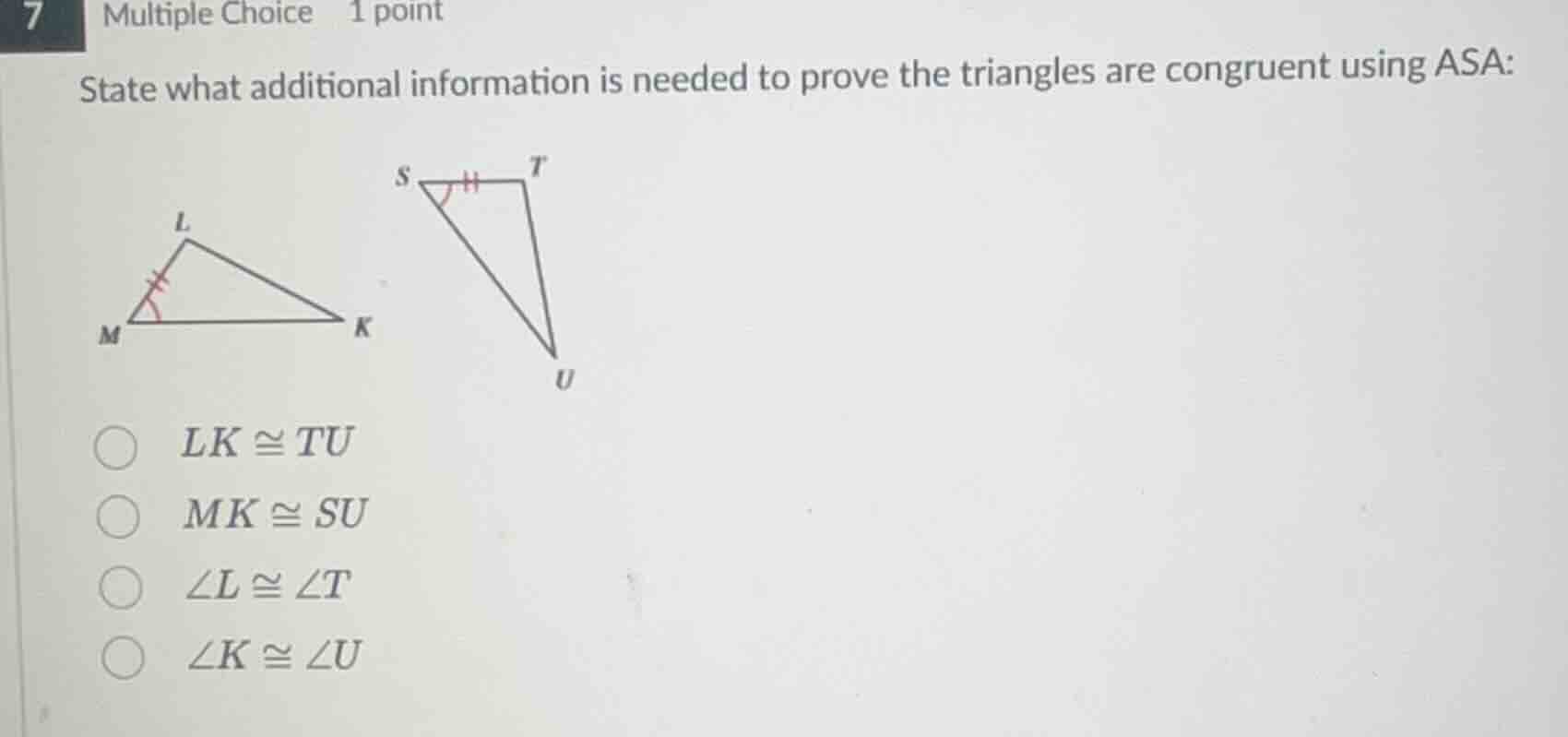
state what additional information is needed to prove the triangles are congruent using asa:

\\(lk \cong tu\\)
\\(mk \cong su\\)
\\(\angle l \cong \angle t\\)
\\(\angle k \cong \angle u\\)

Explanation:

Response

<pre_analysis>
{
"quality": "clear",
"question_count": 1,
"skills_matched": [
"step_cot",
"multiple_choice_formatter",
"explain_then_answer",
"tutor"
],
"needs_drawing": false,
"concepts_used": [
"Triangle Congruence Postulates"
],
"new_concepts": [
"ASA Congruence Postulate"
],
"current_concepts": [
"Triangle Congruence Postulates",
"ASA Congruence Postulate"
]
}
</pre_analysis>

<reasoning>

Identify given congruent parts

We analyze the markings on the given triangles \(\Delta LMK\) and \(\Delta TSU\).

  • The single tick marks indicate congruent sides: \(\overline{LM} \cong \overline{TS}\).
  • The single arc marks indicate congruent angles: \(\angle M \cong \angle S\).

Apply the ASA Congruence Postulate

We use the Triangle Congruence Postulates to find the missing information.

  • The Angle-Side-Angle (ASA) postulate requires two angles and their included side.
  • The given congruent side is \(\overline{LM}\) in \(\Delta LMK\) and \(\overline{TS}\) in \(\Delta TSU\).
  • The included side must lie between the two congruent angles.
  • For \(\overline{LM}\), the adjacent angles are \(\angle L\) and \(\angle M\).
  • For \(\overline{TS}\), the adjacent angles are \(\angle T\) and \(\angle S\).

Determine the missing congruent angles

Since we already have \(\angle M \cong \angle S\) and side \(\overline{LM} \cong \overline{TS}\):

  • The other adjacent angles must be congruent.
  • Therefore, we need \(\angle L \cong \angle T\).

</reasoning>

<answer>
<mcq-option>(A) \(LK \cong TU\)</mcq-option>
<mcq-option>(B) \(MK \cong SU\)</mcq-option>
<mcq-correct>(C) \(\angle L \cong \angle T\)</mcq-correct>
<mcq-option>(D) \(\angle K \cong \angle U\)</mcq-option>
</answer>

<post_analysis>
{
"subject": "Mathematics",
"question_type": "Multiple Choice",
"knowledge_point": [
"Mathematics",
"Geometry",
"Triangle Congruence Postulates"
]
}
</post_analysis>

Answer:

<pre_analysis>
{
"quality": "clear",
"question_count": 1,
"skills_matched": [
"step_cot",
"multiple_choice_formatter",
"explain_then_answer",
"tutor"
],
"needs_drawing": false,
"concepts_used": [
"Triangle Congruence Postulates"
],
"new_concepts": [
"ASA Congruence Postulate"
],
"current_concepts": [
"Triangle Congruence Postulates",
"ASA Congruence Postulate"
]
}
</pre_analysis>

<reasoning>

Identify given congruent parts

We analyze the markings on the given triangles \(\Delta LMK\) and \(\Delta TSU\).

  • The single tick marks indicate congruent sides: \(\overline{LM} \cong \overline{TS}\).
  • The single arc marks indicate congruent angles: \(\angle M \cong \angle S\).

Apply the ASA Congruence Postulate

We use the Triangle Congruence Postulates to find the missing information.

  • The Angle-Side-Angle (ASA) postulate requires two angles and their included side.
  • The given congruent side is \(\overline{LM}\) in \(\Delta LMK\) and \(\overline{TS}\) in \(\Delta TSU\).
  • The included side must lie between the two congruent angles.
  • For \(\overline{LM}\), the adjacent angles are \(\angle L\) and \(\angle M\).
  • For \(\overline{TS}\), the adjacent angles are \(\angle T\) and \(\angle S\).

Determine the missing congruent angles

Since we already have \(\angle M \cong \angle S\) and side \(\overline{LM} \cong \overline{TS}\):

  • The other adjacent angles must be congruent.
  • Therefore, we need \(\angle L \cong \angle T\).

</reasoning>

<answer>
<mcq-option>(A) \(LK \cong TU\)</mcq-option>
<mcq-option>(B) \(MK \cong SU\)</mcq-option>
<mcq-correct>(C) \(\angle L \cong \angle T\)</mcq-correct>
<mcq-option>(D) \(\angle K \cong \angle U\)</mcq-option>
</answer>

<post_analysis>
{
"subject": "Mathematics",
"question_type": "Multiple Choice",
"knowledge_point": [
"Mathematics",
"Geometry",
"Triangle Congruence Postulates"
]
}
</post_analysis>