QUESTION IMAGE
Question
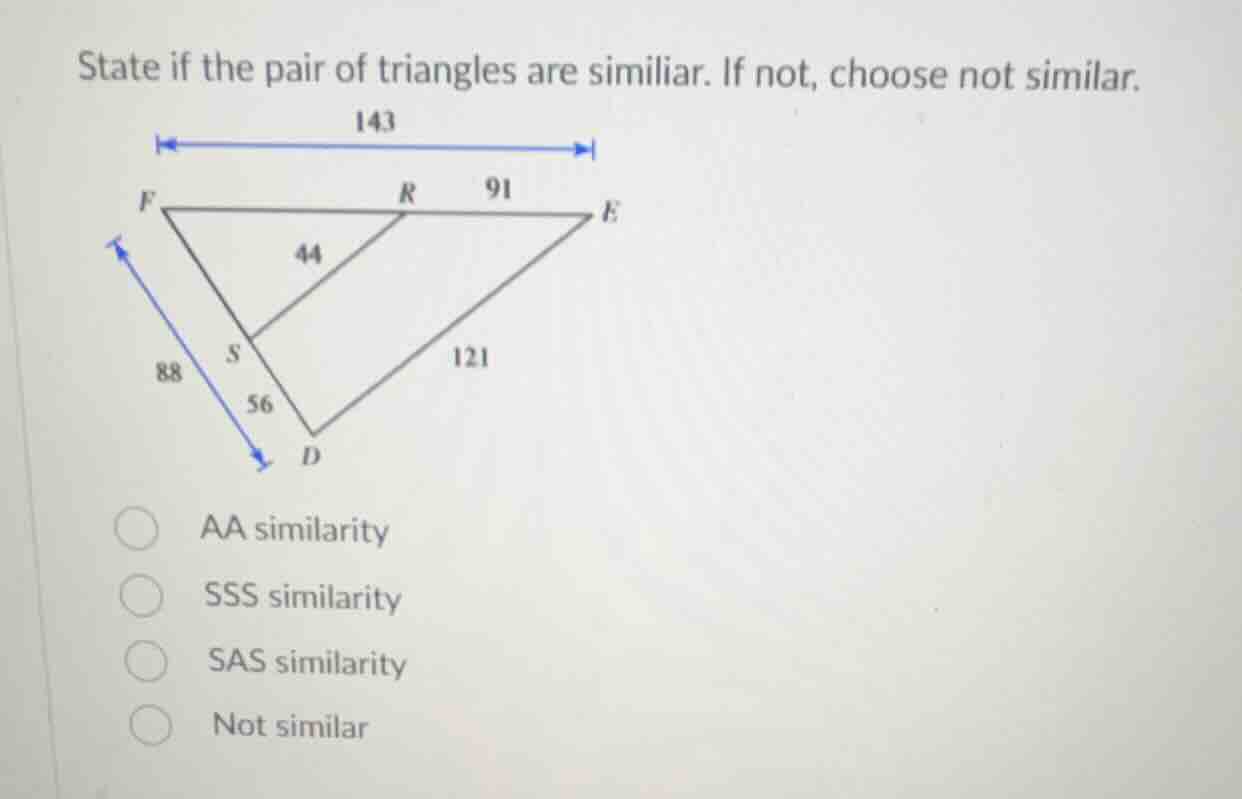
state if the pair of triangles are similiar. if not, choose not similar.
aa similarity
sss similarity
sas similarity
not similar
Identify the given side lengths
We are given two triangles sharing an angle: small triangle \(\triangle RSE\) and large triangle \(\triangle FDE\).
The shared angle is \(\angle E\).
Let's find the lengths of the sides forming \(\angle E\) for both triangles:
For the small triangle \(\triangle RSE\):
- \(RE = 91\)
- We need to find \(SE\). We are given \(FD = 88\), \(SD = 56\). Since \(S\) lies on \(FD\), we have:
\(FS = FD - SD = 88 - 56 = 32\).
However, looking at the diagram, the side with length \(88\) is \(FD\). The segment \(SD = 56\).
Let's re-examine the labels:
The side \(FE\) has length \(143\).
The point \(R\) lies on \(FE\), with \(RE = 91\).
Thus, \(FR = FE - RE = 143 - 91 = 52\).
The side \(FD\) has length \(88\).
The point \(S\) lies on \(FD\), with \(SD = 56\).
Thus, \(FS = FD - SD = 88 - 56 = 32\).
The segment \(RS\) has length \(44\).
The side \(DE\) has length \(121\).
Let's check the two triangles \(\triangle FDE\) and \(\triangle SRE\):
They share the angle \(\angle E\).
The sides adjacent to \(\angle E\) are:
- For \(\triangle FDE\): \(FE = 143\) and \(DE = 121\).
- For \(\triangle SRE\): We need to check if we can use the sides \(RE = 91\) and \(SE\). But \(SE\) is not directly given, nor is \(S\) on \(DE\).
Let's look at the diagram carefully:
\(S\) is on \(FD\), and \(R\) is on \(FE\).
So the small triangle is \(\triangle RSE\)? No, the line segment is \(RS\).
The vertices of the small triangle are \(R\), \(S\), and \(F\)?
Yes, \(\triangle FSR\) is a triangle at the corner.
Let's check if \(\triangle FSR\) is similar to \(\triangle FDE\).
They share the angle \(\angle F\).
The sides adjacent to \(\angle F\) are:
- For \(\triangle FSR\): \(FS = 32\) and \(FR = 52\).
- For \(\triangle FDE\): \(FD = 88\) and \(FE = 143\).
Calculate the ratios of corresponding sides
Let's compare the ratios of the sides adjacent to the shared angle \(\angle F\):
Ratio 1:
Ratio 2:
Let's simplify \(\frac{52}{143}\):
Both \(52\) and \(143\) are divisible by \(13\):
So:
Since \(\frac{FS}{FD} = \frac{FR}{FE} = \frac{4}{11}\) and the included angle \(\angle F\) is shared (\(\angle SFR = \angle DFE\)), the triangles \(\triangle FSR\) and \(\triangle FDE\) are similar by SAS similarity.
Verify with the third side ratio
Let's check if the ratio of the third sides matches:
Both \(44\) and \(121\) are divisible by \(11\):
So:
Since all three pairs of corresponding sides have the same ratio \(\frac{4}{11}\), this confirms that \(\triangle FSR \sim \triangle FDE\) by SAS similarity (or SSS similarity, but SAS is directly established using the shared angle \(\angle F\) and its adjacent sides).

Snap & solve any problem in the app
Get step-by-step solutions on Sovi AI
Photo-based solutions with guided steps
Explore more problems and detailed explanations
- AA similarity
- SSS similarity
- SAS similarity (Correct answer)
- Not similar