QUESTION IMAGE
Question
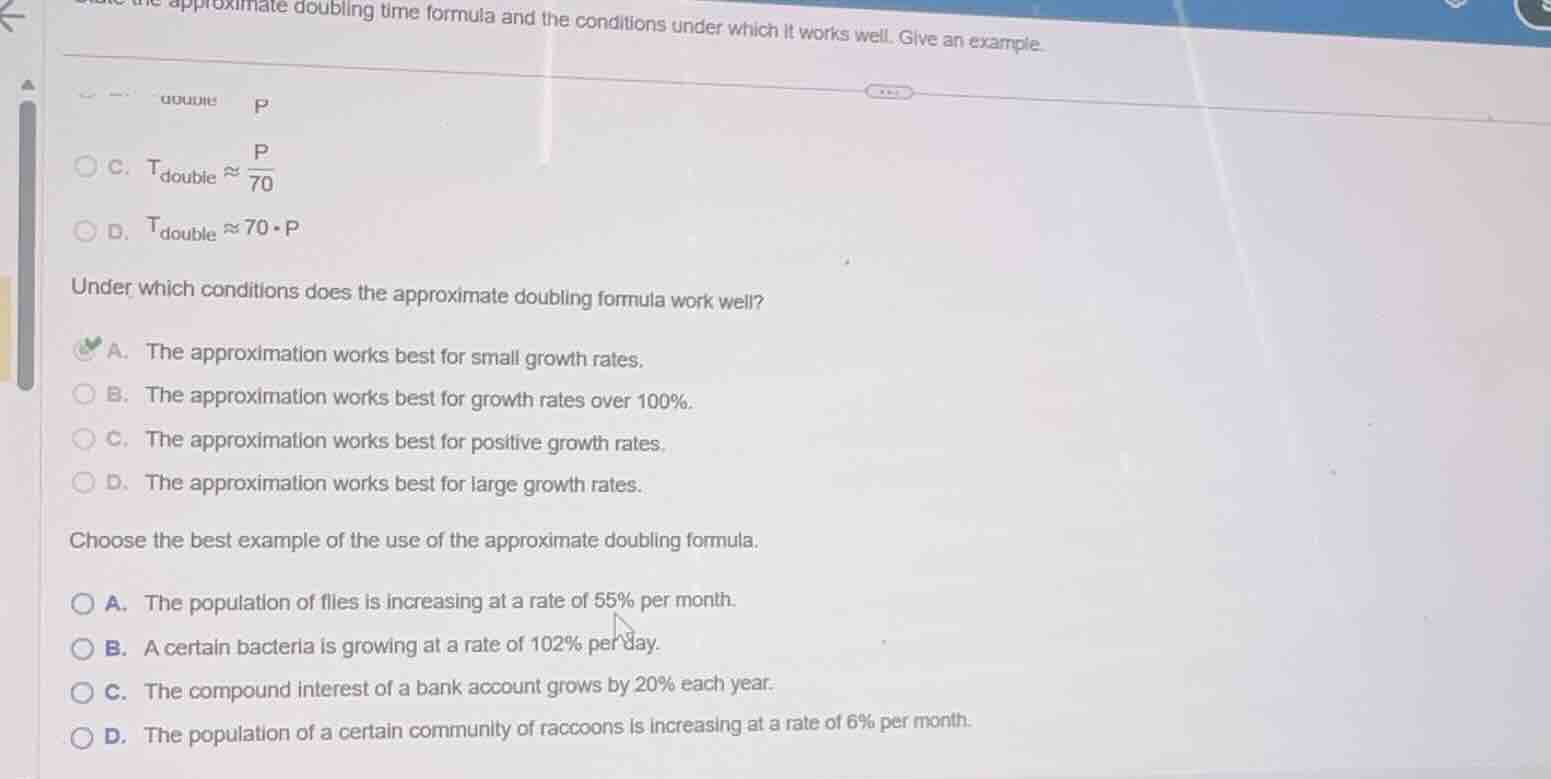
state the approximate doubling time formula and the conditions under which it works well. give an example.
c. \\(t_{\text{double}} \approx \frac{p}{70}\\)
d. \\(t_{\text{double}} \approx 70 \cdot p\\)
under which conditions does the approximate doubling formula work well?
a. the approximation works best for small growth rates.
b. the approximation works best for growth rates over 100%.
c. the approximation works best for positive growth rates.
d. the approximation works best for large growth rates.
choose the best example of the use of the approximate doubling formula.
a. the population of flies is increasing at a rate of 55% per month.
b. a certain bacteria is growing at a rate of 102% per day.
c. the compound interest of a bank account grows by 20% each year.
d. the population of a certain community of raccoons is increasing at a rate of 6% per month.
State the approximate doubling time formula
Using the Rule of 70 and Doubling Time knowledge points
Identify the conditions under which the formula works well
Using the Rule of 70 knowledge point
- The approximation is derived from \(\ln(2) \approx 0.693\).
- It assumes continuous compounding or small growth rates \(P\).
- Therefore, the approximation works best for small growth rates.
Choose the best example of the use of the approximate doubling formula
Using the Rule of 70 and Doubling Time knowledge points
- We seek the scenario with the smallest growth rate \(P\).
- Comparing the given rates: \(55\%\), \(102\%\), \(20\%\), and \(6\%\).
- \(6\%\) is the smallest growth rate, making it the best fit.

Snap & solve any problem in the app
Get step-by-step solutions on Sovi AI
Photo-based solutions with guided steps
Explore more problems and detailed explanations
Question 1
- C. \(T_{\text{double}} \approx \frac{P}{70}\)
- D. \(T_{\text{double}} \approx 70 \cdot P\)
Question 2
- A. The approximation works best for small growth rates. (Correct answer)
- B. The approximation works best for growth rates over 100%.
- C. The approximation works best for positive growth rates.
- D. The approximation works best for large growth rates.
Question 3
- A. The population of flies is increasing at a rate of 55% per month.
- B. A certain bacteria is growing at a rate of 102% per day.
- C. The compound interest of a bank account grows by 20% each year.
- D. The population of a certain community of raccoons is increasing at a rate of 6% per month. (Correct answer)