QUESTION IMAGE
Question
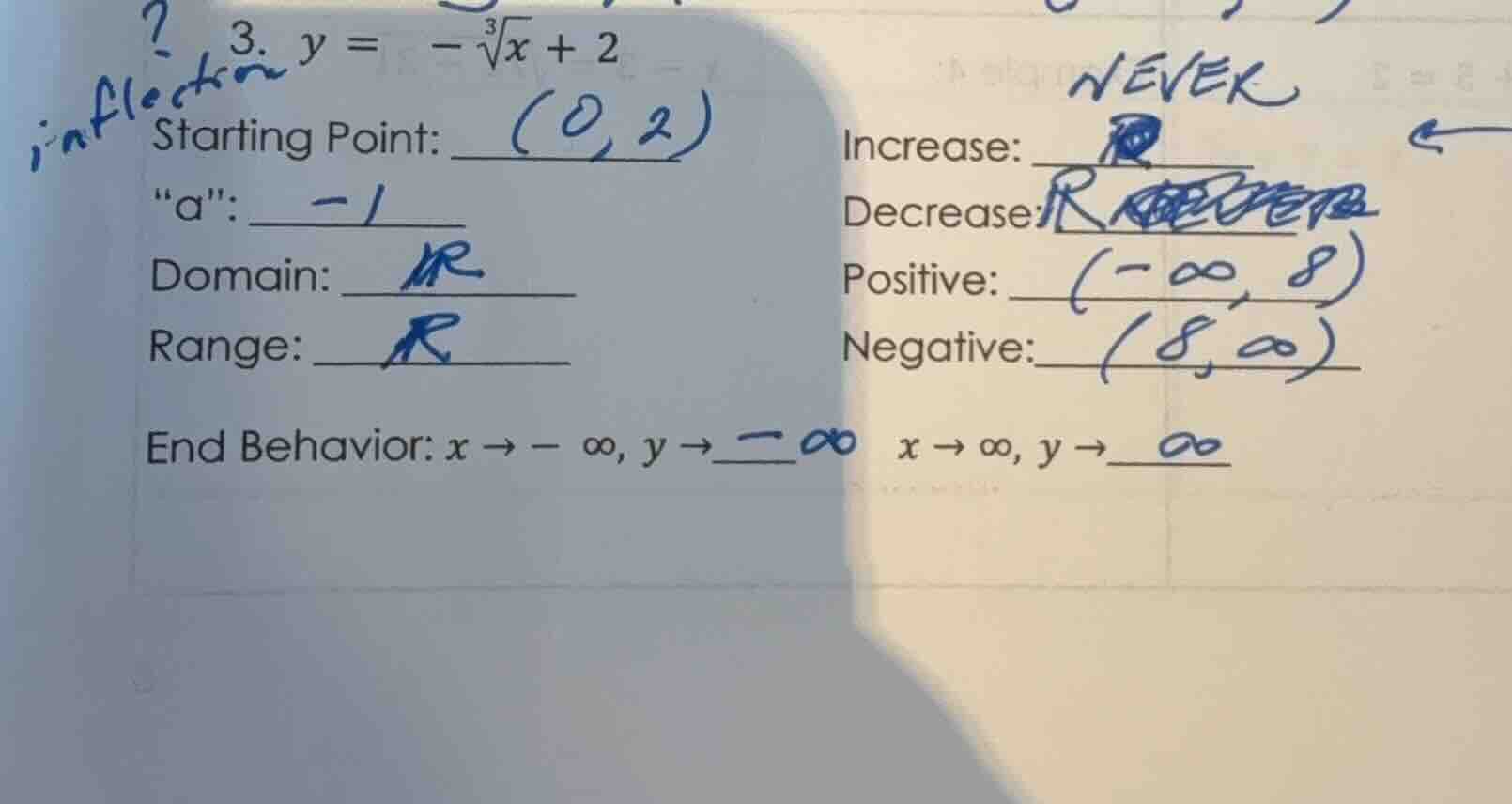
- \\(y = -\sqrt3{x} + 2\\)
starting point: \\((0, 2)\\)
\a\: \\(-1\\)
domain: \\(\mathbb{r}\\)
range: \\(\mathbb{r}\\)
increase: never
decrease: \\(\mathbb{r}\\)
positive: \\((-\infty, 8)\\)
negative: \\((8, \infty)\\)
end behavior: \\(x \to -\infty, y \to \infty\\), \\(x \to \infty, y \to -\infty\\)
🆕 New Concept Discovered: Graphing Radical Functions
Analyzing key features of cube root functions.
Step 1: Identify the key features of the function
The given function is:
- Inflection Point (Starting Point): The parent function \( y = \sqrt[3]{x} \) has its inflection point at \( (0,0) \). Shifting it up by \( 2 \) units gives the inflection point at \( (0, 2) \).
- Value of "a": The coefficient in front of the radical is \( a = -1 \).
- Domain: Since we can take the cube root of any real number, the domain is all real numbers, \( \mathbb{R} \) or \( (-\infty, \infty) \).
- Range: The output of a cube root function can be any real number, so the range is all real numbers, \( \mathbb{R} \) or \( (-\infty, \infty) \).
---
Step 2: Determine intervals of increase and decrease
The parent function \( y = \sqrt[3]{x} \) is strictly increasing.
Because \( a = -1 \) is negative, the graph is reflected vertically across the x-axis. This reverses the behavior:
- Increase: Never
- Decrease: On the entire domain, which is \( \mathbb{R} \) or \( (-\infty, \infty) \)
---
Step 3: Find the x-intercept to determine positive and negative intervals
To find where the function changes from positive to negative, we find the x-intercept by setting \( y = 0 \):
Since the function is strictly decreasing:
- It is positive (\( y > 0 \)) to the left of the intercept: \( (-\infty, 8) \)
- It is negative (\( y < 0 \)) to the right of the intercept: \( (8, \infty) \)
---
Step 4: Determine end behavior
As \( x \) goes to positive or negative infinity, we look at the limit of \( y = -\sqrt[3]{x} + 2 \):
- As \( x \to -\infty \), \( \sqrt[3]{x} \to -\infty \), so \( -\sqrt[3]{x} \to \infty \). Thus, \( y \to \infty \).
- As \( x \to \infty \), \( \sqrt[3]{x} \to \infty \), so \( -\sqrt[3]{x} \to -\infty \). Thus, \( y \to -\infty \).
---

Snap & solve any problem in the app
Get step-by-step solutions on Sovi AI
Photo-based solutions with guided steps
Explore more problems and detailed explanations
Here are the corrected values for the worksheet:
- Starting Point (Inflection Point): \( (0,2) \)
- "a": \( -1 \)
- Domain: \( \mathbb{R} \) or \( (-\infty, \infty) \)
- Range: \( \mathbb{R} \) or \( (-\infty, \infty) \)
- Increase: Never
- Decrease: \( \mathbb{R} \) or \( (-\infty, \infty) \)
- Positive: \( (-\infty, 8) \)
- Negative: \( (8, \infty) \)
- End Behavior:
- As \( x \to -\infty \), \( y \to \infty \)
- As \( x \to \infty \), \( y \to -\infty \)