QUESTION IMAGE
Question
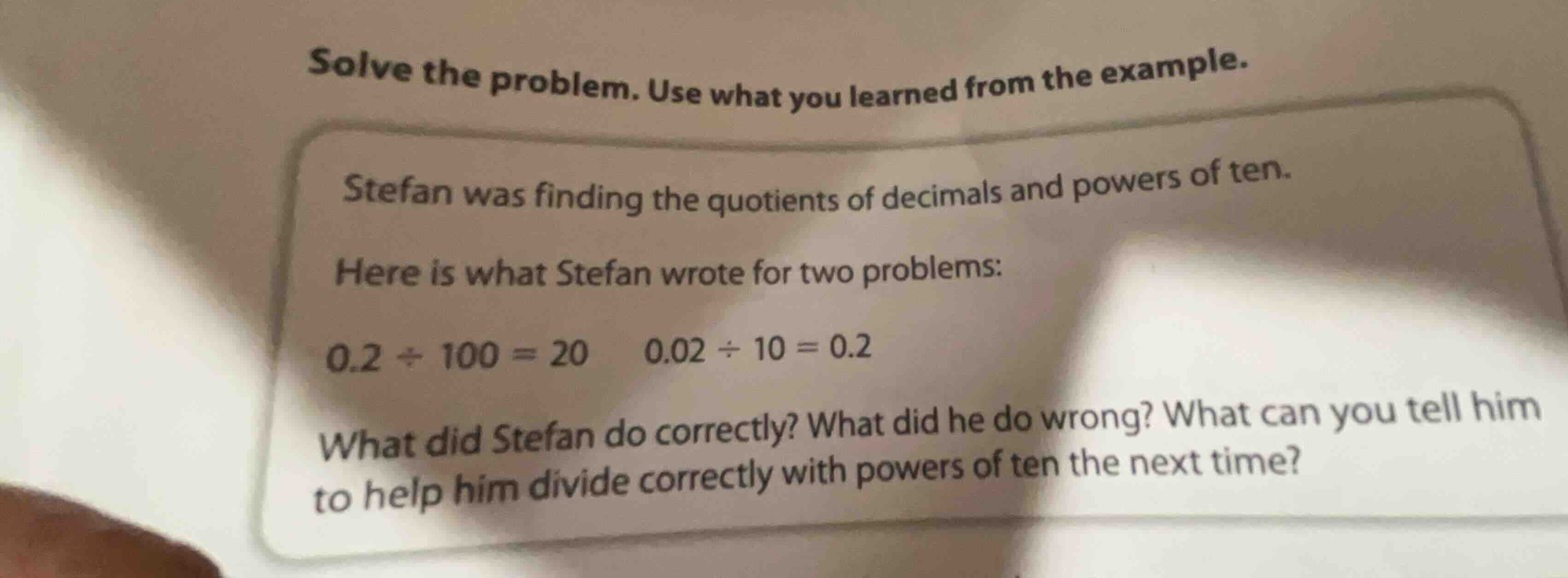
solve the problem. use what you learned from the example.
stefan was finding the quotients of decimals and powers of ten.
here is what stefan wrote for two problems:
(0.2 \div 100 = 20) (0.02 \div 10 = 0.2)
what did stefan do correctly? what did he do wrong? what can you tell him to help him divide correctly with powers of ten the next time?
<pre_analysis>
{
"quality": "clear",
"question_count": 1,
"skills_matched": [
"step_cot",
"explain_then_answer",
"tutor"
],
"needs_drawing": false,
"concepts_used": [
"Dividing Decimals by Powers of Ten"
],
"new_concepts": [
"Decimal Division Error Analysis"
],
"current_concepts": [
"Dividing Decimals by Powers of Ten",
"Decimal Place Value Relationships",
"Decimal Division Error Analysis"
]
}
</pre_analysis>
<reasoning>
Analyze Stefan's calculations
Let's look at the two equations Stefan wrote:
- \(0.2 \div 100 = 20\)
- \(0.02 \div 10 = 0.2\)
We need to find the correct mathematical results for these operations.
Determine correct mathematical results
Using the Dividing Decimals by Powers of Ten concept:
- For \(0.2 \div 100\), dividing by \(100\) (which is \(10^2\)) shifts the decimal point \(2\) places to the left:
\[0.2 \div 100 = 0.002\]
- For \(0.02 \div 10\), dividing by \(10\) (which is \(10^1\)) shifts the decimal point \(1\) place to the left:
\[0.02 \div 10 = 0.002\]
Identify what Stefan did correctly
Stefan correctly identified the digits involved in the numbers. In both of his answers, he kept the non-zero digit \(2\). He also recognized that dividing decimals by powers of ten changes the place value of the digits.
Identify what Stefan did wrong
Stefan shifted the decimal point in the wrong direction.
- In \(0.2 \div 100 = 20\), he shifted the decimal point \(2\) places to the right instead of the left (multiplying instead of dividing).
- In \(0.02 \div 10 = 0.2\), he shifted the decimal point \(1\) place to the right instead of the left.
Formulate helpful advice for Stefan
To divide by a power of ten, count the number of zeros in the power of ten (or the exponent). Move the decimal point that many places to the left because division makes the number smaller. Add placeholder zeros as needed.
</reasoning>
<answer>
What Stefan did correctly:
Stefan correctly kept the digit \(2\) in his answers, showing he understood which non-zero digit belongs in the quotient.
What Stefan did wrong:
Stefan moved the decimal point to the right instead of to the left. This caused his answers to become larger instead of smaller, effectively multiplying by powers of ten instead of dividing.
- For \(0.2 \div 100\), the correct answer is \(0.002\) (moving the decimal point \(2\) places to the left), but Stefan wrote \(20\).
- For \(0.02 \div 10\), the correct answer is \(0.002\) (moving the decimal point \(1\) place to the left), but Stefan wrote \(0.2\).
Advice to help him next time:
When dividing a decimal by a power of ten (\(10\), \(100\), \(1,000\), etc.):
- Count the number of zeros in the power of ten.
- Move the decimal point that same number of places to the left to make the value smaller.
- Use zeros as placeholders in the empty spaces.
</answer>
<post_analysis>
{
"subject": "Mathematics",
"question_type": "Free Response",
"knowledge_point": [
"Mathematics",
"Arithmetic",
"Dividing Decimals by Powers of Ten"
]
}
</post_analysis>
Snap & solve any problem in the app
Get step-by-step solutions on Sovi AI
Photo-based solutions with guided steps
Explore more problems and detailed explanations
<pre_analysis>
{
"quality": "clear",
"question_count": 1,
"skills_matched": [
"step_cot",
"explain_then_answer",
"tutor"
],
"needs_drawing": false,
"concepts_used": [
"Dividing Decimals by Powers of Ten"
],
"new_concepts": [
"Decimal Division Error Analysis"
],
"current_concepts": [
"Dividing Decimals by Powers of Ten",
"Decimal Place Value Relationships",
"Decimal Division Error Analysis"
]
}
</pre_analysis>
<reasoning>
Analyze Stefan's calculations
Let's look at the two equations Stefan wrote:
- \(0.2 \div 100 = 20\)
- \(0.02 \div 10 = 0.2\)
We need to find the correct mathematical results for these operations.
Determine correct mathematical results
Using the Dividing Decimals by Powers of Ten concept:
- For \(0.2 \div 100\), dividing by \(100\) (which is \(10^2\)) shifts the decimal point \(2\) places to the left:
\[0.2 \div 100 = 0.002\]
- For \(0.02 \div 10\), dividing by \(10\) (which is \(10^1\)) shifts the decimal point \(1\) place to the left:
\[0.02 \div 10 = 0.002\]
Identify what Stefan did correctly
Stefan correctly identified the digits involved in the numbers. In both of his answers, he kept the non-zero digit \(2\). He also recognized that dividing decimals by powers of ten changes the place value of the digits.
Identify what Stefan did wrong
Stefan shifted the decimal point in the wrong direction.
- In \(0.2 \div 100 = 20\), he shifted the decimal point \(2\) places to the right instead of the left (multiplying instead of dividing).
- In \(0.02 \div 10 = 0.2\), he shifted the decimal point \(1\) place to the right instead of the left.
Formulate helpful advice for Stefan
To divide by a power of ten, count the number of zeros in the power of ten (or the exponent). Move the decimal point that many places to the left because division makes the number smaller. Add placeholder zeros as needed.
</reasoning>
<answer>
What Stefan did correctly:
Stefan correctly kept the digit \(2\) in his answers, showing he understood which non-zero digit belongs in the quotient.
What Stefan did wrong:
Stefan moved the decimal point to the right instead of to the left. This caused his answers to become larger instead of smaller, effectively multiplying by powers of ten instead of dividing.
- For \(0.2 \div 100\), the correct answer is \(0.002\) (moving the decimal point \(2\) places to the left), but Stefan wrote \(20\).
- For \(0.02 \div 10\), the correct answer is \(0.002\) (moving the decimal point \(1\) place to the left), but Stefan wrote \(0.2\).
Advice to help him next time:
When dividing a decimal by a power of ten (\(10\), \(100\), \(1,000\), etc.):
- Count the number of zeros in the power of ten.
- Move the decimal point that same number of places to the left to make the value smaller.
- Use zeros as placeholders in the empty spaces.
</answer>
<post_analysis>
{
"subject": "Mathematics",
"question_type": "Free Response",
"knowledge_point": [
"Mathematics",
"Arithmetic",
"Dividing Decimals by Powers of Ten"
]
}
</post_analysis>