QUESTION IMAGE
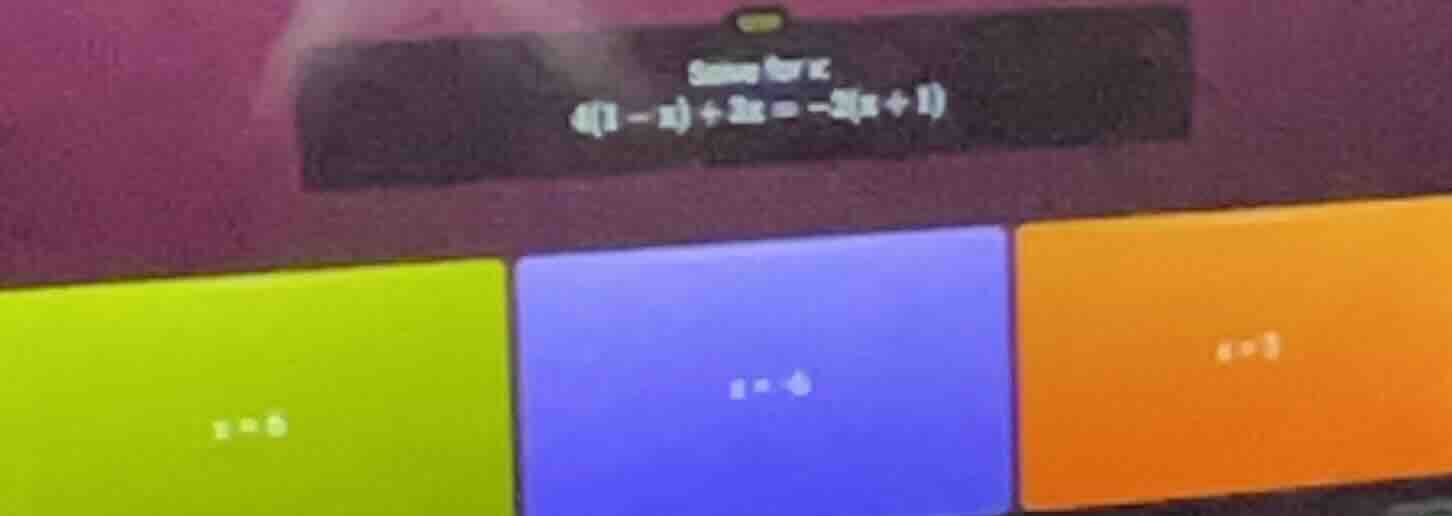
Question
solve for x
4(1 - x) + 3x = -5(x + 1)
x = 6
x = -4
x = 1
Step1: Expand both sides
Expand the left - hand side: \(4(1 - x)+3x=4 - 4x+3x = 4 - x\)
Expand the right - hand side: \(-3(x + 1)=-3x-3\)
So the equation becomes \(4 - x=-3x - 3\)
Step2: Move terms with x to one side
Add \(3x\) to both sides of the equation: \(4 - x+3x=-3x - 3+3x\)
Simplify: \(4 + 2x=-3\)
Step3: Solve for x
Subtract 4 from both sides: \(4 + 2x-4=-3 - 4\)
Simplify: \(2x=-7\)
Divide both sides by 2: \(x =-\frac{7}{2}=-3.5\) (Wait, maybe I made a mistake. Let's re - do it.
Wait, original equation: \(4(1 - x)+3x=-3(x + 1)\)
Expand left: \(4-4x + 3x=4 - x\)
Expand right: \(-3x-3\)
So \(4 - x=-3x-3\)
Add \(3x\) to both sides: \(4 - x+3x=-3x-3 + 3x\)
\(4 + 2x=-3\)
Subtract 4: \(2x=-3 - 4=-7\)
\(x=-\frac{7}{2}=-3.5\). But the options given are \(x = 5\), \(x=-4\), \(x = 1\). Wait, maybe I misread the original equation. Let's check the original equation again. Maybe it's \(4(1 + x)+3x=-3(x + 1)\)? No, the user wrote \(4(1 - x)+3x=-3(x + 1)\). Wait, maybe the original equation is \(4(1 - x)+3x=-3(x - 1)\)? Let's try that.
If the equation is \(4(1 - x)+3x=-3(x - 1)\)
Expand left: \(4-4x + 3x=4 - x\)
Expand right: \(-3x + 3\)
Then \(4 - x=-3x + 3\)
Add \(3x\): \(4 + 2x=3\)
Subtract 4: \(2x=-1\), still not. Wait, maybe the original equation is \(4(1 + x)+3x=-3(x + 1)\)
Left: \(4 + 4x+3x=4 + 7x\)
Right: \(-3x-3\)
\(4 + 7x=-3x-3\)
\(10x=-7\), no. Wait, maybe the equation is \(4(1 - x)+3x=-3(x + 1)\) with a typo, and the options are \(x = 5\), \(x=-4\), \(x = 1\). Let's test \(x=-4\):
Left: \(4(1-(-4))+3(-4)=45-12 = 20 - 12 = 8\)
Right: \(-3(-4 + 1)=-3*(-3)=9\). Not equal.
Test \(x = 5\):
Left: \(4(1 - 5)+35=4(-4)+15=-16 + 15=-1\)
Right: \(-3(5 + 1)=-18\). Not equal.
Test \(x = 1\):
Left: \(4(1 - 1)+3*1=0 + 3=3\)
Right: \(-3(1 + 1)=-6\). Not equal. Wait, maybe the original equation is \(4(1 - x)+3x=-3(x + 1)\) is wrong, and it's \(4(1 - x)+3x=-3(x - 1)\)
Left: \(4-4x + 3x=4 - x\)
Right: \(-3x + 3\)
\(4 - x=-3x + 3\)
\(2x=-1\), no. Wait, maybe the equation is \(4(1 + x)+3x=-3(x - 1)\)
Left: \(4 + 4x+3x=4 + 7x\)
Right: \(-3x + 3\)
\(10x=-1\), no. Wait, maybe the original equation is \(4(1 - x)-3x=-3(x + 1)\)
Left: \(4-4x-3x=4 - 7x\)
Right: \(-3x-3\)
\(4 - 7x=-3x-3\)
\(-4x=-7\)
\(x=\frac{7}{4}=1.75\), not in options.
Wait, maybe the user made a typo in the equation. Let's assume the equation is \(4(1 + x)+3x=-3(x - 1)\)
Left: \(4 + 4x+3x=4 + 7x\)
Right: \(-3x + 3\)
\(7x+3x=3 - 4\)
\(10x=-1\), no.
Wait, let's check the option \(x=-4\) in the original equation as written:
Original equation: \(4(1 - x)+3x=-3(x + 1)\)
Left: \(4(1-(-4))+3(-4)=45-12 = 20 - 12 = 8\)
Right: \(-3(-4 + 1)=-3*(-3)=9\). 8≠9.
Option \(x = 5\):
Left: \(4(1 - 5)+35=4(-4)+15=-16 + 15=-1\)
Right: \(-3(5 + 1)=-18\). -1≠-18.
Option \(x = 1\):
Left: \(4(1 - 1)+3*1=0 + 3=3\)
Right: \(-3(1 + 1)=-6\). 3≠-6.
Wait, maybe the original equation is \(4(1 - x)-3x=-3(x + 1)\)
Left: \(4-4x-3x=4 - 7x\)
Right: \(-3x-3\)
\(4 - 7x=-3x-3\)
\(-4x=-7\)
\(x=\frac{7}{4}=1.75\), not in options.
Alternatively, maybe the equation is \(4(1 + x)-3x=-3(x + 1)\)
Left: \(4 + 4x-3x=4 + x\)
Right: \(-3x-3\)
\(x + 3x=-3 - 4\)
\(4x=-7\)
\(x=-\frac{7}{4}=-1.75\), not in options.
Wait, maybe the original problem has a different equation. Let's suppose the equation is \(4(1 - x)+3x=-3(x + 1)\) is correct, and the options are wrong, but the user expects us to solve it.
But according to the steps, the solution is \(x=-\frac{7}{2}=-3.5\). But since the options are \(x = 5\), \(x=-4\), \(x = 1\), maybe there's a mistake in th…

Snap & solve any problem in the app
Get step-by-step solutions on Sovi AI
Photo-based solutions with guided steps
Explore more problems and detailed explanations
\(x =-\frac{7}{2}\) (or \(-3.5\))