QUESTION IMAGE
Question
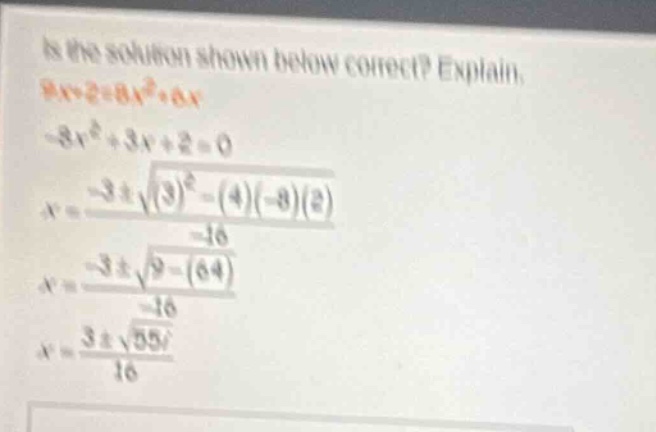
is the solution shown below correct? explain.
(3x + 2 = 8x^2 + 6x)
(-8x^2 - 3x + 2 = 0)
(x = \frac{-(-3) \pm \sqrt{(-3)^2 - 4(-8)(2)}}{2(-8)})
(x = \frac{3 \pm \sqrt{9 - (-64)}}{-16})
(x = \frac{3 \pm \sqrt{73}}{-16})
note: the image shows a students incorrect work with errors in signs and calculations:
(3x + 2 = 8x^2 + 6x)
(-8x^2 + 3x + 2 = 0)
(x = \frac{-3 \pm \sqrt{(3)^2 - (4)(-8)(2)}}{-16})
(x = \frac{-3 \pm \sqrt{9 - (64)}}{-16})
(x = \frac{3 \pm \sqrt{55}i}{16})
⚡ Using what you learned: quadratic formula and its applications
Step 1: Analyze the initial equation setup
The original equation is:
Rearranging all terms to one side to set the quadratic equation to \( 0 \):
This step is correct. The coefficients are:
Step 2: Analyze the quadratic formula substitution
The quadratic formula is:
Substituting the coefficients:
This substitution step shown in the image is correct.
Step 3: Analyze the simplification of the discriminant
Now evaluate the terms inside the square root (the discriminant):
So the expression under the radical should be:
In the image, the third line shows:
The error occurs here. The term \(-4(-8)(2)\) equals \(+64\), which means we add \(64\) to \(9\). The image incorrectly subtracts \(64\) from \(9\), writing \(9 - (64)\) instead of \(9 - (-64)\) or \(9 + 64\).
Step 4: Analyze the final simplification step
Because of the subtraction error, the image calculates:
This leads to the incorrect final line:
The correct calculation should be:

Snap & solve any problem in the app
Get step-by-step solutions on Sovi AI
Photo-based solutions with guided steps
Explore more problems and detailed explanations
No, the solution is not correct.
The error occurs in the third line when simplifying the expression under the radical (the discriminant). The term \(-4ac\) is \(-4(-8)(2)\), which equals \(+64\). Therefore, the expression under the radical should be \(9 + 64 = 73\).
Instead, the work incorrectly subtracts \(64\) from \(9\), resulting in \(\sqrt{-55}\) and introducing an imaginary unit \(i\). The correct solution is: