QUESTION IMAGE
Question
snc2d - chemistry chemical reactions
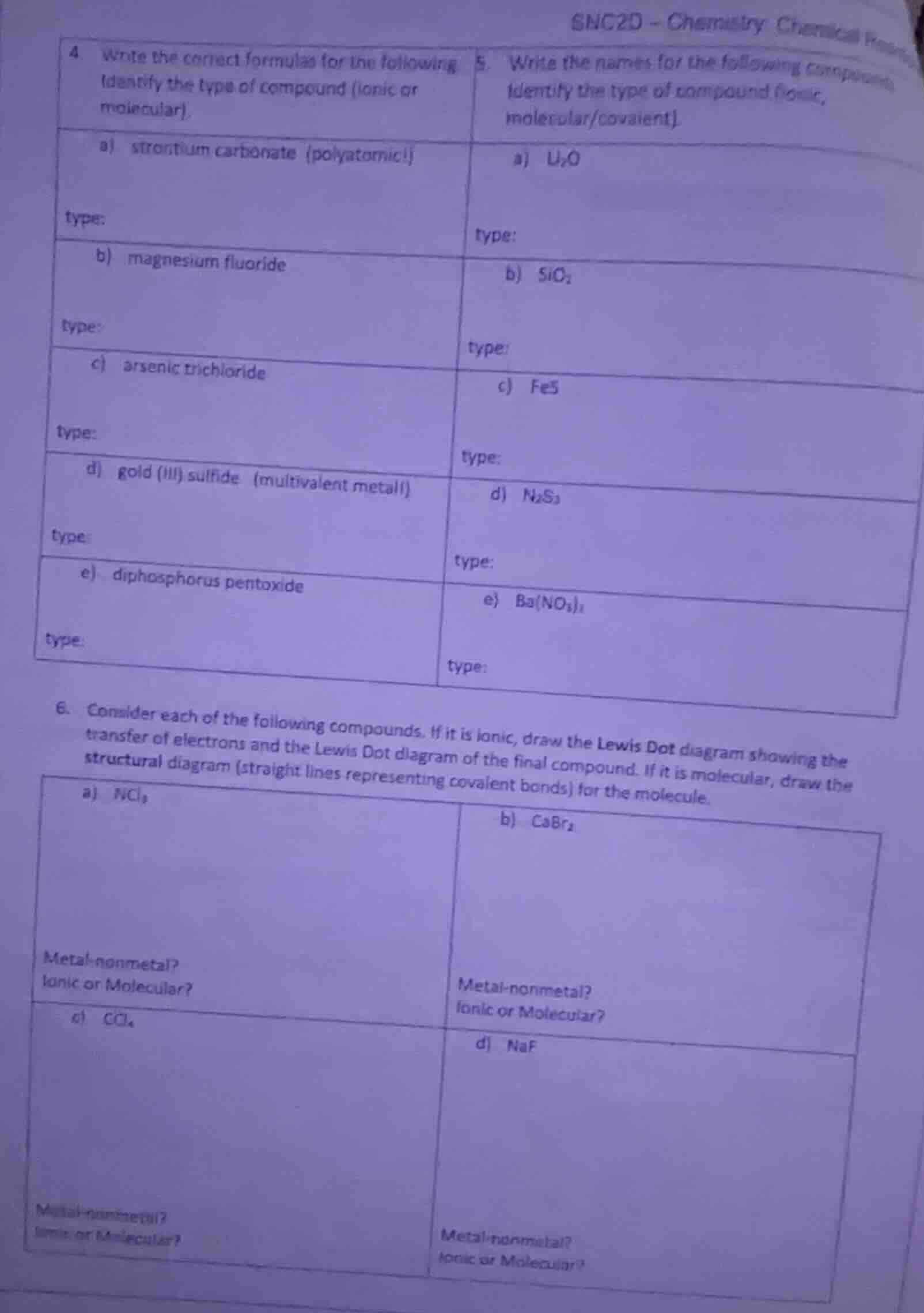
- write the correct formulas for the following. identify the type of compound (ionic or molecular).
a) strontium carbonate (polyatomic)
type:
b) magnesium fluoride
type:
c) arsenic trichloride
type:
d) gold (iii) sulfide (multivalent metal)
type:
e) diphosphorus pentoxide
type:
- write the names for the following compounds. identify the type of compound (ionic, molecular/covalent).
a) \\(li_2o\\)
type:
b) \\(sio_2\\)
type:
c) \\(fes\\)
type:
d) \\(n_2s_3\\)
type:
e) \\(ba(no_3)_2\\)
type:
- consider each of the following compounds. if it is ionic, draw the lewis dot diagram showing the transfer of electrons and the lewis dot diagram of the final compound. if it is molecular, draw the structural diagram (straight lines representing covalent bonds) for the molecule.
a) \\(ncl_3\\)
metal-nonmetal?
ionic or molecular?
b) \\(cabr_2\\)
metal-nonmetal?
ionic or molecular?
c) \\(ccl_4\\)
metal-nonmetal?
ionic or molecular?
d) \\(naf\\)
metal-nonmetal?
ionic or molecular?
Classify and write formulas for Question 4
Using the Ionic and Covalent knowledge point:
- a) strontium carbonate: Strontium (\(\text{Sr}^{2+}\)) is a metal, carbonate (\(\text{CO}_3^{2-}\)) is a polyatomic non-metal ion. This is ionic. Formula: \(\text{SrCO}_3\).
- b) magnesium fluoride: Magnesium (\(\text{Mg}^{2+}\)) is a metal, fluoride (\(\text{F}^-\)) is a non-metal. This is ionic. Formula: \(\text{MgF}_2\).
- c) arsenic trichloride: Arsenic (\(\text{As}\)) and chlorine (\(\text{Cl}\)) are both non-metals/metalloids. This is molecular. Formula: \(\text{AsCl}_3\).
- d) gold (III) sulfide: Gold (\(\text{Au}^{3+}\)) is a transition metal, sulfide (\(\text{S}^{2-}\)) is a non-metal. This is ionic. Formula: \(\text{Au}_2\text{S}_3\).
- e) diphosphorus pentoxide: Phosphorus (\(\text{P}\)) and oxygen (\(\text{O}\)) are non-metals. This is molecular. Formula: \(\text{P}_2\text{O}_5\).
Classify and name compounds for Question 5
Using the Chemical Bonding knowledge point:
- a) \(\text{Li}_2\text{O}\): Lithium is a metal, oxygen is a non-metal. This is ionic. Name: lithium oxide.
- b) \(\text{SiO}_2\): Silicon and oxygen are non-metals. This is molecular/covalent. Name: silicon dioxide.
- c) \(\text{FeS}\): Iron is a multivalent metal (\(\text{Fe}^{2+}\)), sulfur is a non-metal (\(\text{S}^{2-}\)). This is ionic. Name: iron (II) sulfide.
- d) \(\text{N}_2\text{S}_3\): Nitrogen and sulfur are non-metals. This is molecular/covalent. Name: dinitrogen trisulfide.
- e) \(\text{Ba(NO}_3)_2\): Barium is a metal, nitrate is a polyatomic ion. This is ionic. Name: barium nitrate.
Analyze bonding types for Question 6
Using the Ionic and Covalent knowledge point:
- a) \(\text{NCl}_3\): Nitrogen and chlorine are non-metals. It is molecular.
- b) \(\text{CaBr}_2\): Calcium is a metal, bromine is a non-metal. It is ionic.
- c) \(\text{CCl}_4\): Carbon and chlorine are non-metals. It is molecular.
- d) \(\text{NaF}\): Sodium is a metal, fluorine is a non-metal. It is ionic.
Describe structural representations for Question 6
Using the Chemical Bonding knowledge point:
- a) \(\text{NCl}_3\): Molecular. Central \(\text{N}\) atom with one lone pair, single-bonded to three \(\text{Cl}\) atoms (each with three lone pairs):
- b) \(\text{CaBr}_2\): Ionic. Calcium transfers its 2 valence electrons to two bromine atoms:
- c) \(\text{CCl}_4\): Molecular. Central \(\text{C}\) atom single-bonded to four \(\text{Cl}\) atoms (each with three lone pairs):
- d) \(\text{NaF}\): Ionic. Sodium transfers its 1 valence electron to fluorine:

Snap & solve any problem in the app
Get step-by-step solutions on Sovi AI
Photo-based solutions with guided steps
Explore more problems and detailed explanations
Question 4
- a) strontium carbonate (polyatomic)
- Formula: \(\text{SrCO}_3\)
- Type: Ionic
- b) magnesium fluoride
- Formula: \(\text{MgF}_2\)
- Type: Ionic
- c) arsenic trichloride
- Formula: \(\text{AsCl}_3\)
- Type: Molecular
- d) gold (III) sulfide (multivalent metal)
- Formula: \(\text{Au}_2\text{S}_3\)
- Type: Ionic
- e) diphosphorus pentoxide
- Formula: \(\text{P}_2\text{O}_5\)
- Type: Molecular
Question 5
- a) \(\text{Li}_2\text{O}\)
- Name: Lithium oxide
- Type: Ionic
- b) \(\text{SiO}_2\)
- Name: Silicon dioxide
- Type: Molecular/Covalent
- c) \(\text{FeS}\)
- Name: Iron (II) sulfide
- Type: Ionic
- d) \(\text{N}_2\text{S}_3\)
- Name: Dinitrogen trisulfide
- Type: Molecular/Covalent
- e) \(\text{Ba(NO}_3)_2\)
- Name: Barium nitrate
- Type: Ionic
Question 6
- a) \(\text{NCl}_3\)
- Metal-nonmetal? Nonmetal-nonmetal
- Ionic or Molecular? Molecular
- Structural Diagram: Central \(\text{N}\) with 1 lone pair, single-bonded to three \(\text{Cl}\) atoms (each \(\text{Cl}\) has 3 lone pairs).
- b) \(\text{CaBr}_2\)
- Metal-nonmetal? Metal-nonmetal
- Ionic or Molecular? Ionic
- Lewis Dot Diagram: \([\text{Ca}]^{2+}\) and \(2 \times [:\ddot{\text{Br}}:]^-\)
- c) \(\text{CCl}_4\)
- Metal-nonmetal? Nonmetal-nonmetal
- Ionic or Molecular? Molecular
- Structural Diagram: Central \(\text{C}\) single-bonded to four surrounding \(\text{Cl}\) atoms (each \(\text{Cl}\) has 3 lone pairs).
- d) \(\text{NaF}\)
- Metal-nonmetal? Metal-nonmetal
- Ionic or Molecular? Ionic
- Lewis Dot Diagram: \([\text{Na}]^+\) and \([:\ddot{\text{F}}:]^-\)