QUESTION IMAGE
Question
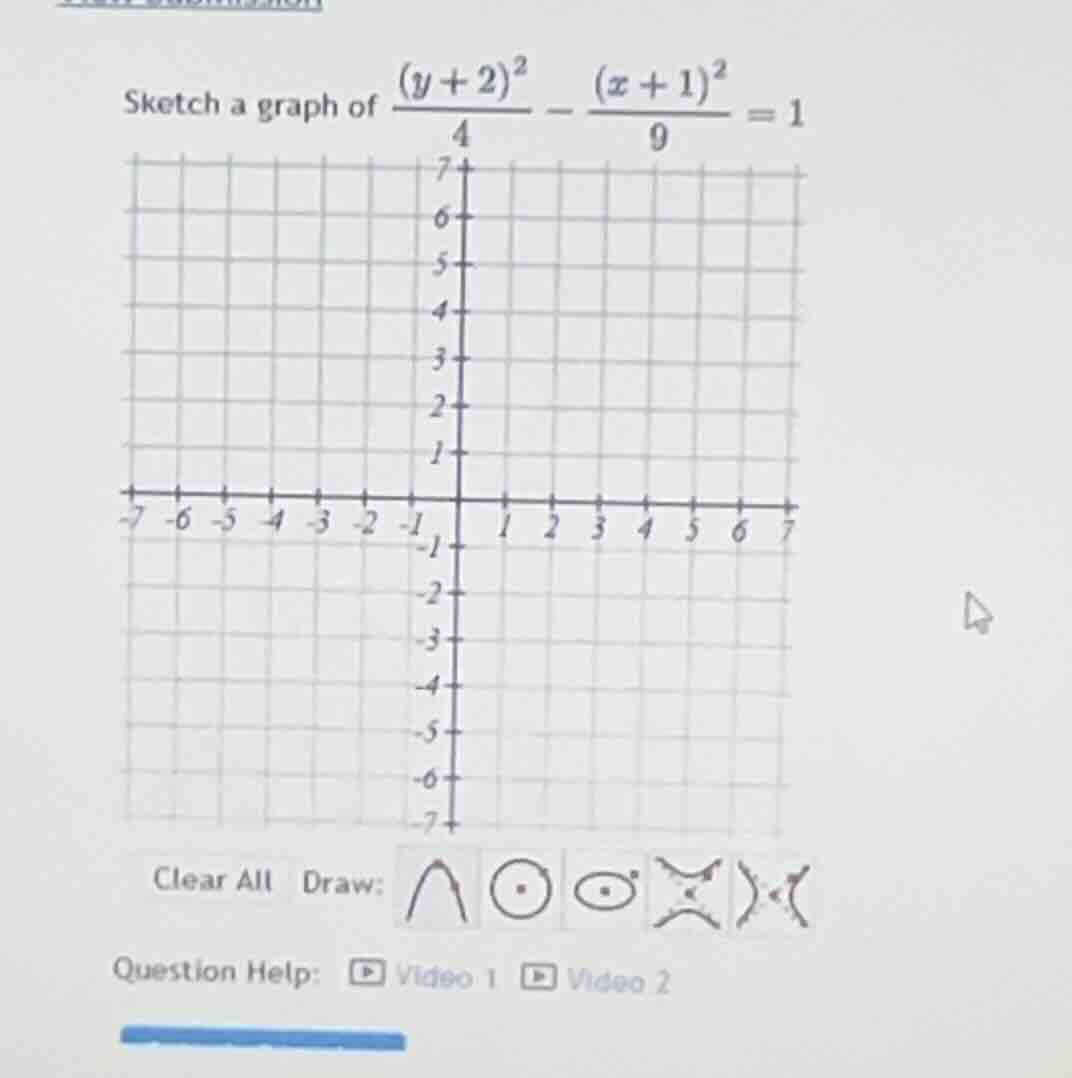
sketch a graph of \frac{(y + 2)^2}{4} - \frac{(x + 1)^2}{9} = 1
Step1: Identify the conic section type
$$\frac{(y+2)^2}{4} - \frac{(x+1)^2}{9} = 1$$
This equation represents a vertical hyperbola.
Step2: Determine the center coordinates
$$(h, k) = (-1, -2)$$
Step3: Find semi-axes values
$$a^2 = 4 \implies a = 2$$
$$b^2 = 9 \implies b = 3$$
Step4: Locate the vertices
$$(h, k \pm a) \implies (-1, 0) \text{ and } (-1, -4)$$
Step5: Determine the asymptotes
$$y - k = \pm \frac{a}{b}(x - h) \implies y + 2 = \pm \frac{2}{3}(x + 1)$$

Snap & solve any problem in the app
Get step-by-step solutions on Sovi AI
Photo-based solutions with guided steps
Explore more problems and detailed explanations
The graph is a vertical hyperbola with:
- Center: \((-1, -2)\)
- Vertices: \((-1, 0)\) and \((-1, -4)\)
- Asymptotes: \(y + 2 = \pm \frac{2}{3}(x + 1)\)
To sketch it, plot the center at \((-1, -2)\), move up and down by \(2\) units to place the vertices at \((-1, 0)\) and \((-1, -4)\), move left and right from the center by \(3\) units to define the central box, draw the asymptotes through the corners of the box, and sketch the two branches of the hyperbola opening vertically (upward and downward) from the vertices.