Sovi.AI - AI Math Tutor

Scan to solve math questions

QUESTION IMAGE

simplify the expression. write your answer as a complex number. (2sqrt{…

Question

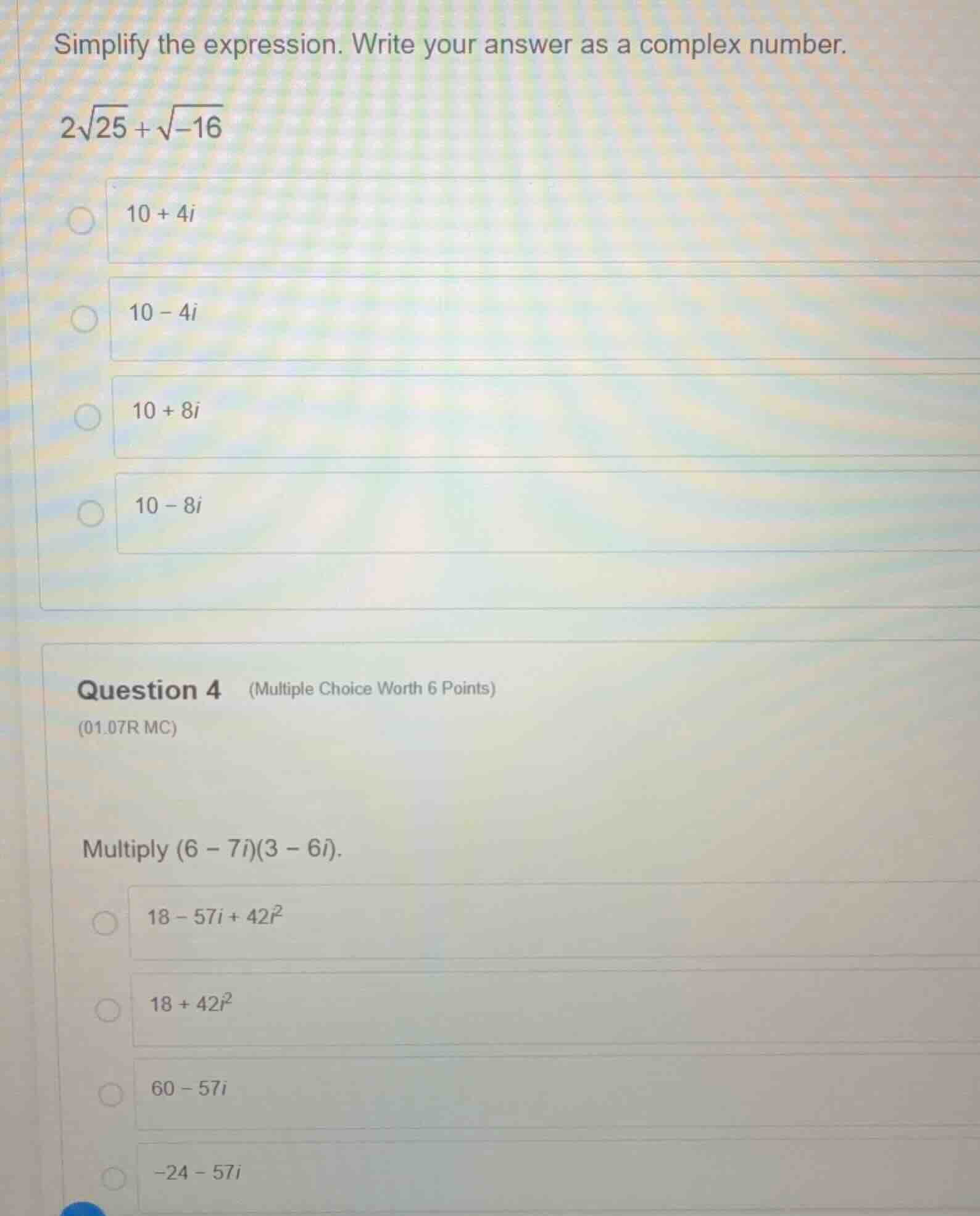
simplify the expression. write your answer as a complex number.

(2sqrt{25} + sqrt{-16})

  • (10 + 4i)
  • (10 - 4i)
  • (10 + 8i)
  • (10 - 8i)

question 4 (multiple choice worth 6 points)
(01.07r mc)

multiply ((6 - 7i)(3 - 6i)).

  • (18 - 57i + 42i^2)
  • (18 + 42i^2)
  • (60 - 57i)
  • (-24 - 57i)

Explanation:

Response

<pre_analysis>
{
"quality": "clear",
"question_count": 2,
"skills_matched": [
"step_cot",
"multiple_choice_formatter",
"explain_then_answer",
"tutor"
],
"needs_drawing": false,
"concepts_used": [],
"new_concepts": [
"Complex Numbers",
"Imaginary Unit",
"Multiplying Complex Numbers"
],
"current_concepts": [
"Complex Numbers",
"Imaginary Unit",
"Multiplying Complex Numbers"
]
}
</pre_analysis>

<reasoning>

Simplify the first expression

We simplify the real and imaginary parts of the expression \(2\sqrt{25} + \sqrt{-16}\).
First, evaluate the real square root:
\[2\sqrt{25} = 2 \cdot 5 = 10\]
Next, evaluate the imaginary square root using \(i = \sqrt{-1}\):
\[\sqrt{-16} = \sqrt{16} \cdot \sqrt{-1} = 4i\]
Combining these terms gives:
\[10 + 4i\]

Multiply the second expression

We expand the product of two complex numbers \((6 - 7i)(3 - 6i)\) using the FOIL method.
Multiply the terms:
\[(6)(3) + (6)(-6i) + (-7i)(3) + (-7i)(-6i)\]
\[= 18 - 36i - 21i + 42i^2\]

Simplify the product

Combine the imaginary terms and substitute \(i^2 = -1\):
\[18 - 57i + 42(-1)\]
\[= 18 - 57i - 42\]
Combine the real constants:
\[(18 - 42) - 57i = -24 - 57i\]
</reasoning>

<answer>

Question 1

<mcq-correct>(A) \(10 + 4i\)</mcq-correct>
<mcq-option>(B) \(10 - 4i\)</mcq-option>
<mcq-option>(C) \(10 + 8i\)</mcq-option>
<mcq-option>(D) \(10 - 8i\)</mcq-option>

Question 2

<mcq-option>(A) \(18 - 57i + 42i^2\)</mcq-option>
<mcq-option>(B) \(18 + 42i^2\)</mcq-option>
<mcq-option>(C) \(60 - 57i\)</mcq-option>
<mcq-correct>(D) \(-24 - 57i\)</mcq-correct>
</answer>

<post_analysis>
{
"subject": "Mathematics",
"question_type": "Multiple Choice",
"knowledge_point": [
"Mathematics",
"Algebra",
"Complex Numbers"
]
}
</post_analysis>

Answer:

<pre_analysis>
{
"quality": "clear",
"question_count": 2,
"skills_matched": [
"step_cot",
"multiple_choice_formatter",
"explain_then_answer",
"tutor"
],
"needs_drawing": false,
"concepts_used": [],
"new_concepts": [
"Complex Numbers",
"Imaginary Unit",
"Multiplying Complex Numbers"
],
"current_concepts": [
"Complex Numbers",
"Imaginary Unit",
"Multiplying Complex Numbers"
]
}
</pre_analysis>

<reasoning>

Simplify the first expression

We simplify the real and imaginary parts of the expression \(2\sqrt{25} + \sqrt{-16}\).
First, evaluate the real square root:
\[2\sqrt{25} = 2 \cdot 5 = 10\]
Next, evaluate the imaginary square root using \(i = \sqrt{-1}\):
\[\sqrt{-16} = \sqrt{16} \cdot \sqrt{-1} = 4i\]
Combining these terms gives:
\[10 + 4i\]

Multiply the second expression

We expand the product of two complex numbers \((6 - 7i)(3 - 6i)\) using the FOIL method.
Multiply the terms:
\[(6)(3) + (6)(-6i) + (-7i)(3) + (-7i)(-6i)\]
\[= 18 - 36i - 21i + 42i^2\]

Simplify the product

Combine the imaginary terms and substitute \(i^2 = -1\):
\[18 - 57i + 42(-1)\]
\[= 18 - 57i - 42\]
Combine the real constants:
\[(18 - 42) - 57i = -24 - 57i\]
</reasoning>

<answer>

Question 1

<mcq-correct>(A) \(10 + 4i\)</mcq-correct>
<mcq-option>(B) \(10 - 4i\)</mcq-option>
<mcq-option>(C) \(10 + 8i\)</mcq-option>
<mcq-option>(D) \(10 - 8i\)</mcq-option>

Question 2

<mcq-option>(A) \(18 - 57i + 42i^2\)</mcq-option>
<mcq-option>(B) \(18 + 42i^2\)</mcq-option>
<mcq-option>(C) \(60 - 57i\)</mcq-option>
<mcq-correct>(D) \(-24 - 57i\)</mcq-correct>
</answer>

<post_analysis>
{
"subject": "Mathematics",
"question_type": "Multiple Choice",
"knowledge_point": [
"Mathematics",
"Algebra",
"Complex Numbers"
]
}
</post_analysis>