QUESTION IMAGE
Question
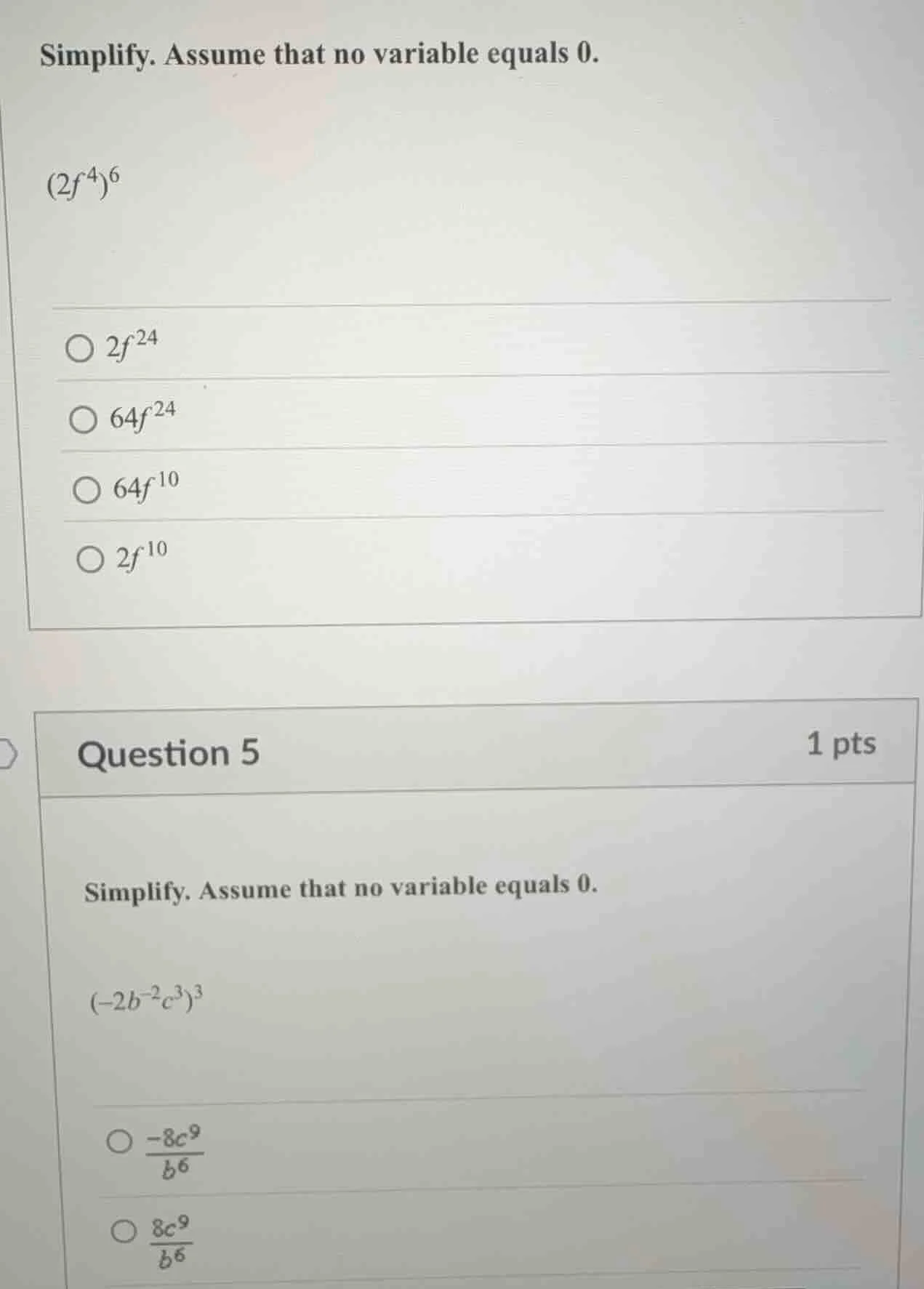
simplify. assume that no variable equals 0.
$(2f^{4})^{6}$
$\bigcirc\\ 2f^{24}$
$\bigcirc\\ 64f^{24}$
$\bigcirc\\ 64f^{10}$
$\bigcirc\\ 2f^{10}$
question 5 1 pts
simplify. assume that no variable equals 0.
$(-2b^{-2}c^{3})^{3}$
$\bigcirc\\ \frac{-8c^{9}}{b^{6}}$
$\bigcirc\\ \frac{8c^{9}}{b^{6}}$
First Problem: Simplify \((2f^{4})^{6}\)
Step 1: Apply the power of a product rule
The power of a product rule states that \((ab)^n = a^n b^n\). So, we can apply this to \((2f^{4})^{6}\) as follows:
\((2f^{4})^{6}=2^{6}\times(f^{4})^{6}\)
Step 2: Calculate \(2^{6}\) and simplify \((f^{4})^{6}\)
We know that \(2^{6}=64\). For the variable part, we use the power of a power rule \((a^m)^n=a^{m\times n}\). So, \((f^{4})^{6}=f^{4\times6}=f^{24}\)
Step 3: Combine the results
Putting it all together, we get \(2^{6}\times(f^{4})^{6}=64\times f^{24} = 64f^{24}\)
Step 1: Apply the power of a product rule
Using the power of a product rule \((ab)^n = a^n b^n\) (extended to three factors), we have:
\((-2b^{-2}c^{3})^{3}=(-2)^{3}\times(b^{-2})^{3}\times(c^{3})^{3}\)
Step 2: Calculate each part
- Calculate \((-2)^{3}\): \((-2)^{3}=(-2)\times(-2)\times(-2)= - 8\)
- For the \(b\) - term, use the power of a power rule \((a^m)^n=a^{m\times n}\): \((b^{-2})^{3}=b^{-2\times3}=b^{-6}\)
- For the \(c\) - term, use the power of a power rule: \((c^{3})^{3}=c^{3\times3}=c^{9}\)
Step 3: Combine the results and simplify negative exponents
Combining the results, we get \((-2)^{3}\times(b^{-2})^{3}\times(c^{3})^{3}=-8\times b^{-6}\times c^{9}\)
We know that \(a^{-n}=\frac{1}{a^{n}}\), so \(b^{-6}=\frac{1}{b^{6}}\). Then, \(-8\times b^{-6}\times c^{9}=-8\times\frac{1}{b^{6}}\times c^{9}=\frac{-8c^{9}}{b^{6}}\)

Snap & solve any problem in the app
Get step-by-step solutions on Sovi AI
Photo-based solutions with guided steps
Explore more problems and detailed explanations
\(64f^{24}\) (corresponding to the option "64\(f^{24}\)")