QUESTION IMAGE
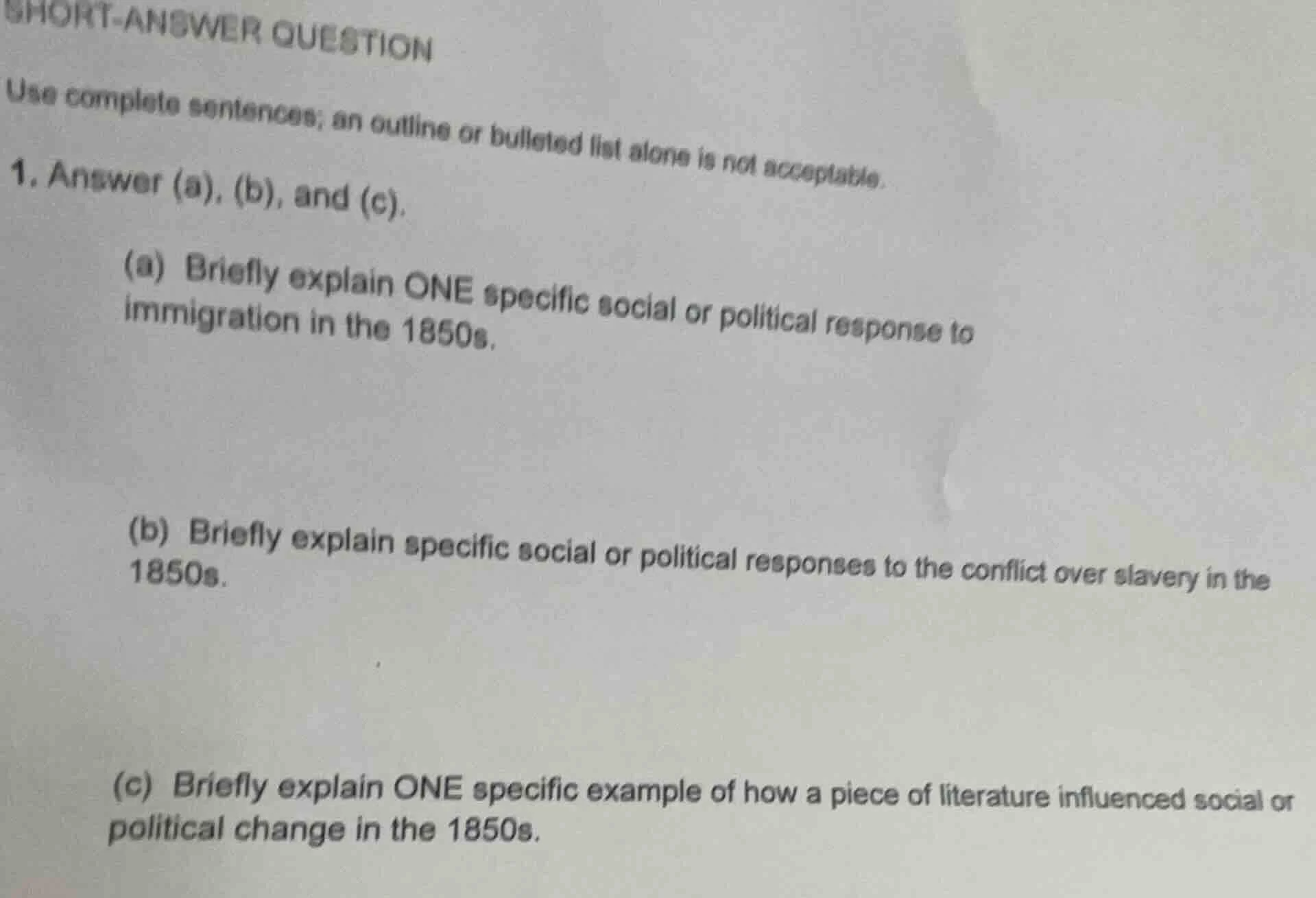
Question
short-answer question
use complete sentences; an outline or bulleted list alone is not acceptable.
- answer (a), (b), and (c).
(a) briefly explain one specific social or political response to immigration in the 1850s.
(b) briefly explain specific social or political responses to the conflict over slavery in the 1850s.
(c) briefly explain one specific example of how a piece of literature influenced social or political change in the 1850s.
(a)
One political response to immigration in the 1850s was the rise of the Know - Nothing Party (also known as the American Party). This party was nativist, opposing immigration, especially from Catholic countries like Ireland and Germany. They believed that these immigrants were a threat to American culture and political institutions. Politically, they sought to restrict immigration through laws, such as requiring a longer naturalization period for immigrants to become citizens and holding public office.
In the 1850s, the conflict over slavery led to several social and political responses. Politically, the Kansas - Nebraska Act of 1854 was a significant response. It allowed the territories of Kansas and Nebraska to decide on the issue of slavery through popular sovereignty. This led to a rush of pro - slavery and anti - slavery settlers into Kansas, resulting in violent conflicts known as "Bleeding Kansas". Socially, the abolitionist movement grew stronger. Abolitionist societies, like the American Anti - Slavery Society, increased their efforts to spread the message of the immorality of slavery through lectures, publications, and helping slaves escape via the Underground Railroad.
Harriet Beecher Stowe's "Uncle Tom's Cabin" (1852) was a piece of literature that influenced social and political change in the 1850s. The novel vividly depicted the harsh realities of slavery, including the separation of slave families and the brutal treatment of slaves. It had a profound impact on public opinion in the North, increasing anti - slavery sentiment. Politically, it heightened tensions between the North and the South, as Southerners felt it misrepresented slavery, and it contributed to the growing divide that would eventually lead to the Civil War. Socially, it inspired more people to join the abolitionist cause and increased support for the Underground Railroad.

Snap & solve any problem in the app
Get step-by-step solutions on Sovi AI
Photo-based solutions with guided steps
Explore more problems and detailed explanations
One political response to immigration in the 1850s was the rise of the Know - Nothing Party, which was nativist and sought to restrict immigration through political actions like advocating for longer naturalization periods for immigrants.