QUESTION IMAGE
Question
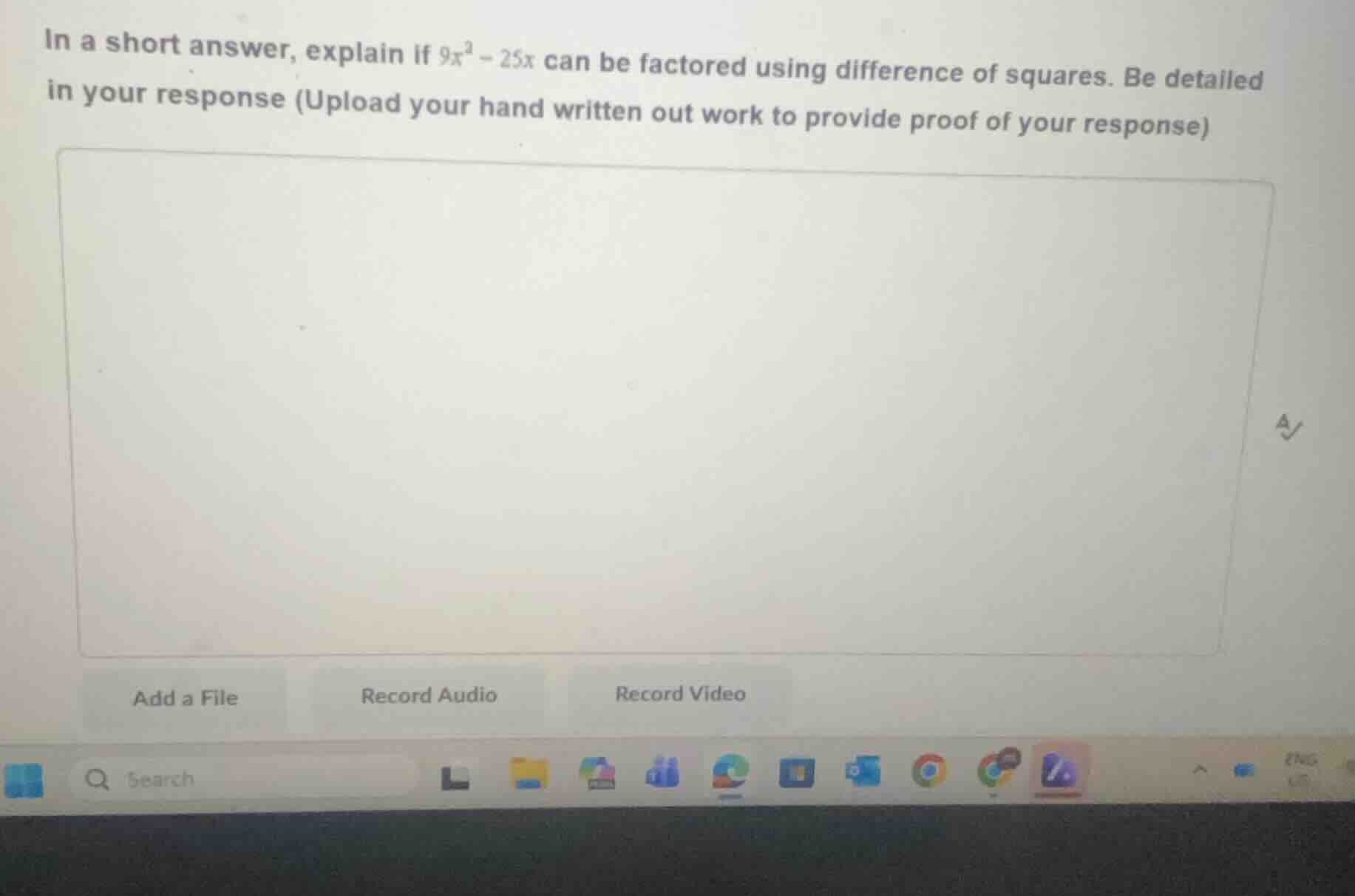
in a short answer, explain if \\(9x^2 - 25x\\) can be factored using difference of squares. be detailed in your response (upload your hand written out work to provide proof of your response)
Identify the expression and the factoring method
The given expression is \(9x^2 - 25x\). We need to determine if it can be factored using the Difference of Squares method.
Define the difference of squares pattern
A binomial can be factored as a difference of squares if it fits the algebraic form:
This requires both terms to be perfect squares separated by a subtraction sign.
Analyze the terms of the expression
Let's examine each term in \(9x^2 - 25x\):
- The first term is \(9x^2\), which is a perfect square: \((3x)^2\).
- The subtraction sign is present between the terms.
- The second term is \(25x\). While the coefficient \(25\) is a perfect square \((5^2)\), the variable part \(x\) is raised to the power of \(1\), which is not an even power and thus not a perfect square.
Determine factorability using other methods
Using Polynomial Factoring, we can factor the expression by finding the greatest common factor (GCF) instead:
This confirms that the expression is factorable, but not by using the difference of squares.

Snap & solve any problem in the app
Get step-by-step solutions on Sovi AI
Photo-based solutions with guided steps
Explore more problems and detailed explanations
No, the expression \(9x^2 - 25x\) cannot be factored using the difference of squares.
While the first term \(9x^2\) is a perfect square \((3x)^2\) and there is a subtraction sign, the second term \(25x\) is not a perfect square because the variable \(x\) has an exponent of \(1\). To be factored as a difference of squares, both terms must be perfect squares (e.g., \(9x^2 - 25\)). Instead, this expression can only be factored by taking out the greatest common factor, \(x\), resulting in \(x(9x - 25)\).