QUESTION IMAGE
Question
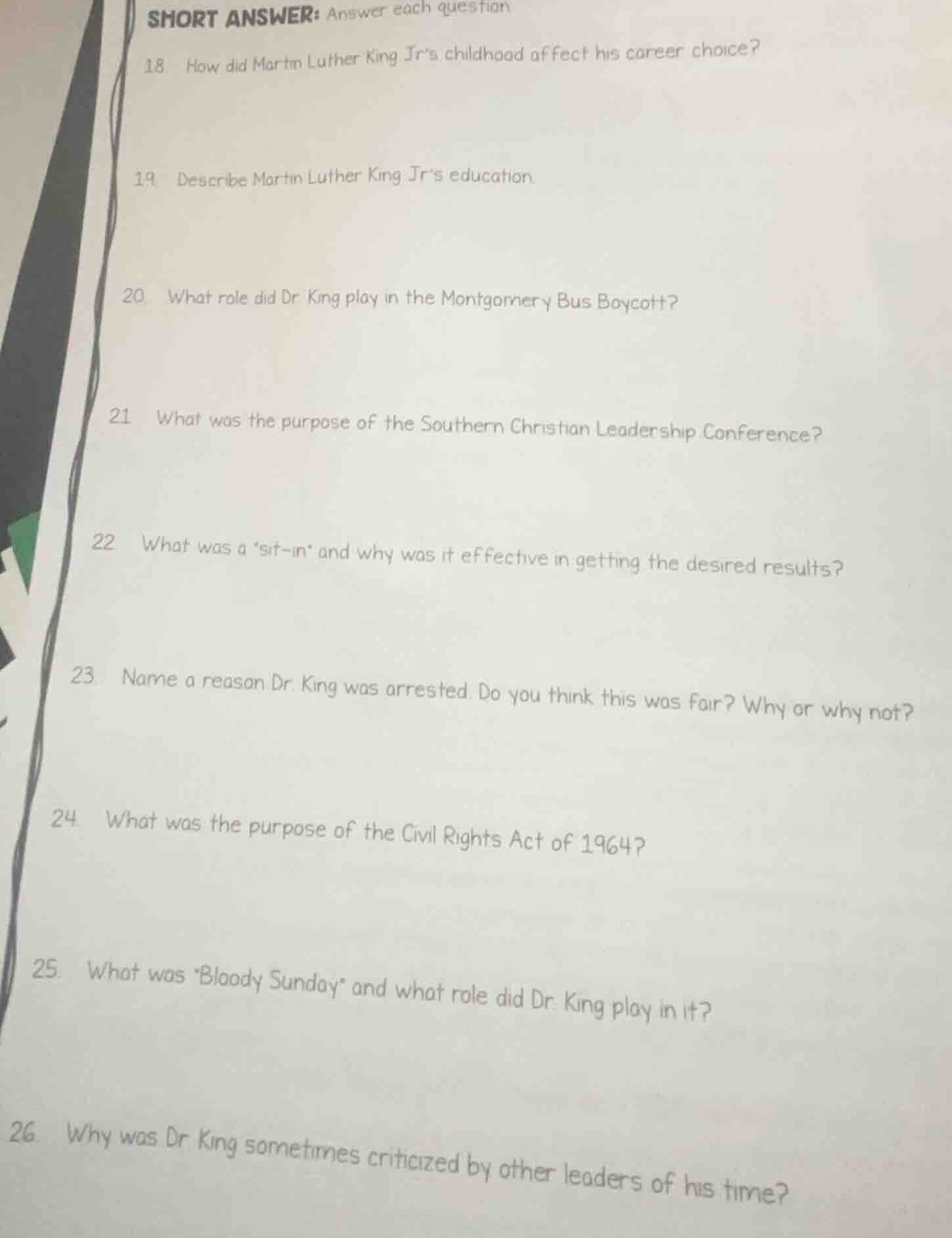
short answer: answer each question
- how did martin luther king jrs childhood affect his career choice?
- describe martin luther king jrs education.
- what role did dr king play in the montgomery bus boycott?
- what was the purpose of the southern christian leadership conference?
- what was a sit - in and why was it effective in getting the desired results?
- name a reason dr. king was arrested. do you think this was fair? why or why not?
- what was the purpose of the civil rights act of 1964?
- what was bloody sunday and what role did dr. king play in it?
- why was dr king sometimes criticized by other leaders of his time?
Brief Explanations
- Q18: Experienced racial segregation firsthand; his family's Baptist faith and emphasis on justice led him to become a minister and civil rights leader, using moral and religious frameworks to fight inequality.
- Q19: Earned a B.A. from Morehouse College (1948); a B.D. from Crozer Theological Seminary (1951); a Ph.D. in Systematic Theology from Boston University (1955), focusing on ethics and nonviolence.
- Q20: Elected the boycott's spokesperson; organized nonviolent protests, articulated its moral goals, and helped sustain the 381-day boycott, which led to the end of bus segregation.
- Q21: To coordinate nonviolent direct action campaigns across the South, fight racial segregation and discrimination, and train activists in nonviolent resistance.
- Q22: A nonviolent protest where activists occupied segregated public spaces (e.g., lunch counters). It was effective because it disrupted business, exposed injustice to the public, and relied on moral pressure to force policy change.
- Q23: He was arrested for leading a nonviolent protest against segregation in Birmingham, Alabama. This was unfair: the arrest targeted peaceful activism against unjust, discriminatory laws, violating his right to free speech and assembly.
- Q24: To prohibit discrimination based on race, color, religion, sex, or national origin in employment, public accommodations, education, and federally funded programs.
- Q25: A 1965 event where state troopers violently attacked peaceful voting rights marchers on the Edmund Pettus Bridge in Selma, Alabama. King helped organize the march, condemned the violence nationally, and used the incident to push for the Voting Rights Act.
- Q26: More militant civil rights leaders criticized his commitment to nonviolence as too slow and ineffective; some white leaders opposed his challenge to segregation and racial inequality.

Snap & solve any problem in the app
Get step-by-step solutions on Sovi AI
Photo-based solutions with guided steps
Explore more problems and detailed explanations
- His firsthand experience of racial segregation, combined with his family's Baptist focus on justice, led him to become a minister and civil rights leader, using nonviolent, moral frameworks to fight inequality.
- He earned a B.A. from Morehouse College (1948), a B.D. from Crozer Theological Seminary (1951), and a Ph.D. in Systematic Theology from Boston University (1955), with studies in nonviolence and ethics.
- He was the boycott's spokesperson, organized nonviolent efforts, sustained the 381-day protest, and helped secure the end of bus segregation.
- To coordinate nonviolent direct action against racial segregation/discrimination across the South and train activists in nonviolent resistance.
- A nonviolent protest where activists occupied segregated public spaces. It disrupted businesses, exposed injustice publicly, and used moral pressure to force policy change.
- He was arrested for leading a Birmingham segregation protest. This was unfair: it targeted peaceful activism against unjust, discriminatory laws, violating his free speech and assembly rights.
- To ban discrimination based on race, color, religion, sex, or national origin in employment, public spaces, education, and federal programs.
- It was the 1965 violent attack on Selma voting rights marchers by state troopers. King organized the march, condemned the violence nationally, and leveraged the incident to pass the Voting Rights Act.
- Militant civil rights leaders saw his nonviolence as too slow; white leaders opposed his challenge to segregation and racial inequality.