QUESTION IMAGE
Question
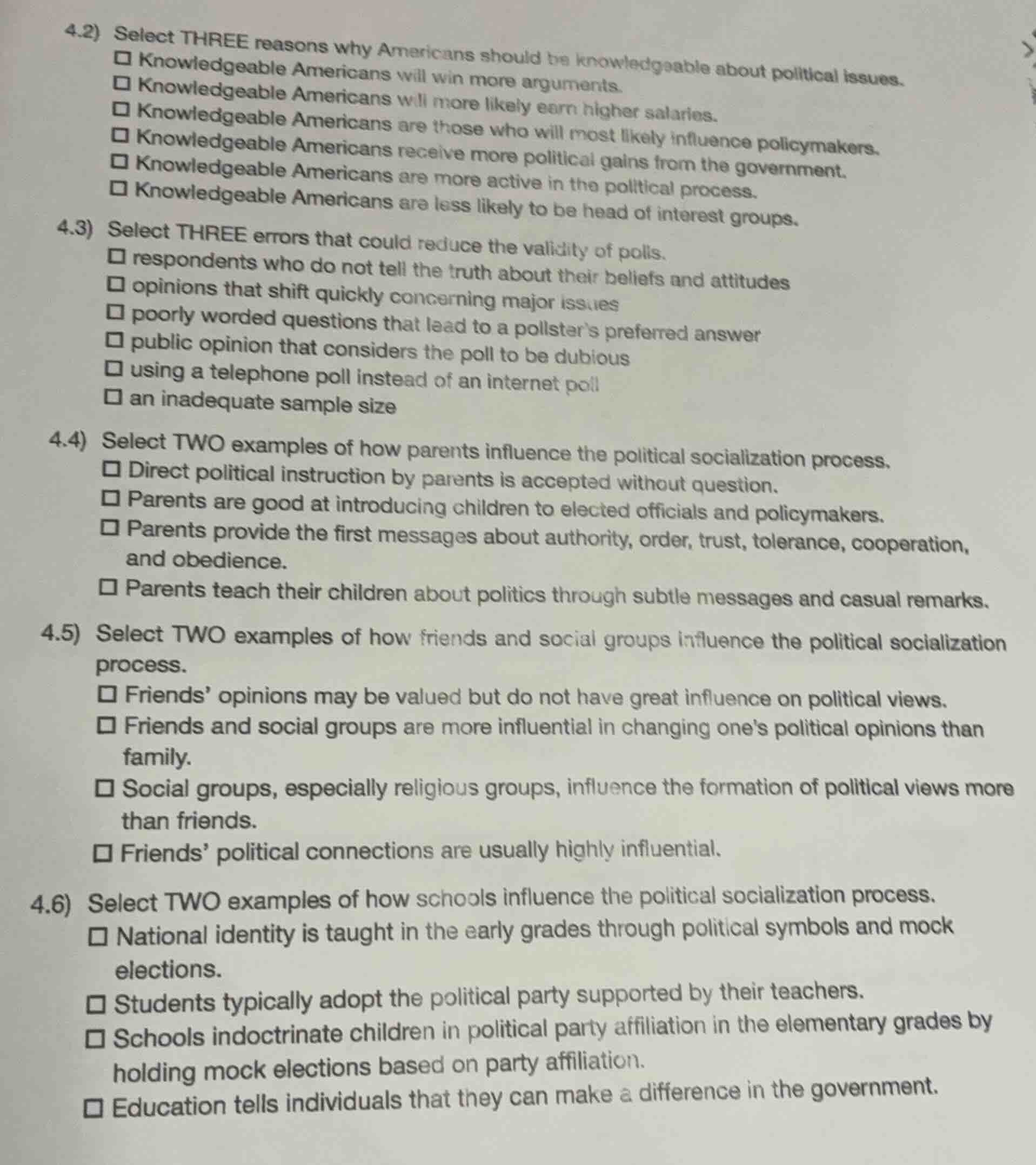
4.2) select three reasons why americans should be knowledgeable about political issues.
□ knowledgeable americans will win more arguments.
□ knowledgeable americans will more likely earn higher salaries.
□ knowledgeable americans are those who will most likely influence policymakers.
□ knowledgeable americans receive more political gains from the government.
□ knowledgeable americans are more active in the political process.
□ knowledgeable americans are less likely to be head of interest groups.
4.3) select three errors that could reduce the validity of polls.
□ respondents who do not tell the truth about their beliefs and attitudes
□ opinions that shift quickly concerning major issues
□ poorly worded questions that lead to a pollster’s preferred answer
□ public opinion that considers the poll to be dubious
□ using a telephone poll instead of an internet poll
□ an inadequate sample size
4.4) select two examples of how parents influence the political socialization process.
□ direct political instruction by parents is accepted without question.
□ parents are good at introducing children to elected officials and policymakers.
□ parents provide the first messages about authority, order, trust, tolerance, cooperation, and obedience.
□ parents teach their children about politics through subtle messages and casual remarks.
4.5) select two examples of how friends and social groups influence the political socialization process.
□ friends’ opinions may be valued but do not have great influence on political views.
□ friends and social groups are more influential in changing one’s political opinions than family.
□ social groups, especially religious groups, influence the formation of political views more than friends.
□ friends’ political connections are usually highly influential.
4.6) select two examples of how schools influence the political socialization process.
□ national identity is taught in the early grades through political symbols and mock elections.
□ students typically adopt the political party supported by their teachers.
□ schools indoctrinate children in political party affiliation in the elementary grades by holding mock elections based on party affiliation.
□ education tells individuals that they can make a difference in the government.
4.2
- Political knowledge helps citizens engage with policymakers, participate in politics, and advocate for their interests effectively. Winning arguments and salary links are not core civic reasons, and being less likely to lead interest groups is incorrect.
4.3
- Poll validity depends on truthful responses, clear questions, and adequate sampling. Shifting opinions are a public attitude issue, poll type (phone vs internet) doesn't inherently reduce validity, and public doubt is a reaction, not an error in the poll itself.
4.4
- Parents shape early political socialization through foundational values and subtle, everyday political messaging. Blind acceptance of instruction and direct introductions to officials are not typical primary influences.
4.5
- Peer and group influence often outweigh family in changing political views, and religious groups are strong shapers of political beliefs. Friends' opinions and connections are not the most impactful factors here.
4.6
- Schools build national identity through symbolic learning and teach civic efficacy. They do not indoctrinate party affiliation, and students do not typically adopt teachers' party loyalties as a standard influence.

Snap & solve any problem in the app
Get step-by-step solutions on Sovi AI
Photo-based solutions with guided steps
Explore more problems and detailed explanations
4.2
- Knowledgeable Americans are those who will most likely influence policymakers.
- Knowledgeable Americans are more active in the political process.
- Knowledgeable Americans receive more political gains from the government.
4.3
- respondents who do not tell the truth about their beliefs and attitudes
- poorly worded questions that lead to a pollster's preferred answer
- an inadequate sample size
4.4
- Parents provide the first messages about authority, order, trust, tolerance, cooperation, and obedience.
- Parents teach their children about politics through subtle messages and casual remarks.
4.5
- Friends and social groups are more influential in changing one's political opinions than family.
- Social groups, especially religious groups, influence the formation of political views more than friends.
4.6
- National identity is taught in the early grades through political symbols and mock elections.
- Education tells individuals that they can make a difference in the government.