QUESTION IMAGE
Question
select the correct answer.
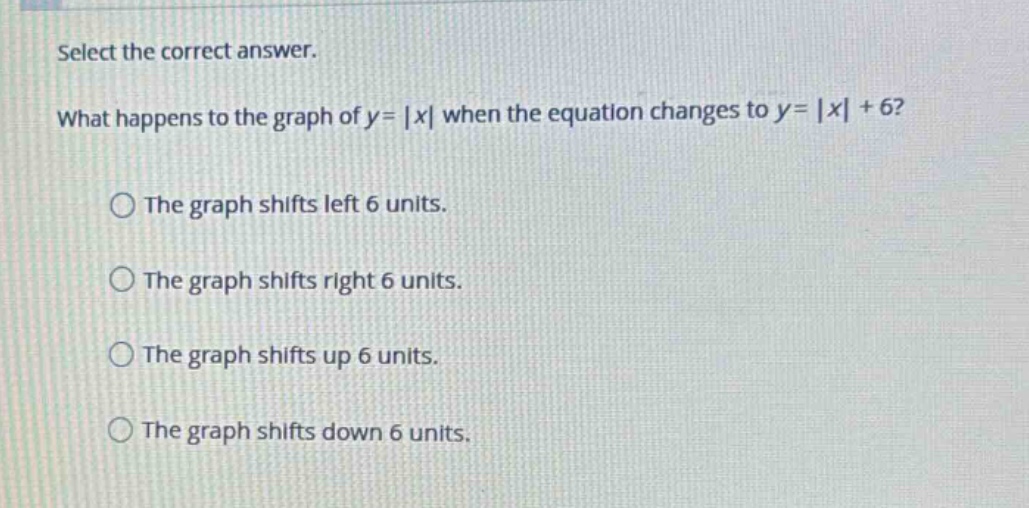
what happens to the graph of (y = |x|) when the equation changes to (y = |x| + 6)?
- the graph shifts left 6 units.
- the graph shifts right 6 units.
- the graph shifts up 6 units.
- the graph shifts down 6 units.
🆕 New Concept Discovered: Transforming Functions
Moving a graph up, down, left, or right.
Step 1: Analyze the change in the equation
We start with the parent function:
The equation is changed to:
This change adds a constant value of \( 6 \) to the output of the original function.
Step 2: Determine the geometric effect
When we add a positive constant \( k \) to the outside of a function, \( y = f(x) + k \), every \( y \)-coordinate increases by \( k \) units.
- Adding \( 6 \) to the outside of the function shifts the entire graph vertically upward by \( 6 \) units.
- If it were inside the absolute value, like \( y = |x + 6| \), it would shift the graph horizontally.
Therefore, the graph of \( y = |x| + 6 \) is the graph of \( y = |x| \) shifted up \( 6 \) units.

Snap & solve any problem in the app
Get step-by-step solutions on Sovi AI
Photo-based solutions with guided steps
Explore more problems and detailed explanations
The graph shifts up 6 units.