QUESTION IMAGE
Question
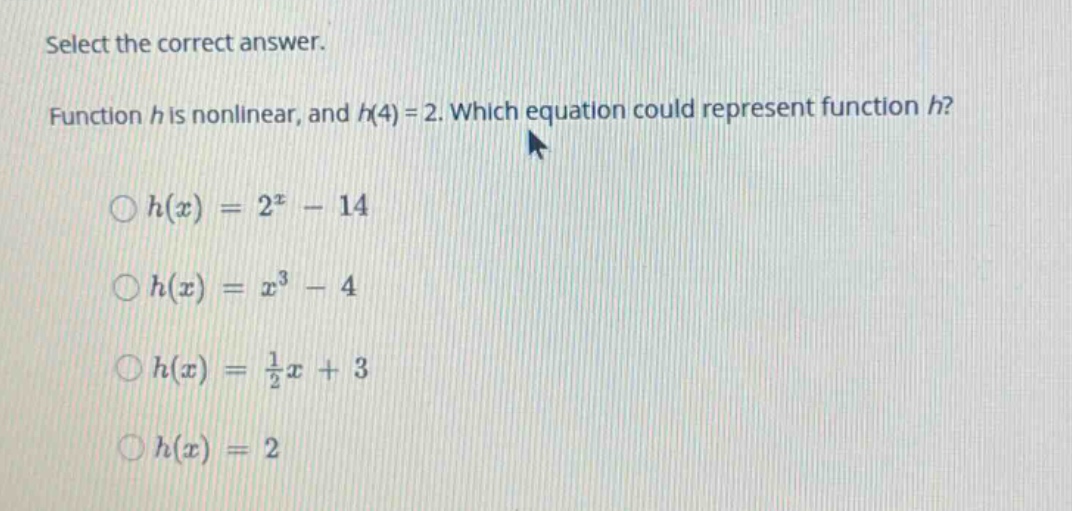
select the correct answer.
function (h) is nonlinear, and (h(4) = 2). which equation could represent function (h)?
(h(x) = 2^x - 14)
(h(x) = x^3 - 4)
(h(x) = \frac{1}{2}x + 3)
(h(x) = 2)
⚡ Using: understanding linear functions · 🆕 New: Evaluating Nonlinear Functions
Evaluating functions and identifying linear vs. nonlinear relationships.
Step 1: Understand the conditions
We are looking for a function \( h(x) \) that satisfies two conditions:
- The function must be nonlinear (its graph is not a straight line; the variable \( x \) is not raised to the power of 1 in a simple linear form \( mx + b \)).
- The function must satisfy \( h(4) = 2 \) (when we substitute \( x = 4 \), the output must be \( 2 \)).
Step 2: Identify and eliminate linear functions
Let's look at the options to see which ones are linear:
- \( h(x) = \frac{1}{2}x + 3 \) is a linear function because it is in the slope-intercept form \( y = mx + b \).
- \( h(x) = 2 \) is a constant function, which is also a type of linear function (a horizontal line).
This leaves us with two nonlinear options to test:
- \( h(x) = 2^x - 14 \) (exponential)
- \( h(x) = x^3 - 4 \) (cubic)
Step 3: Test the remaining options with \( x = 4 \)
Let's evaluate \( h(4) \) for both nonlinear options:
Option 1: \( h(x) = 2^x - 14 \)
This matches our condition \( h(4) = 2 \).
Option 2: \( h(x) = x^3 - 4 \)
This does not equal \( 2 \).

Snap & solve any problem in the app
Get step-by-step solutions on Sovi AI
Photo-based solutions with guided steps
Explore more problems and detailed explanations
\( h(x) = 2^x - 14 \)