QUESTION IMAGE
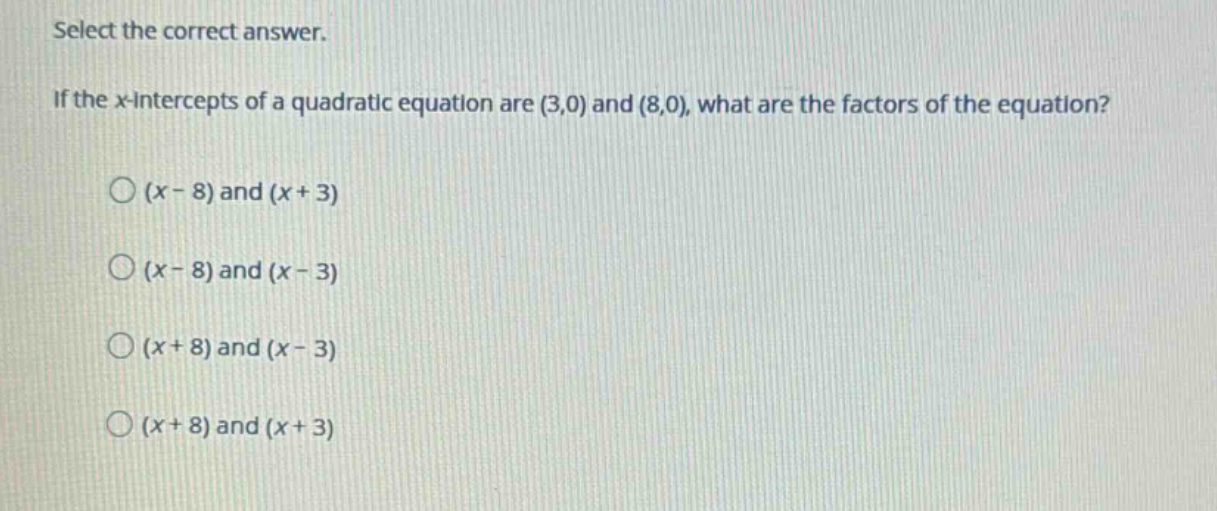
Question
select the correct answer.
if the (x)-intercepts of a quadratic equation are ((3,0)) and ((8,0)), what are the factors of the equation?
(a) ((x - 8)) and ((x + 3))
(b) ((x - 8)) and ((x - 3))
(c) ((x + 8)) and ((x - 3))
(d) ((x + 8)) and ((x + 3))
🆕 New Concept Discovered: Factor Theorem for Quadratics
Connecting graph intercepts directly to algebraic factors.
Step 1: Identify the roots
The \(x\)-intercepts of a quadratic equation represent its roots (or zeros). This is where the graph crosses the \(x\)-axis and the value of the equation is zero:
Step 2: Apply the Factor Theorem
The Factor Theorem states that if \(x = r\) is a root of a polynomial, then \((x - r)\) is a factor of that polynomial.
To find the factors, we rewrite each root equation so that it equals zero:
- For \(x = 3\), subtract \(3\) from both sides:
- For \(x = 8\), subtract \(8\) from both sides:
Therefore, the factors of the quadratic equation are \((x - 3)\) and \((x - 8)\).

Snap & solve any problem in the app
Get step-by-step solutions on Sovi AI
Photo-based solutions with guided steps
Explore more problems and detailed explanations
\((x - 8)\) and \((x - 3)\)