QUESTION IMAGE
Question
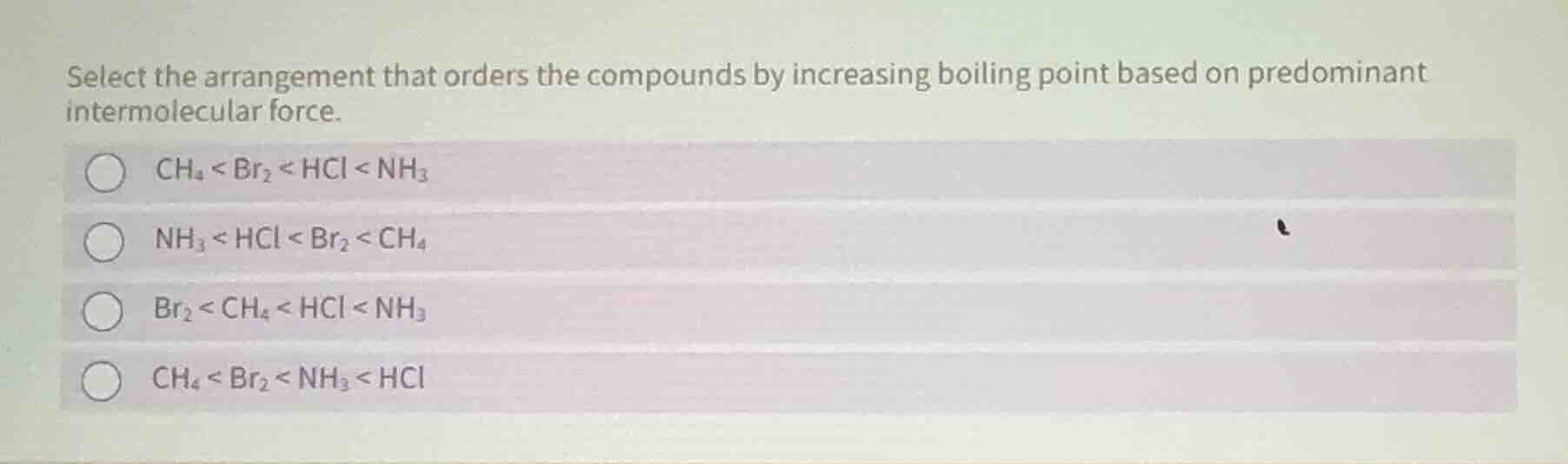
select the arrangement that orders the compounds by increasing boiling point based on predominant intermolecular force.
\\(\text{ch}_4 < \text{br}_2 < \text{hcl} < \text{nh}_3\\)
\\(\text{nh}_3 < \text{hcl} < \text{br}_2 < \text{ch}_4\\)
\\(\text{br}_2 < \text{ch}_4 < \text{hcl} < \text{nh}_3\\)
\\(\text{ch}_4 < \text{br}_2 < \text{nh}_3 < \text{hcl}\\)
Identify predominant intermolecular forces
- \(\text{CH}_4\): Nonpolar molecule, predominant force is London dispersion forces (weakest).
- \(\text{Br}_2\): Nonpolar molecule, predominant force is London dispersion forces. However, because it has a much larger electron cloud than \(\text{CH}_4\), its dispersion forces are stronger, but the question specifies ordering "based on predominant intermolecular force" type.
- \(\text{HCl}\): Polar molecule, predominant force is dipole-dipole interactions (moderate).
- \(\text{NH}_3\): Polar molecule with \(\text{N-H}\) bonds, predominant force is hydrogen bonding (strongest).
Order by increasing strength of predominant force
- London dispersion forces < Dipole-dipole interactions < Hydrogen bonding.
- This yields the sequence: \(\text{CH}_4 < \text{Br}_2 < \text{HCl} < \text{NH}_3\).

Snap & solve any problem in the app
Get step-by-step solutions on Sovi AI
Photo-based solutions with guided steps
Explore more problems and detailed explanations
- (A) \(\text{CH}_4 < \text{Br}_2 < \text{HCl} < \text{NH}_3\) (Correct answer)
- (B) \(\text{NH}_3 < \text{HCl} < \text{Br}_2 < \text{CH}_4\)
- (C) \(\text{Br}_2 < \text{CH}_4 < \text{HCl} < \text{NH}_3\)
- (D) \(\text{CH}_4 < \text{Br}_2 < \text{NH}_3 < \text{HCl}\)