Sovi.AI - AI Math Tutor

Scan to solve math questions

QUESTION IMAGE

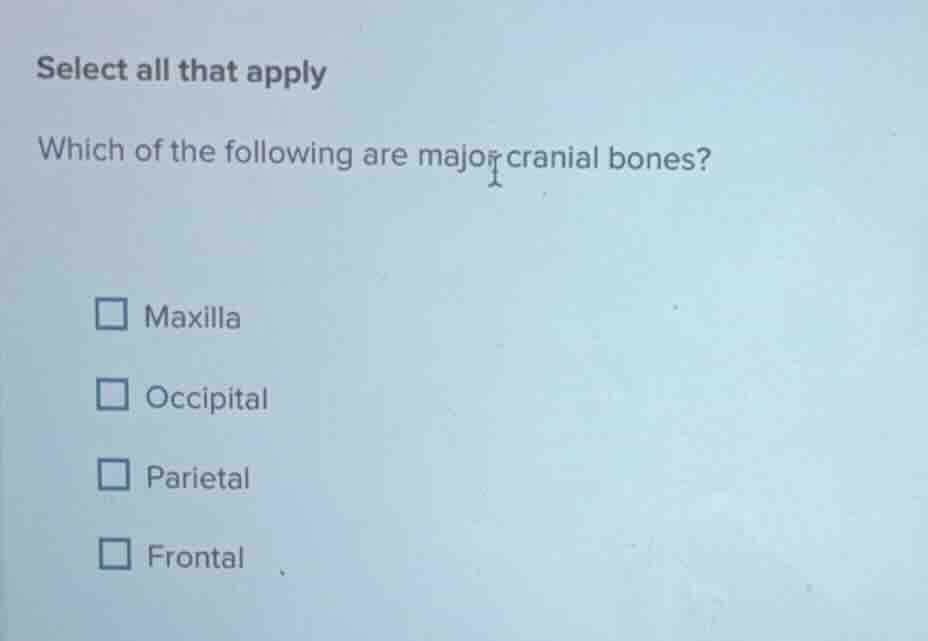
select all that apply which of the following are major cranial bones? m…

Question

select all that apply

which of the following are major cranial bones?

maxilla
occipital
parietal
frontal

Explanation:

Response

<pre_analysis>
{
"quality": "clear",
"question_count": 1,
"skills_matched": [
"direct_cot",
"multiple_choice_formatter",
"explain_then_answer",
"tutor",
"mastery_adaptive_brevity"
],
"needs_drawing": false,
"concepts_used": [
"Skull Bone Classification"
],
"new_concepts": [],
"current_concepts": [
"Skull Bone Classification",
"Skeletal Anatomy",
"Bone Identification"
]
}
</pre_analysis>

<reasoning>

Distinguish cranial and facial bones

Using the Skull Bone Classification knowledge point

The skull is divided into two main categories of bones:

  • Cranial bones: These bones enclose and protect the brain. The eight cranial bones are the frontal, parietal (2), temporal (2), occipital, sphenoid, and ethmoid bones.
  • Facial bones: These bones form the structure of the face. Examples include the maxilla, mandible, zygomatic, nasal, lacrimal, palatine, inferior nasal conchae, and vomer.

Evaluate the given options

  • Maxilla: This is a facial bone that forms the upper jaw, not a cranial bone.
  • Occipital: This is a cranial bone located at the back and base of the skull.
  • Parietal: These are cranial bones forming the sides and roof of the cranium.
  • Frontal: This is a cranial bone forming the forehead.

</reasoning>

<answer>
<mcq-option>Maxilla</mcq-option>
<mcq-correct>Occipital</mcq-correct>
<mcq-correct>Parietal</mcq-correct>
<mcq-correct>Frontal</mcq-correct>
</answer>

<post_analysis>
{
"subject": "Natural Science",
"question_type": "Multiple Choice",
"knowledge_point": [
"Natural Science",
"Anatomy",
"Skull Bone Classification"
]
}
</post_analysis>

Answer:

<pre_analysis>
{
"quality": "clear",
"question_count": 1,
"skills_matched": [
"direct_cot",
"multiple_choice_formatter",
"explain_then_answer",
"tutor",
"mastery_adaptive_brevity"
],
"needs_drawing": false,
"concepts_used": [
"Skull Bone Classification"
],
"new_concepts": [],
"current_concepts": [
"Skull Bone Classification",
"Skeletal Anatomy",
"Bone Identification"
]
}
</pre_analysis>

<reasoning>

Distinguish cranial and facial bones

Using the Skull Bone Classification knowledge point

The skull is divided into two main categories of bones:

  • Cranial bones: These bones enclose and protect the brain. The eight cranial bones are the frontal, parietal (2), temporal (2), occipital, sphenoid, and ethmoid bones.
  • Facial bones: These bones form the structure of the face. Examples include the maxilla, mandible, zygomatic, nasal, lacrimal, palatine, inferior nasal conchae, and vomer.

Evaluate the given options

  • Maxilla: This is a facial bone that forms the upper jaw, not a cranial bone.
  • Occipital: This is a cranial bone located at the back and base of the skull.
  • Parietal: These are cranial bones forming the sides and roof of the cranium.
  • Frontal: This is a cranial bone forming the forehead.

</reasoning>

<answer>
<mcq-option>Maxilla</mcq-option>
<mcq-correct>Occipital</mcq-correct>
<mcq-correct>Parietal</mcq-correct>
<mcq-correct>Frontal</mcq-correct>
</answer>

<post_analysis>
{
"subject": "Natural Science",
"question_type": "Multiple Choice",
"knowledge_point": [
"Natural Science",
"Anatomy",
"Skull Bone Classification"
]
}
</post_analysis>