QUESTION IMAGE
Question
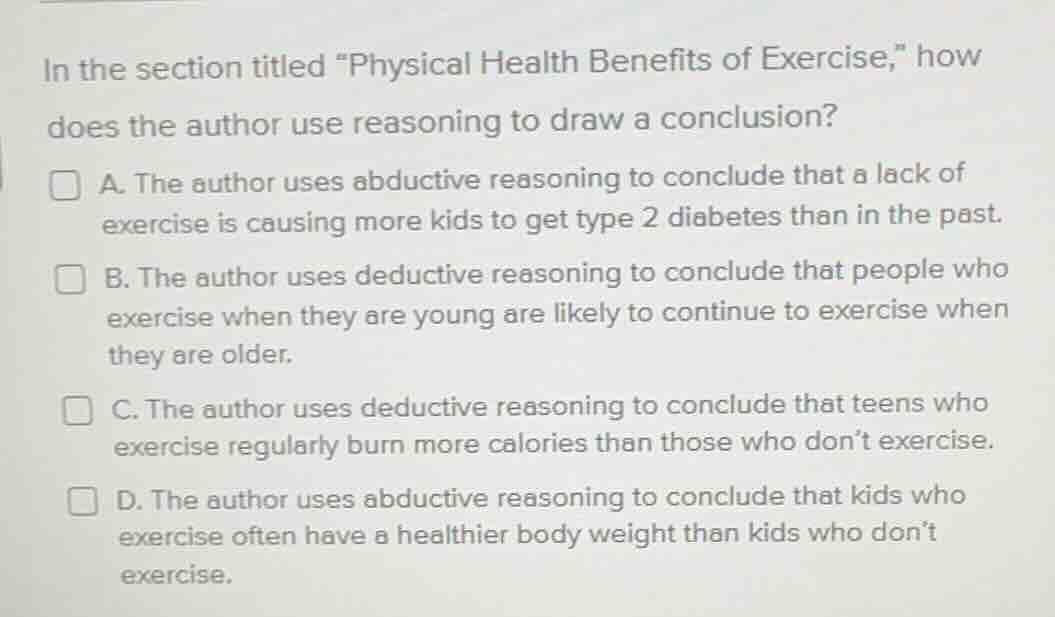
in the section titled \physical health benefits of exercise,\ how does the author use reasoning to draw a conclusion?
a. the author uses abductive reasoning to conclude that a lack of exercise is causing more kids to get type 2 diabetes than in the past.
b. the author uses deductive reasoning to conclude that people who exercise when they are young are likely to continue to exercise when they are older.
c. the author uses deductive reasoning to conclude that teens who exercise regularly burn more calories than those who dont exercise.
d. the author uses abductive reasoning to conclude that kids who exercise often have a healthier body weight than kids who dont exercise.
To solve this, we analyze each option:
- Option A: Abductive reasoning involves inferring the best explanation, but the link between lack of exercise and kids' type 2 diabetes increase is not a typical abductive conclusion here.
- Option B: Deductive reasoning starts from general principles to a specific conclusion. The idea that young exercisers continue as older is not a deductive conclusion from general exercise principles.
- Option C: Deductive reasoning can be applied here. The general principle is that exercise burns calories, so from that, we deduce that teens who exercise regularly (apply the general principle) burn more calories than non - exercisers (specific conclusion).
- Option D: Abductive reasoning is about the best explanation, and the conclusion about kids' body weight and exercise is more of an inductive or deductive type rather than abductive.

Snap & solve any problem in the app
Get step-by-step solutions on Sovi AI
Photo-based solutions with guided steps
Explore more problems and detailed explanations
C. The author uses deductive reasoning to conclude that teens who exercise regularly burn more calories than those who don't exercise.