QUESTION IMAGE
Question
section a: 25 marks
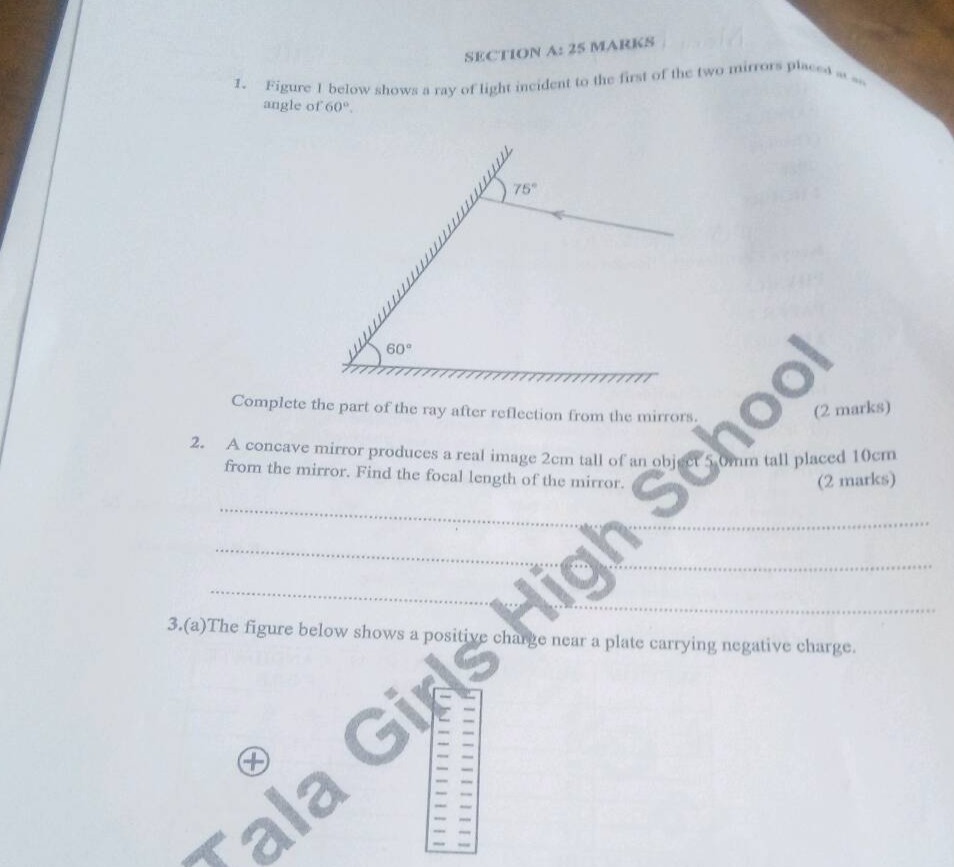
- figure 1 below shows a ray of light incident to the first of the two mirrors placed at an angle of \\(60^{\circ}\\).
complete the part of the ray after reflection from the mirrors. (2 marks)
- a concave mirror produces a real image \\(2\text{ cm}\\) tall of an object \\(5.0\text{ mm}\\) tall placed \\(10\text{ cm}\\) from the mirror. find the focal length of the mirror. (2 marks)
- (a) the figure below shows a positive charge near a plate carrying negative charge.
🆕 New Concept Discovered: Reflection of Light and Mirror Equations
How light bounces off mirrors and forms images.
Step 1: Solve Question 1 (Ray Reflection)
To complete the path of the ray after reflection from the mirrors, we apply the law of reflection: the angle of incidence equals the angle of reflection (\(i = r\)), measured relative to the normal (a line perpendicular to the mirror surface).
- First Reflection (at the inclined mirror):
- The incoming ray makes an angle of \(75^\circ\) with the surface of the inclined mirror.
- The normal is perpendicular (\(90^\circ\)) to the mirror surface. Therefore, the angle of incidence is:
$$
i_1 = 90^\circ - 75^\circ = 15^\circ
$$
- By the law of reflection, the angle of reflection is also:
$$
r_1 = 15^\circ
$$
- This means the reflected ray also makes an angle of \(75^\circ\) with the inclined mirror surface as it travels downwards towards the horizontal mirror.
- Path between the mirrors:
- The two mirrors meet at an angle of \(60^\circ\).
- The reflected ray, the inclined mirror, and the horizontal mirror form a triangle.
- The interior angles of this triangle must add up to \(180^\circ\).
- We know two of the angles: the angle between the mirrors (\(60^\circ\)) and the angle the reflected ray makes with the inclined mirror (\(75^\circ\)).
- Let \(\theta\) be the angle the ray makes with the horizontal mirror surface:
$$
60^\circ + 75^\circ + \theta = 180^\circ
$$
$$
135^\circ + \theta = 180^\circ \implies \theta = 45^\circ
$$
- Second Reflection (at the horizontal mirror):
- The ray strikes the horizontal mirror at an angle of \(45^\circ\) to the surface.
- The angle of incidence at this second mirror is:
$$
i_2 = 90^\circ - 45^\circ = 45^\circ
$$
- The angle of reflection is:
$$
r_2 = 45^\circ
$$
- The ray reflects off the horizontal mirror, traveling upwards and to the right, making an angle of \(45^\circ\) with the horizontal mirror surface.
---
Step 2: Solve Question 2 (Concave Mirror Focal Length)
We are given:
- Height of the object, \(h_o = 5.0\text{ mm} = 0.5\text{ cm}\)
- Height of the real image, \(h_i = -2\text{ cm}\) (negative because real images formed by concave mirrors are inverted)
- Object distance, \(u = 10\text{ cm}\) (always positive in real-is-positive sign convention)
- Find the image distance (\(v\)) using magnification (\(m\)):
- Magnification is defined as:
$$
m = \frac{\text{Height of image}}{\text{Height of object}} = \frac{h_i}{h_o} = \frac{2\text{ cm}}{0.5\text{ cm}} = 4
$$
- Magnification is also related to distances by:
$$
m = \frac{v}{u} \implies 4 = \frac{v}{10\text{ cm}} \implies v = 40\text{ cm}
$$
- Since the image is real, \(v\) is positive (\(v = 40\text{ cm}\)).
- Calculate the focal length (\(f\)) using the mirror formula:
- The mirror formula is:
$$
\frac{1}{f} = \frac{1}{u} + \frac{1}{v}
$$
- Substitute the values:
$$
\frac{1}{f} = \frac{1}{10} + \frac{1}{40}
$$
$$
\frac{1}{f} = \frac{4 + 1}{40} = \frac{5}{40} = \frac{1}{8}
$$
$$
f = 8\text{ cm}
$$
---
Step 3: Solve Question 3(a) (Electric Field Lines)
We need to show the electric field pattern between a positive point charge and a negatively charged plate.
- Direction of Electric Field Lines:
- Electric field lines always start on positive charges and end on negative charges.
- Therefore, the lines will…

Snap & solve any problem in the app
Get step-by-step solutions on Sovi AI
Photo-based solutions with guided steps
Explore more problems and detailed explanations
1. Ray Diagram Completion
- First mirror reflection: Draw the reflected ray leaving the inclined mirror at an angle of \(75^\circ\) to the mirror surface (or \(15^\circ\) to the normal).
- Path to second mirror: Draw this ray hitting the bottom horizontal mirror. The interior angle of the triangle formed at the bottom mirror surface is \(45^\circ\).
- Second mirror reflection: Draw the ray reflecting off the bottom mirror at an angle of \(45^\circ\) to the horizontal surface (or \(45^\circ\) to the normal), directed upwards and to the right.
2. Focal Length of the Concave Mirror
- Focal length: \(8\text{ cm}\)
3. Electric Field Pattern
- Draw continuous curved lines starting from the positive point charge \((+)\) and ending on the negative plate.
- Ensure the lines have arrows pointing away from the positive charge and towards the negative plate, meeting the plate's surface at right angles (\(90^\circ\)).