QUESTION IMAGE
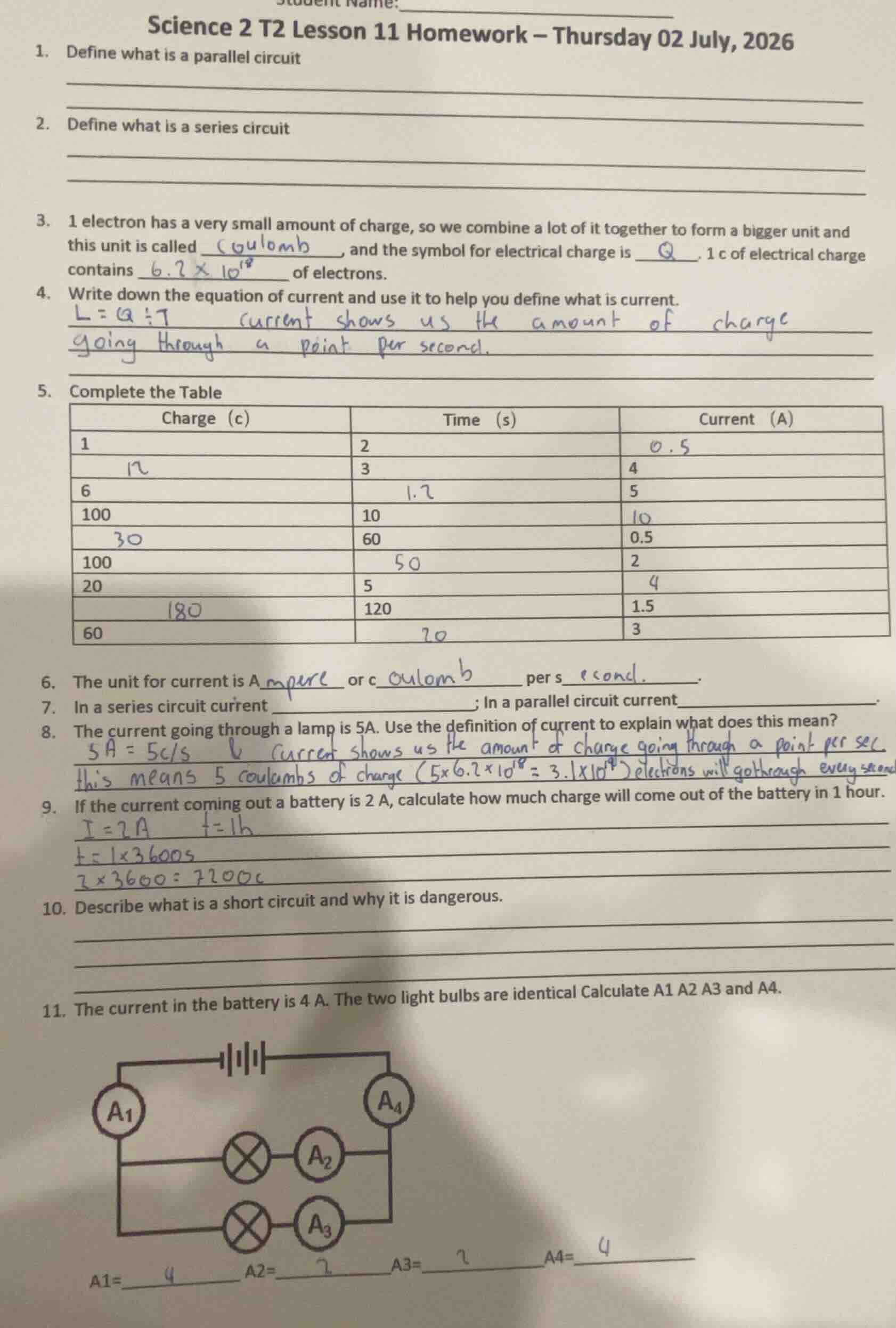
Question
science 2 t2 lesson 11 homework - thursday 02 july, 2026
- define what is a parallel circuit
- define what is a series circuit
- 1 electron has a very small amount of charge, so we combine a lot of it together to form a bigger unit and this unit is called coulomb, and the symbol for electrical charge is q. 1 c of electrical charge contains \\(6.2 \times 10^{18}\\) of electrons.
- write down the equation of current and use it to help you define what is current.
\\(i = q \div t\\) current shows us the amount of charge going through a point per second.
- complete the table
\
- the unit for current is ampere or coulomb per second.
- in a series circuit current \underline{\quad\quad\quad\quad\quad\quad\quad\quad\quad\quad\quad\quad}; in a parallel circuit current \underline{\quad\quad\quad\quad\quad\quad\quad\quad\quad\quad\quad\quad}.
- the current going through a lamp is 5a. use the definition of current to explain what does this mean?
5a = 5c/s. current shows us the amount of charge going through a point per sec. this means 5 coulombs of charge (\\(5 \times 6.2 \times 10^{18} = 3.1 \times 10^{19}\\)) electrons will go through every second.
- if the current coming out a battery is 2 a, calculate how much charge will come out of the battery in 1 hour.
\\(i = 2\text{ a}\\), \\(t = 1\text{ h}\\)
\\(t = 1 \times 3600\text{ s}\\)
\\(2 \times 3600 = 7200\text{ c}\\)
- describe what is a short circuit and why it is dangerous.
- the current in the battery is 4 a. the two light bulbs are identical. calculate a1 a2 a3 and a4.
Step1: Define parallel circuit
A parallel circuit has multiple paths for current.
Step2: Define series circuit
A series circuit has a single path for current.
Step3: Fill in blanks for charge unit
Charge unit is Coulomb (\(Q\)), containing \(6.24 \times 10^{18}\) electrons.
Step4: Write current equation and definition
\(I = \frac{Q}{t}\); current is charge flow rate.
Step5: Calculate missing values in table
Use \(Q = I \times t\), \(I = \frac{Q}{t}\), and \(t = \frac{Q}{I}\).
Step6: Identify current units
Current units are Ampere or coulomb per second.
Step7: Describe current behavior
Series current is constant; parallel current splits.
Step8: Explain 5A current meaning
\(5\text{ A}\) means \(5\text{ C}\) of charge passes per second.
Step9: Calculate charge in 1 hour
Step10: Define short circuit danger
Low-resistance path causes high current and fire hazards.
Step11: Calculate currents in circuit
Total current splits equally between two identical parallel branches.

Snap & solve any problem in the app
Get step-by-step solutions on Sovi AI
Photo-based solutions with guided steps
Explore more problems and detailed explanations
- A parallel circuit is an electrical circuit with multiple paths for current to flow, where components are connected across the same common points.
- A series circuit is an electrical circuit with only one path for current to flow, where components are connected end-to-end in a single loop.
- Coulomb; \(Q\); \(6.24 \times 10^{18}\)
- \(I = \frac{Q}{t}\); Current is the rate of flow of electric charge past a point in a circuit.
- See the completed table below:
| Charge (C) | Time (s) | Current (A) |
|---|---|---|
| 12 | 3 | 4 |
| 6 | 1.2 | 5 |
| 100 | 10 | 10 |
| 30 | 60 | 0.5 |
| 100 | 50 | 2 |
| 20 | 5 | 4 |
| 180 | 120 | 1.5 |
| 60 | 20 | 3 |
- Ampere; coulomb per second
- is the same at all points; splits along the parallel branches
- A current of \(5\text{ A}\) means that \(5\text{ coulombs}\) of electrical charge pass through a point in the lamp every second.
- \(7200\text{ C}\)
- A short circuit is an unintended low-resistance path that bypasses the main load in a circuit. It is dangerous because it causes an excessively high current to flow, which can lead to overheating, melting wires, or electrical fires.
- \(\text{A}_1 = 4\text{ A}\), \(\text{A}_2 = 2\text{ A}\), \(\text{A}_3 = 2\text{ A}\), \(\text{A}_4 = 4\text{ A}\)