QUESTION IMAGE
Question
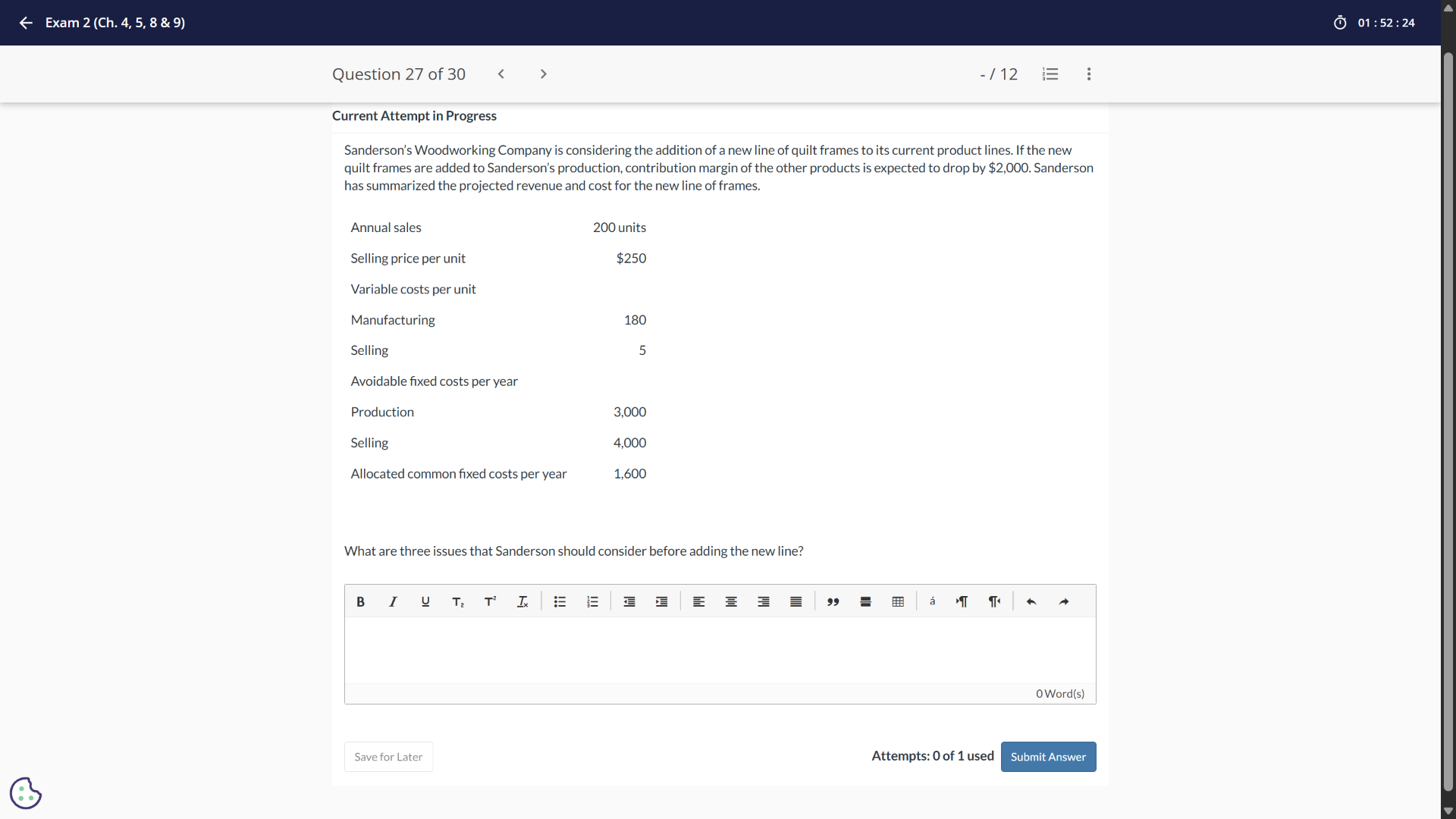
sandersons woodworking company is considering the addition of a new line of quilt frames to its current product lines. if the new quilt frames are added to sandersons production, contribution margin of the other products is expected to drop by \\$2,000. sanderson has summarized the projected revenue and cost for the new line of frames.
annual sales: 200 units
selling price per unit: \\$250
variable costs per unit
manufacturing: 180
selling: 5
avoidable fixed costs per year
production: 3,000
selling: 4,000
allocated common fixed costs per year: 1,600
what are three issues that sanderson should consider before adding the new line?
🆕 New Concept Discovered: Relevant Cost Analysis
Evaluating financial and qualitative factors for business decisions.
Step 1: Calculate the financial impact (Net Incremental Benefit)
To evaluate the decision, we first calculate the net financial impact of adding the new product line. We only include relevant revenues and costs (revenues and costs that change as a direct result of this decision).
- Incremental Revenue:
- Incremental Variable Costs:
- Manufacturing: \(200 \text{ units} \times \$180 = \$36,000\)
- Selling: \(200 \text{ units} \times \$5 = \$1,000\)
- Total Variable Costs: \(\$36,000 + \$1,000 = \$37,000\)
- Incremental Contribution Margin from New Line:
- Avoidable Fixed Costs:
- Production: \(\$3,000\)
- Selling: \(\$4,000\)
- Total Avoidable Fixed Costs: \(\$7,000\)
(Note: Allocated common fixed costs of \$1,600 are irrelevant because they will continue to exist whether the new line is added or not.)
- Opportunity Cost (Lost Contribution Margin of other products):
- Net Incremental Profit:
Since the net incremental profit is positive (\(\$4,000\)), the addition is financially viable.
---
Step 2: Identify qualitative and strategic issues
Beyond the direct financial calculation, a business must consider qualitative, strategic, and capacity-related factors before introducing a new product line. Three key issues include:
- Impact on Existing Products (Cannibalization and Synergies):
The introduction of the quilt frames is expected to reduce the contribution margin of existing products by \(\$2,000\). Sanderson must consider whether this negative impact (cannibalization) might increase over time, or if there are potential positive synergies (e.g., customers buying other woodworking products because they bought a quilt frame).
- Capacity and Resource Constraints:
Sanderson must evaluate whether the company has the excess production capacity (such as machine hours, factory space, and skilled labor) to produce 200 units of quilt frames annually without disrupting the production of existing, potentially more profitable lines.
- Irrelevance of Allocated Common Fixed Costs:
The \(\$1,600\) in allocated common fixed costs will not change regardless of the decision. Sanderson must ensure these costs are ignored during the decision-making process, as including them might lead to an incorrect conclusion about the profitability of the new line.

Snap & solve any problem in the app
Get step-by-step solutions on Sovi AI
Photo-based solutions with guided steps
Explore more problems and detailed explanations
Three issues that Sanderson should consider before adding the new line are:
- Financial Viability and Opportunity Cost: The new product line is projected to generate a positive net incremental profit of \(\$4,000\) per year (Incremental Contribution Margin of \(\$13,000\) minus Avoidable Fixed Costs of \(\$7,000\) and the \(\$2,000\) lost contribution margin from existing products).
- Product Cannibalization: The addition of the quilt frames will cause a \(\$2,000\) drop in the contribution margin of other products, which must be weighed against the benefits of the new line.
- Capacity and Resource Allocation: Whether the factory has the physical space, labor, and machine capacity to produce the additional 200 units without negatively impacting the production efficiency of other product lines.