QUESTION IMAGE
Question
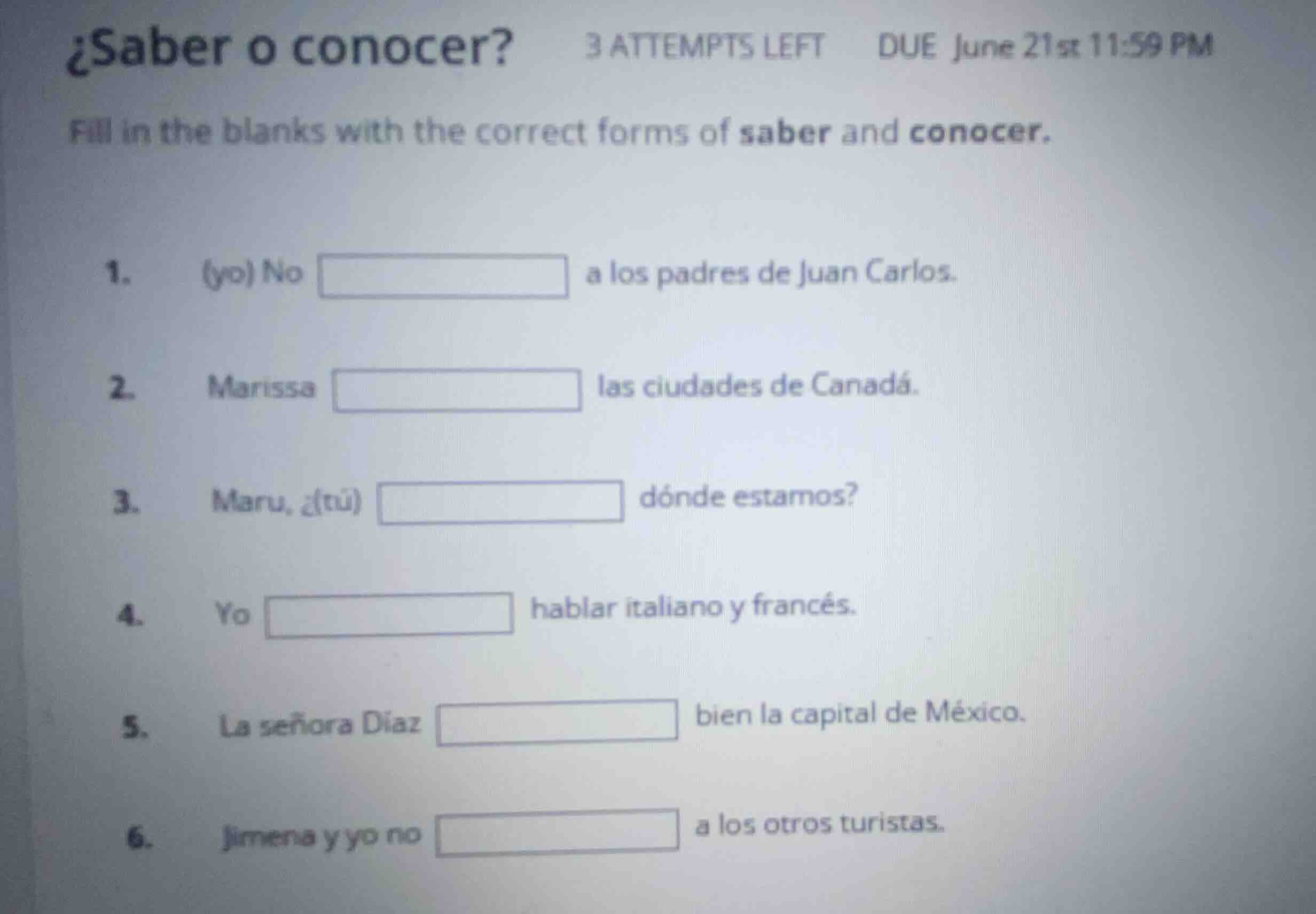
¿saber o conocer?
fill in the blanks with the correct forms of saber and conocer.
- (yo) no a los padres de juan carlos.
- marissa las ciudades de canadá.
- maru, ¿(tú) dónde estamos?
- yo hablar italiano y francés.
- la señora díaz bien la capital de méxico.
- jimena y yo no a los otros turistas.
Analyze questions 1 and 2
- The direct object is "a los padres de Juan Carlos" (people). We use conocer for knowing people. The subject is yo, so the conjugated form is conozco.
- The direct object is "las ciudades de Canadá" (places). We use conocer for being familiar with places. The subject is Marissa (third-person singular), so the conjugated form is conoce.
Analyze questions 3 and 4
- The clause is "dónde estamos?" (question word/information). We use saber for facts or information. The subject is tú, so the conjugated form is sabes.
- The following word is "hablar" (infinitive verb representing a skill). We use saber + infinitive for knowing how to do something. The subject is Yo, so the conjugated form is sé.
Analyze questions 5 and 6
- The direct object is "la capital de México" (a place). We use conocer for being familiar with places. The subject is La señora Díaz (third-person singular), so the conjugated form is conoce.
- The direct object is "a los otros turistas" (people). We use conocer for knowing people. The subject is Jimena y yo (we / nosotros), so the conjugated form is conocemos.

Snap & solve any problem in the app
Get step-by-step solutions on Sovi AI
Photo-based solutions with guided steps
Explore more problems and detailed explanations
Question 1
(yo) No <blank>conozco</blank> a los padres de Juan Carlos.
Question 2
Marissa <blank>conoce</blank> las ciudades de Canadá.
Question 3
Maru, ¿(tú) <blank>sabes</blank> dónde estamos?
Question 4
Yo <blank>sé</blank> hablar italiano y francés.
Question 5
La señora Díaz <blank>conoce</blank> bien la capital de México.
Question 6
Jimena y yo no <blank>conocemos</blank> a los otros turistas.