QUESTION IMAGE
Question
romeo
what shall i swear by?
juliet
do not swear at all;
or, if thou wilt, swear by thy gracious self,
which is the god of my idolatry,
120and ill believe thee.
romeo
if my hearts dear love—
juliet
well, do not swear: although i joy in thee,
i have no joy of this contract to - night:
it is too rash, too unadvised, too sudden;
too like the lightning, which doth cease to be
ere one can say it lightens. sweet, good night!
this bud of love, by summers ripening breath,
may prove a beauteous flower when next we meet.
good night, good night! as sweet repose and rest
130come to thy heart as that within my breast!
romeo
o, wilt thou leave me so unsatisfied?
juliet
what satisfaction canst thou have to - night?
romeo
the exchange of thy loves faithful vow for mine.
juliet
i gave thee mine before thou didst request it:
and yet i would it were to give again.
romeo
wouldst thou withdraw it? for what purpose, love?
juliet
but to be frank, and give it thee again.
and yet i wish but for the thing i have:
my bounty is as boundless as the sea,
140my love as deep; the more i give to thee,
the more i have, for both are infinite.
nurse calls within
i hear some noise within; dear love, adieu!
anon, good nurse! sweet montague, be true.
stay but a little, i will come again.
exit, above
romeo
o blessed, blessed night! i am afeard.
being in night, all this is but a dream,
too flattering - sweet to be substantial.
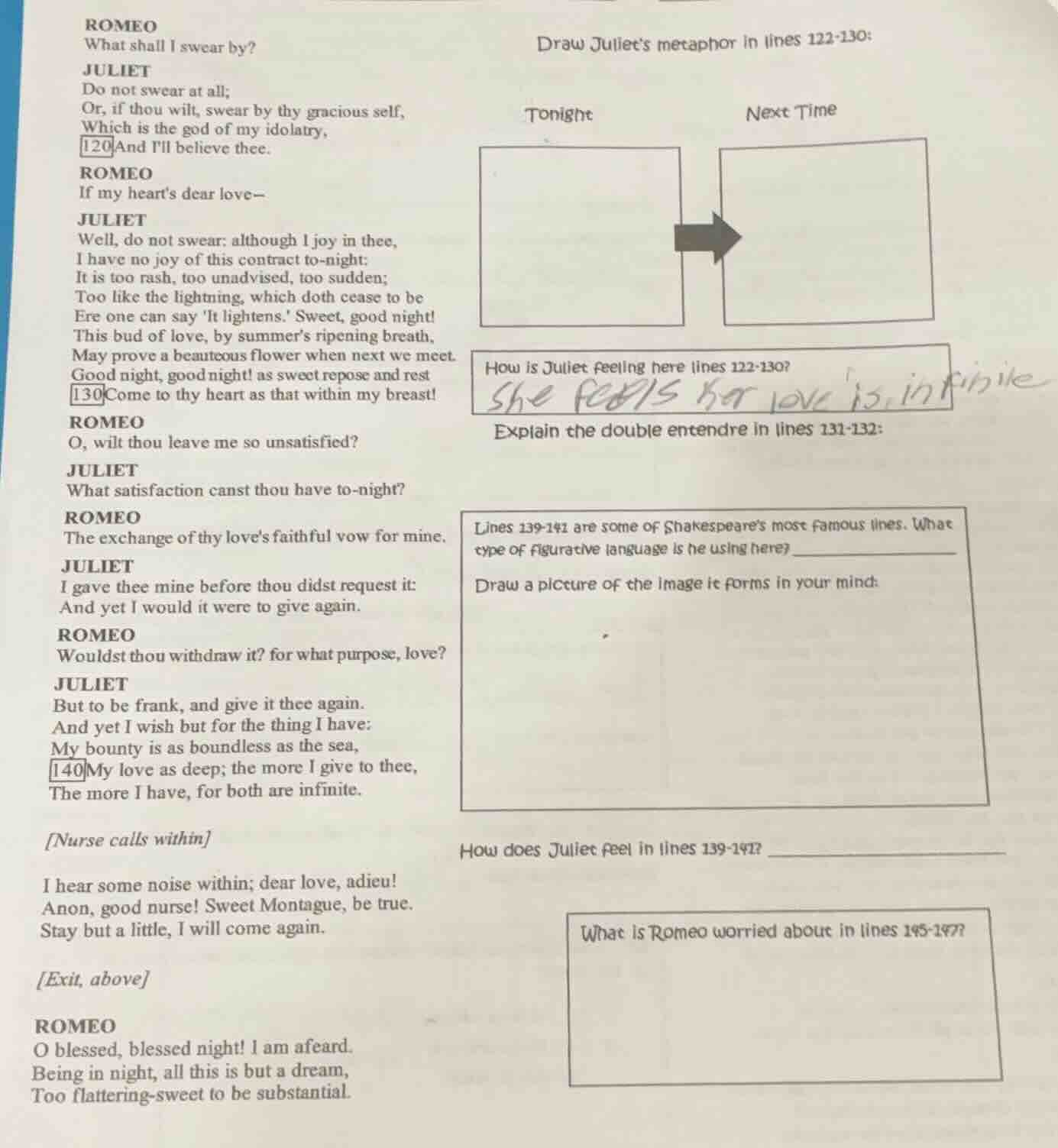
draw juliets metaphor in lines 122 - 130:
tonight next time
how is juliet feeling here lines 122 - 130?
explain the double entendre in lines 131 - 132:
lines 139 - 141 are some of shakespeares most famous lines. what type of figurative language is he using here?
draw a picture of the image it forms in your mind:
how does juliet feel in lines 139 - 141?
what is romeo worried about in lines 145 - 147?
For the question "What type of figurative language is Shakespeare using in lines 139 - 142?"
In lines 139 - 142 ("My bounty is as boundless as the sea, My love as deep; the more I give to thee, The more I have, for both are infinite"), Juliet is using a simile (comparing her bounty and love to the sea using "as") and also hyperbole (exaggerating the boundlessness and infiniteness of her love and bounty). The most prominent here is simile as it directly uses "as" to make a comparison.
In these lines, Juliet expresses that her love is as boundless as the sea and as deep, and the more she gives, the more she has (since both are infinite). This shows she feels deeply in love, passionate, and certain about the vastness and endless nature of her love for Romeo.
Romeo is worried that the wonderful night with Juliet (their declarations of love) is just a dream. He fears that the sweet and flattering moments are not real ("too flattering - sweet to be substantial") and that it might all be an illusion since it is nighttime (which can be associated with dreams).

Snap & solve any problem in the app
Get step-by-step solutions on Sovi AI
Photo-based solutions with guided steps
Explore more problems and detailed explanations
Simile (and hyperbole, but simile is the key comparative figurative language here as it uses "as" to compare her bounty/love to the sea)