Sovi.AI - AI Math Tutor

Scan to solve math questions

QUESTION IMAGE

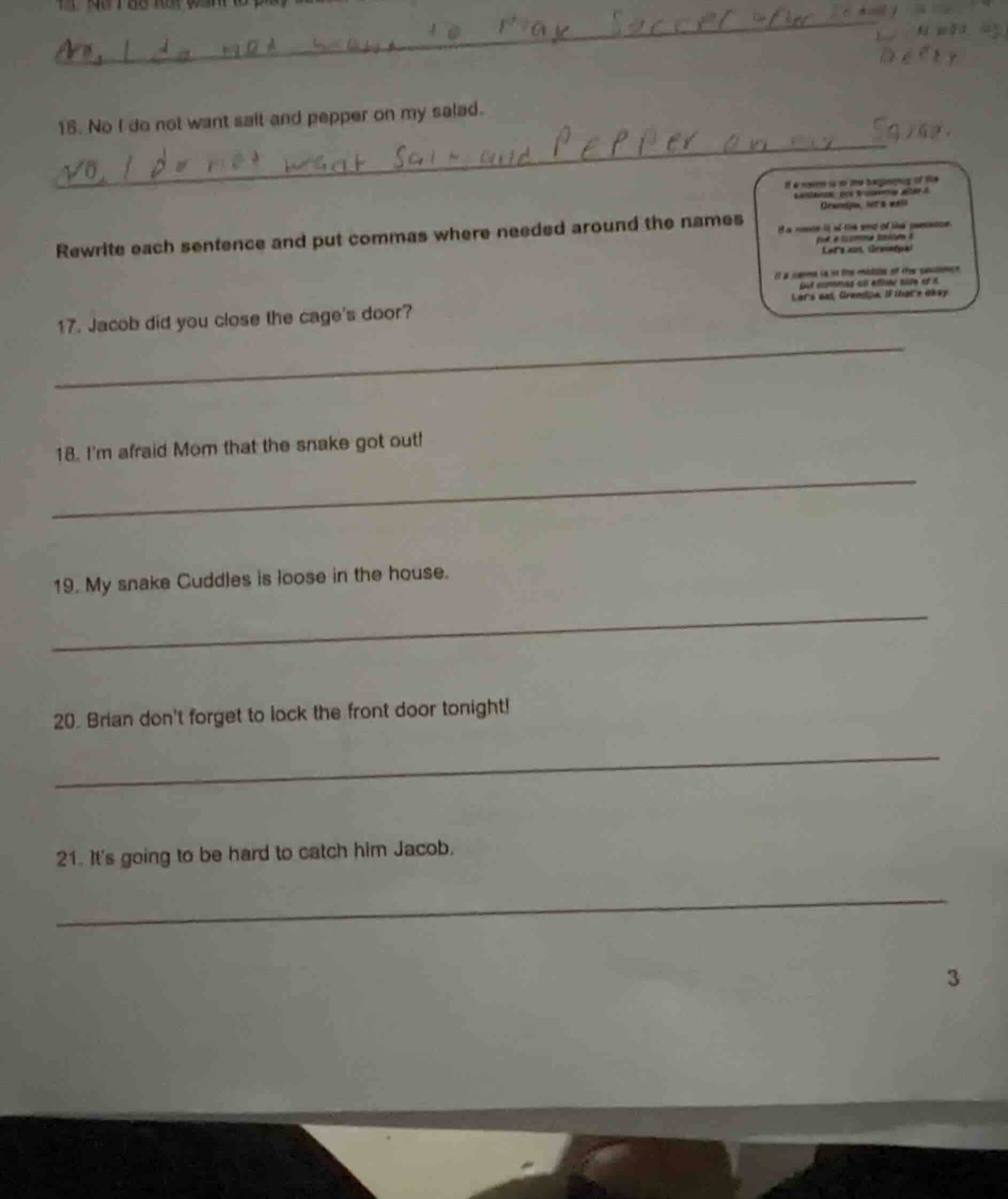
rewrite each sentence and put commas where needed around the names 17. …

Question

rewrite each sentence and put commas where needed around the names

  1. jacob did you close the cages door?
  1. im afraid mom that the snake got out!
  1. my snake cuddles is loose in the house.
  1. brian dont forget to lock the front door tonight!
  1. its going to be hard to catch him jacob.

Explanation:

Response

<pre_analysis>
{
"quality": "clear",
"question_count": 5,
"skills_matched": [
"direct_cot",
"explain_then_answer",
"tutor"
],
"needs_drawing": false,
"concepts_used": [],
"new_concepts": [
"Nouns of Direct Address",
"Appositives",
"Comma Rules"
],
"current_concepts": [
"Nouns of Direct Address",
"Appositives",
"Comma Rules"
]
}
</pre_analysis>

<reasoning>

Identify the grammar rules for names in direct address

When addressing someone directly by name, commas must set off the name:

  • If the name is at the beginning of the sentence, place a comma after it.
  • If the name is at the end of the sentence, place a comma before it.
  • If the name is in the middle of the sentence, place commas on both sides of it.

Identify the grammar rules for appositives

When a name renames or explains a noun immediately preceding it (acting as an appositive), it is set off by commas if the information is non-essential (non-restrictive):

  • In "My snake Cuddles is loose...", "Cuddles" is a non-essential appositive identifying the specific snake (assuming the speaker has one main snake or is treating the name as parenthetical information). Thus, it should be set off by commas on both sides.

Apply rules to Question 17

Sentence: "Jacob did you close the cage's door?"

  • "Jacob" is a direct address at the beginning of the sentence.
  • Place a comma after "Jacob".
  • Result: "Jacob, did you close the cage's door?"

Apply rules to Question 18

Sentence: "I'm afraid Mom that the snake got out!"

  • "Mom" is a direct address in the middle of the sentence.
  • Place commas on both sides of "Mom".
  • Result: "I'm afraid, Mom, that the snake got out!"

Apply rules to Questions 19, 20, and 21

Sentence 19: "My snake Cuddles is loose in the house."

  • "Cuddles" is an appositive renaming "My snake".
  • Place commas on both sides of "Cuddles".
  • Result: "My snake, Cuddles, is loose in the house."

Sentence 20: "Brian don't forget to lock the front door tonight!"

  • "Brian" is a direct address at the beginning of the sentence.
  • Place a comma after "Brian".
  • Result: "Brian, don't forget to lock the front door tonight!"

Sentence 21: "It's going to be hard to catch him Jacob."

  • "Jacob" is a direct address at the end of the sentence.
  • Place a comma before "Jacob".
  • Result: "It's going to be hard to catch him, Jacob."

</reasoning>

<answer>

Question 17

Jacob, did you close the cage's door?

Question 18

I'm afraid, Mom, that the snake got out!

Question 19

My snake, Cuddles, is loose in the house.

Question 20

Brian, don't forget to lock the front door tonight!

Question 21

It's going to be hard to catch him, Jacob.
</answer>

<post_analysis>
{
"subject": "Others",
"question_type": "Free Response",
"knowledge_point": [
"Others",
"English Language Arts",
"Punctuation Rules"
]
}
</post_analysis>

Answer:

<pre_analysis>
{
"quality": "clear",
"question_count": 5,
"skills_matched": [
"direct_cot",
"explain_then_answer",
"tutor"
],
"needs_drawing": false,
"concepts_used": [],
"new_concepts": [
"Nouns of Direct Address",
"Appositives",
"Comma Rules"
],
"current_concepts": [
"Nouns of Direct Address",
"Appositives",
"Comma Rules"
]
}
</pre_analysis>

<reasoning>

Identify the grammar rules for names in direct address

When addressing someone directly by name, commas must set off the name:

  • If the name is at the beginning of the sentence, place a comma after it.
  • If the name is at the end of the sentence, place a comma before it.
  • If the name is in the middle of the sentence, place commas on both sides of it.

Identify the grammar rules for appositives

When a name renames or explains a noun immediately preceding it (acting as an appositive), it is set off by commas if the information is non-essential (non-restrictive):

  • In "My snake Cuddles is loose...", "Cuddles" is a non-essential appositive identifying the specific snake (assuming the speaker has one main snake or is treating the name as parenthetical information). Thus, it should be set off by commas on both sides.

Apply rules to Question 17

Sentence: "Jacob did you close the cage's door?"

  • "Jacob" is a direct address at the beginning of the sentence.
  • Place a comma after "Jacob".
  • Result: "Jacob, did you close the cage's door?"

Apply rules to Question 18

Sentence: "I'm afraid Mom that the snake got out!"

  • "Mom" is a direct address in the middle of the sentence.
  • Place commas on both sides of "Mom".
  • Result: "I'm afraid, Mom, that the snake got out!"

Apply rules to Questions 19, 20, and 21

Sentence 19: "My snake Cuddles is loose in the house."

  • "Cuddles" is an appositive renaming "My snake".
  • Place commas on both sides of "Cuddles".
  • Result: "My snake, Cuddles, is loose in the house."

Sentence 20: "Brian don't forget to lock the front door tonight!"

  • "Brian" is a direct address at the beginning of the sentence.
  • Place a comma after "Brian".
  • Result: "Brian, don't forget to lock the front door tonight!"

Sentence 21: "It's going to be hard to catch him Jacob."

  • "Jacob" is a direct address at the end of the sentence.
  • Place a comma before "Jacob".
  • Result: "It's going to be hard to catch him, Jacob."

</reasoning>

<answer>

Question 17

Jacob, did you close the cage's door?

Question 18

I'm afraid, Mom, that the snake got out!

Question 19

My snake, Cuddles, is loose in the house.

Question 20

Brian, don't forget to lock the front door tonight!

Question 21

It's going to be hard to catch him, Jacob.
</answer>

<post_analysis>
{
"subject": "Others",
"question_type": "Free Response",
"knowledge_point": [
"Others",
"English Language Arts",
"Punctuation Rules"
]
}
</post_analysis>