QUESTION IMAGE
Question
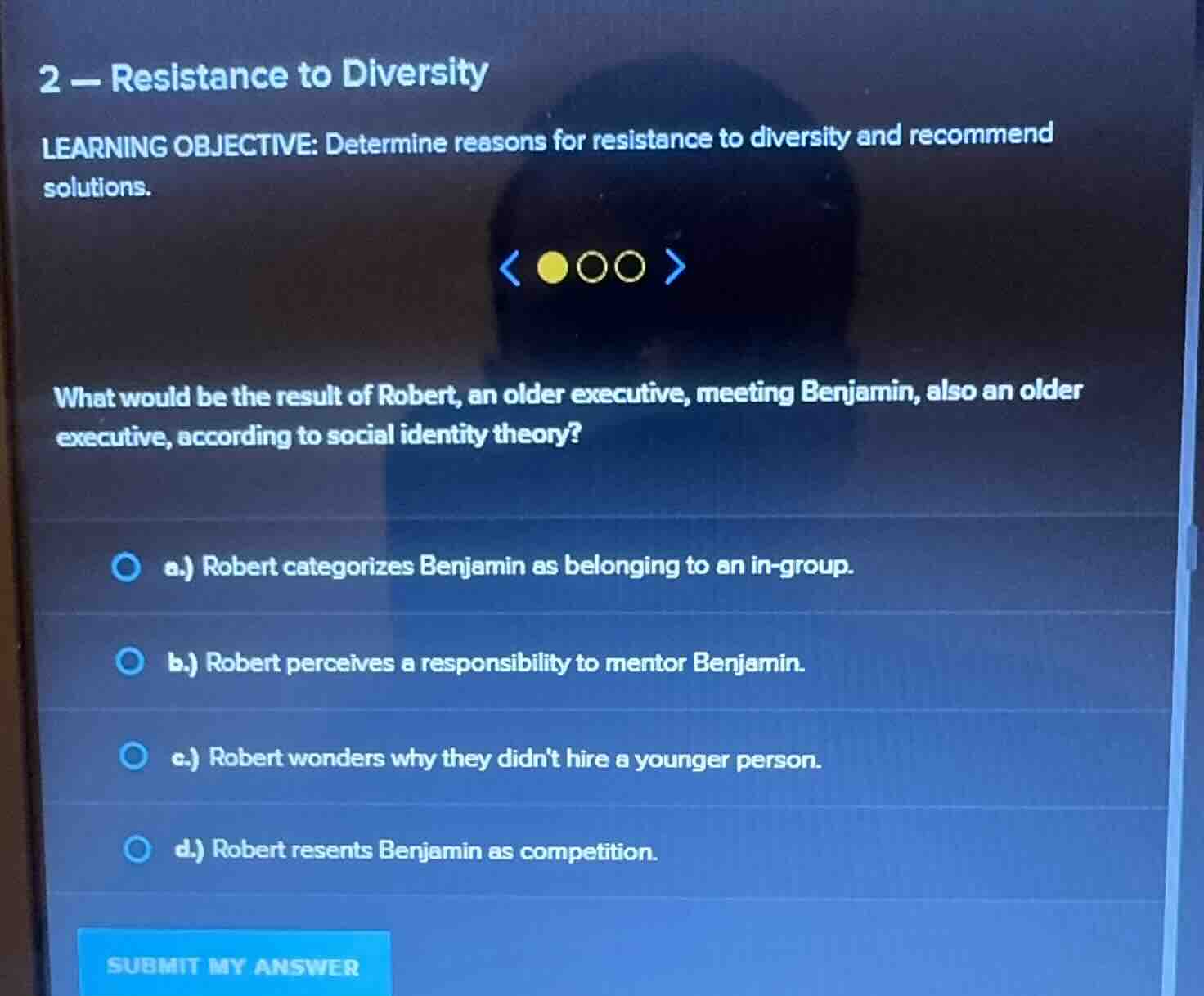
2 - resistance to diversity
learning objective: determine reasons for resistance to diversity and recommend solutions.
what would be the result of robert, an older executive, meeting benjamin, also an older executive, according to social identity theory?
a.) robert categorizes benjamin as belonging to an in-group.
b.) robert perceives a responsibility to mentor benjamin.
c.) robert wonders why they didnt hire a younger person.
d.) robert resents benjamin as competition.
Analyze the core concepts of the question
Using the Workplace Diversity and Surface-Level Diversity knowledge points, we analyze the interaction between Robert and Benjamin. Both individuals share salient demographic and professional characteristics: they are both older and both executives.
Apply Social Identity Theory
Social identity theory states that individuals classify themselves and others into various social categories, such as organizational membership, age, gender, or religious affiliation. When an individual encounters someone who shares similar salient social categories (in this case, age and professional status), they tend to perceive that person as part of their "in-group" (the group to which they feel they belong).
Evaluate the given options
- Option a: Robert categorizes Benjamin as belonging to an in-group. This directly aligns with social identity theory, as they share key social categories (older age, executive status).
- Option b: Mentorship is a behavioral outcome that is not the primary cognitive categorization predicted directly by social identity theory in this context.
- Option c: Wondering why they didn't hire a younger person suggests out-group bias or ageism, which contradicts the shared category membership.
- Option d: Resenting Benjamin as competition relates to realistic group conflict theory or interpersonal rivalry, rather than the basic categorization process of social identity theory.
Therefore, the most accurate prediction according to social identity theory is that Robert categorizes Benjamin as belonging to an in-group.

Snap & solve any problem in the app
Get step-by-step solutions on Sovi AI
Photo-based solutions with guided steps
Explore more problems and detailed explanations
- a.) Robert categorizes Benjamin as belonging to an in-group. (Correct answer)
- b.) Robert perceives a responsibility to mentor Benjamin.
- c.) Robert wonders why they didn't hire a younger person.
- d.) Robert resents Benjamin as competition.