QUESTION IMAGE
Question
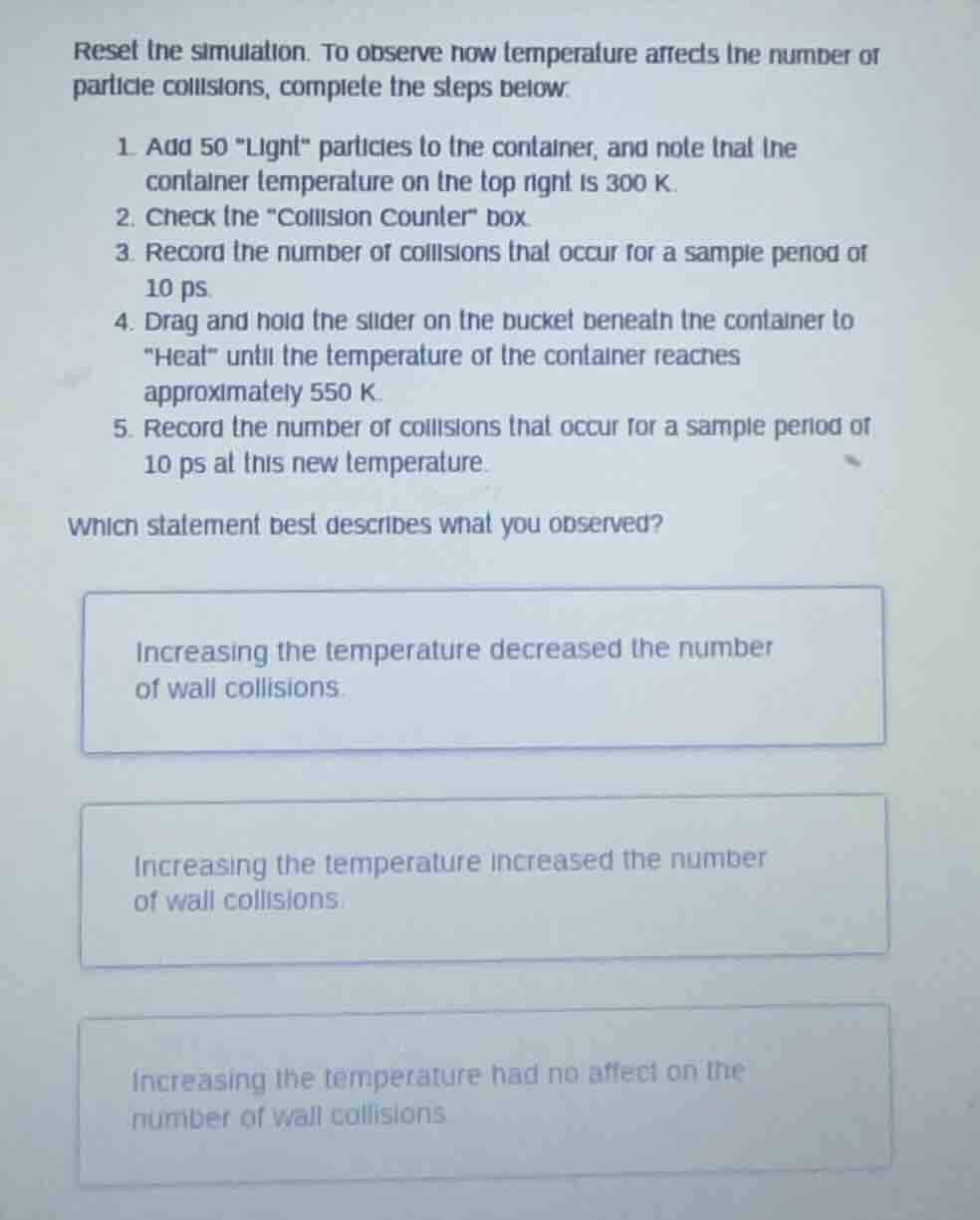
reset the simulation. to observe how temperature affects the number of particle collisions, complete the steps below:
- add 50 \light\ particles to the container, and note that the container temperature on the top right is 300 k.
- check the \collision counter\ box.
- record the number of collisions that occur for a sample period of 10 ps.
- drag and hold the slider on the bucket beneath the container to \heat\ until the temperature of the container reaches approximately 550 k.
- record the number of collisions that occur for a sample period of 10 ps at this new temperature.
which statement best describes what you observed?
- increasing the temperature decreased the number of wall collisions.
- increasing the temperature increased the number of wall collisions.
- increasing the temperature had no affect on the number of wall collisions.
Analyze temperature and particle speed
According to the kinetic molecular theory, increasing the temperature of a gas increases the average kinetic energy and speed of its particles:
Relate particle speed to collision frequency
As gas particles move faster at higher temperatures, they travel across the container more quickly. This results in more frequent impacts with the container boundaries over any given time interval.
Determine the correct observation
Therefore, heating the container from \(300\text{ K}\) to \(550\text{ K}\) increases the frequency of particle impacts, meaning that increasing the temperature increases the number of wall collisions.

Snap & solve any problem in the app
Get step-by-step solutions on Sovi AI
Photo-based solutions with guided steps
Explore more problems and detailed explanations
- Increasing the temperature decreased the number of wall collisions.
- Increasing the temperature increased the number of wall collisions. (Correct answer)
- Increasing the temperature had no affect on the number of wall collisions.