QUESTION IMAGE
Question
refresher course math 1050 and 1060 practice problems set e spring 2008
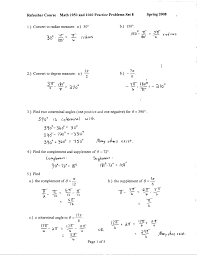
- convert to radian measure: a) \\(30^{\circ}\\)
b) \\(150^{\circ}\\)
- convert to degree measure: a) \\(\frac{3\pi}{2}\\)
b) \\(-\frac{7\pi}{6}\\)
- find two coterminal angles (one positive and one negative) for \\(\theta = 390^{\circ}\\).
- find the complement and supplement of \\(\theta = 72^{\circ}\\).
- find
a) the complement of \\(\theta = \frac{\pi}{12}\\).
b) the supplement of \\(\theta = \frac{5\pi}{6}\\).
c) a coterminal angle to \\(\theta = \frac{17\pi}{6}\\).
🆕 New Concept Discovered: Angle Relationships in Radians
Finding complements, supplements, and coterminal angles using radian measure.
Step 1: Find the complement of \(\theta = \frac{\pi}{12}\)
Two angles are complementary if their sum is \(90^\circ\), which is \(\frac{\pi}{2}\) radians. To find the complement, subtract the given angle from \(\frac{\pi}{2}\):
Find a common denominator, which is \(12\):
---
Step 2: Find the supplement of \(\theta = \frac{5\pi}{6}\)
Two angles are supplementary if their sum is \(180^\circ\), which is \(\pi\) radians. To find the supplement, subtract the given angle from \(\pi\):
Find a common denominator, which is \(6\):
---
Step 3: Find a coterminal angle to \(\theta = \frac{17\pi}{6}\)
Coterminal angles share the same terminal side. We find them by adding or subtracting full rotations of \(360^\circ\), which is \(2\pi\) radians.
Subtracting one full rotation (\(2\pi\)):
Alternatively, adding one full rotation (\(2\pi\)):

Snap & solve any problem in the app
Get step-by-step solutions on Sovi AI
Photo-based solutions with guided steps
Explore more problems and detailed explanations
- a) Complement of \(\theta = \frac{\pi}{12}\): \(\frac{5\pi}{12}\)
- b) Supplement of \(\theta = \frac{5\pi}{6}\): \(\frac{\pi}{6}\)
- c) Coterminal angle to \(\theta = \frac{17\pi}{6}\): \(\frac{5\pi}{6}\) (or \(\frac{29\pi}{6}\))