QUESTION IMAGE
Question
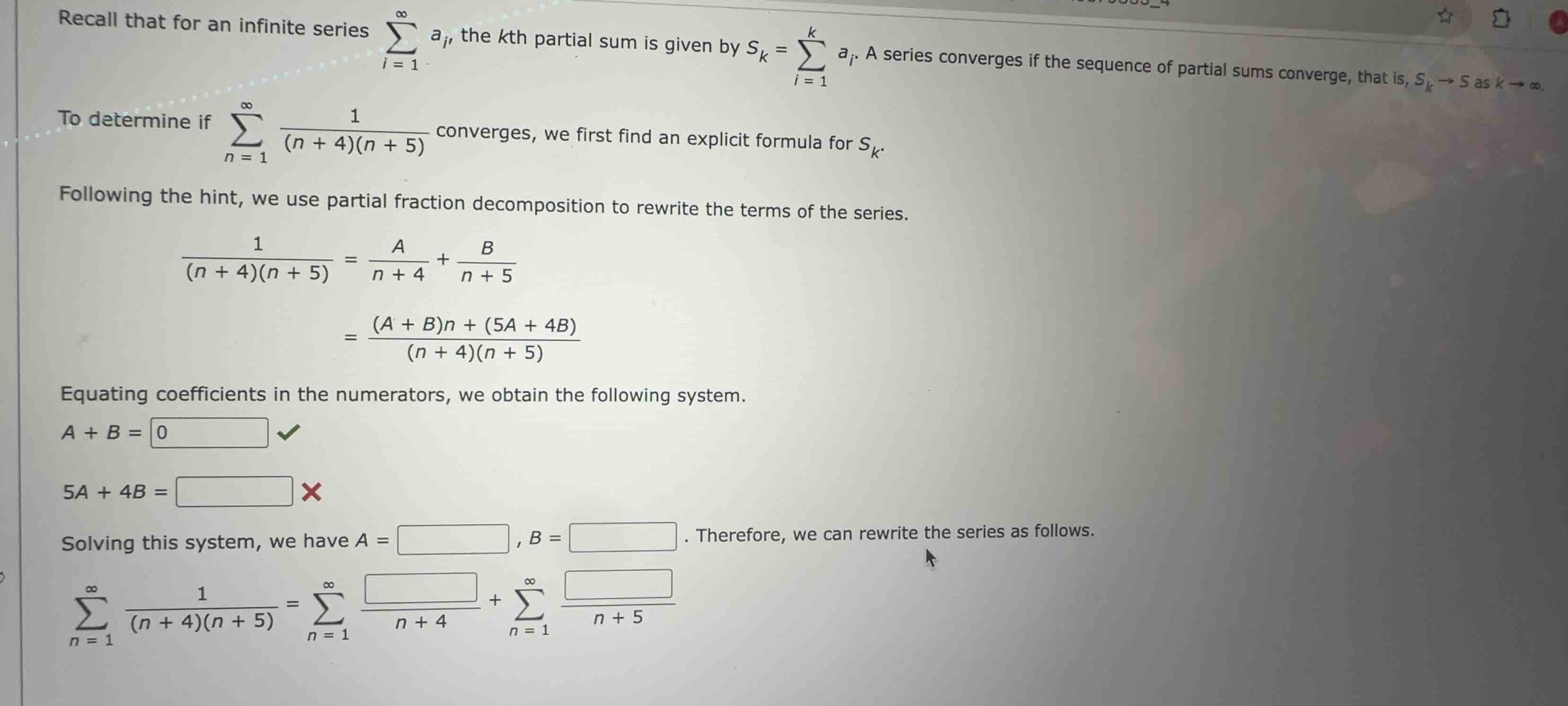
recall that for an infinite series \\(\sum_{i = 1}^{\infty} a_i\\), the \\(k\\)th partial sum is given by \\(s_k = \sum_{i = 1}^{k} a_i\\). a series converges if the sequence of partial sums converge, that is, \\(s_k \to s\\) as \\(k \to \infty\\).
to determine if \\(\sum_{n = 1}^{\infty} \frac{1}{(n + 4)(n + 5)}\\) converges, we first find an explicit formula for \\(s_k\\).
following the hint, we use partial fraction decomposition to rewrite the terms of the series.
\\\frac{1}{(n + 4)(n + 5)} = \frac{a}{n + 4} + \frac{b}{n + 5}\\
\\= \frac{(a + b)n + (5a + 4b)}{(n + 4)(n + 5)}\\
equating coefficients in the numerators, we obtain the following system.
\\(a + b =\\)
\\(5a + 4b =\\)
solving this system, we have \\(a =\\) , \\(b =\\) . therefore, we can rewrite the series as follows.
\\(\sum_{n = 1}^{\infty} \frac{1}{(n + 4)(n + 5)} = \sum_{n = 1}^{\infty} \frac{\text{ }}{n + 4} + \sum_{n = 1}^{\infty} \frac{\text{ }}{n + 5}\\)
Set up the system of equations
Solve for A and B
Rewrite the series terms

Snap & solve any problem in the app
Get step-by-step solutions on Sovi AI
Photo-based solutions with guided steps
Explore more problems and detailed explanations
Equating coefficients in the numerators, we obtain the following system.
\(A + B =\) <blank>0</blank>
\(5A + 4B =\) <blank>1</blank>
Solving this system, we have \(A =\) <blank>1</blank>, \(B =\) <blank>-1</blank>. Therefore, we can rewrite the series as follows.